- 1 What is an API Gateway? Single Entry Point for Microservices
- 2 What is NAT? Network Address Translation Explained
- 3 What is GitLab CI/CD? Automated Pipeline for Build, Test, and Deploy
- 4 What is Apache Kafka? Distributed Event Streaming Platform Explained
- 5 What is Serverless? FaaS, Cold Start, and When to Go Serverless
- 6 What is Subnet & CIDR? IP Network Segmentation and Routing
- 7 What is Kubernetes? The Most Popular Container Orchestration Platform Today
- 8 What is a Proxy? Forward Proxy, Reverse Proxy and SOCKS5 Explained
- 9 What is Nginx? Web server, reverse proxy, and load balancer in one
NAT (Network Address Translation) is the networking technique that lets millions of home and office devices share a single public IP address — the practical solution to IPv4 address exhaustion. This article explains what NAT is, how PAT works step by step, and how NAT operates in home routers, cloud VPCs, and Docker.
Need data solutions for your business?
AlgoData has helped businesses with data engineering, analytics & AI since 2019.
What is NAT?
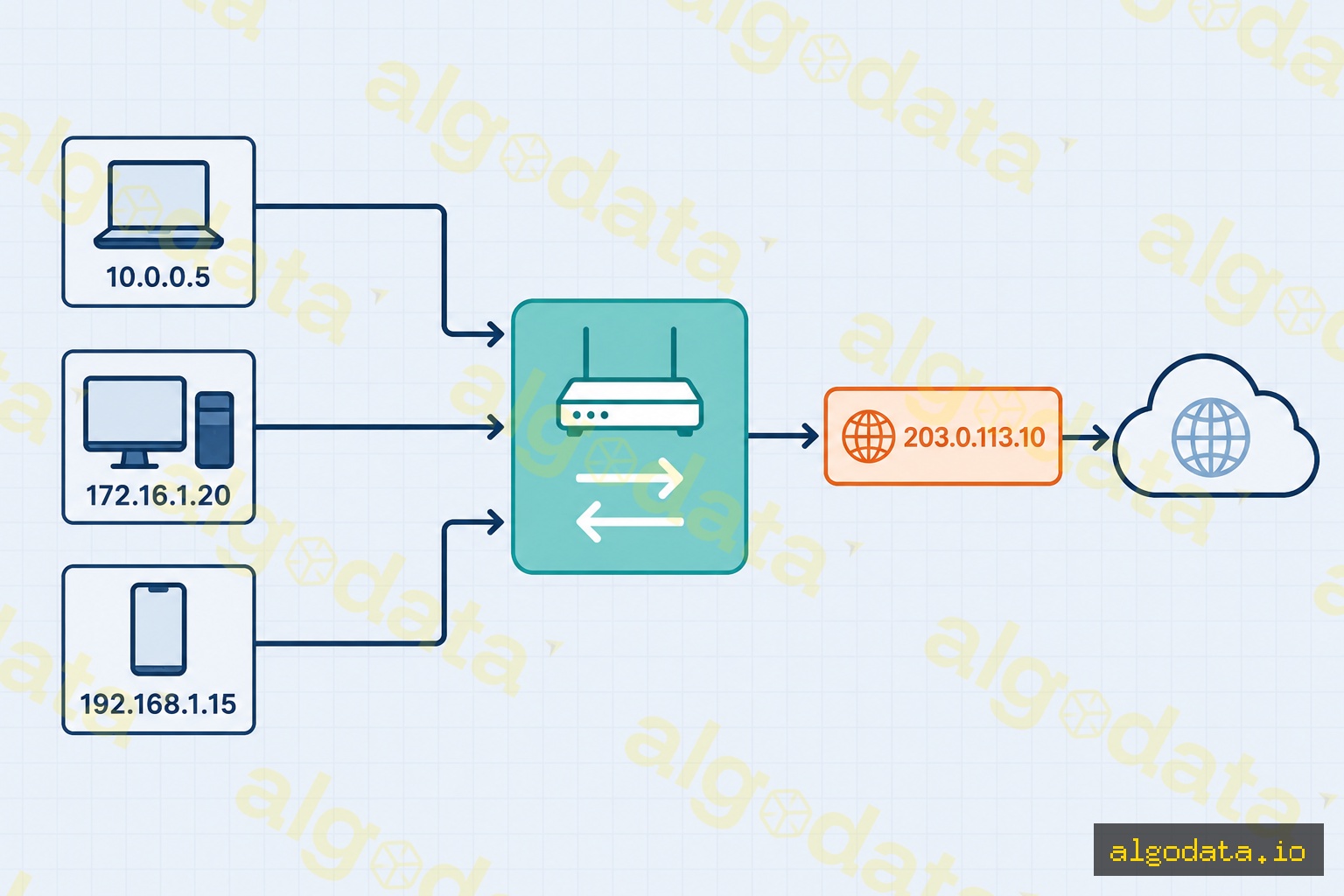
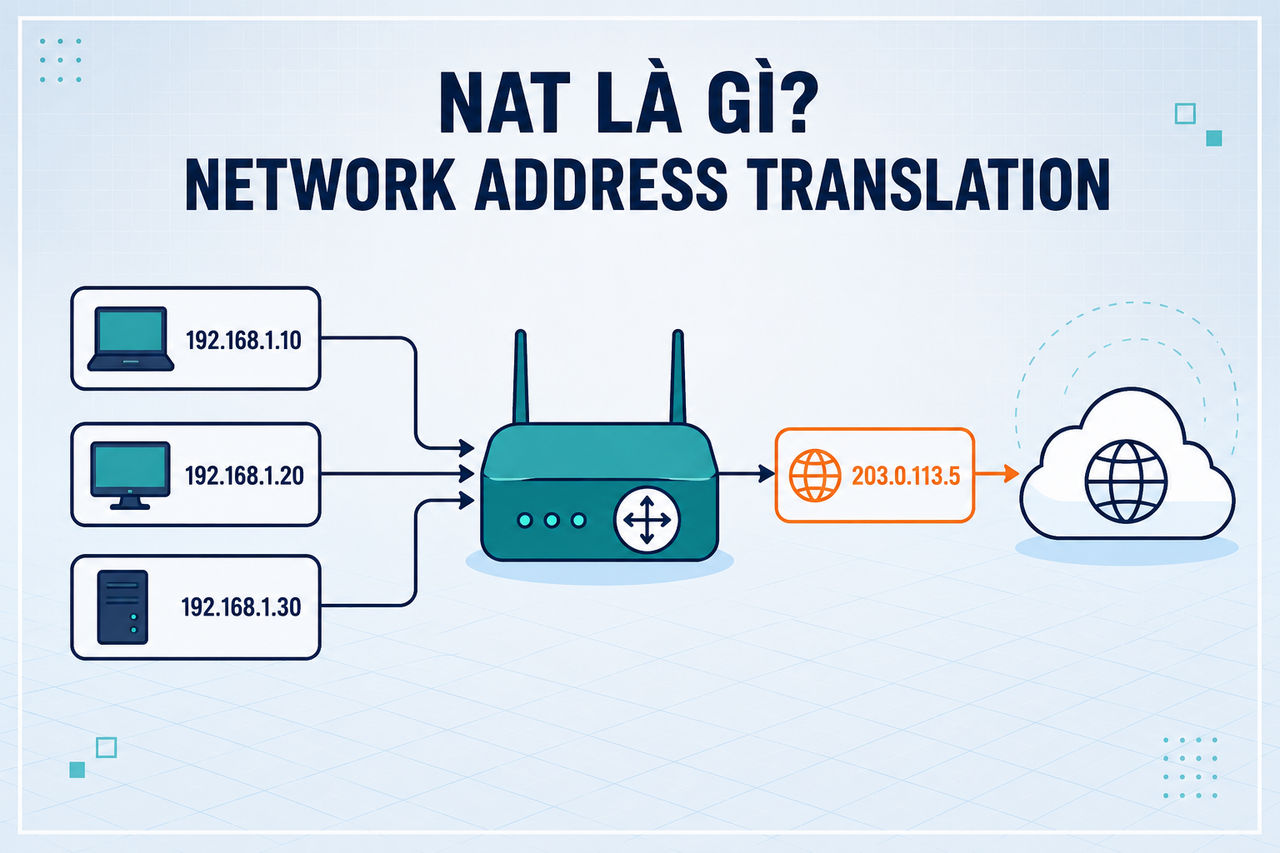
NAT (Network Address Translation) is the process by which a router or firewall modifies IP addresses in packet headers as those packets pass through the device. The original goal: allow multiple devices on a private network to share a single public IP address when communicating with the internet.
In 1996, IANA predicted IPv4 would run out — and they were right (it happened in 2011). NAT became the "life raft" that extended IPv4's lifespan by 15+ years by separating the private address space from the public internet.
Private IP ranges (not routable on the public internet):
10.0.0.0/8— Class A, up to 16 million internal addresses172.16.0.0/12— Class B, commonly used in mid-size enterprises192.168.0.0/16— Class C, ubiquitous in home networks (65,536 addresses)
Devices on a local network can use any address in these ranges without registering with IANA, because they never appear directly on the public internet — NAT handles the translation at the boundary.
3 Types of NAT
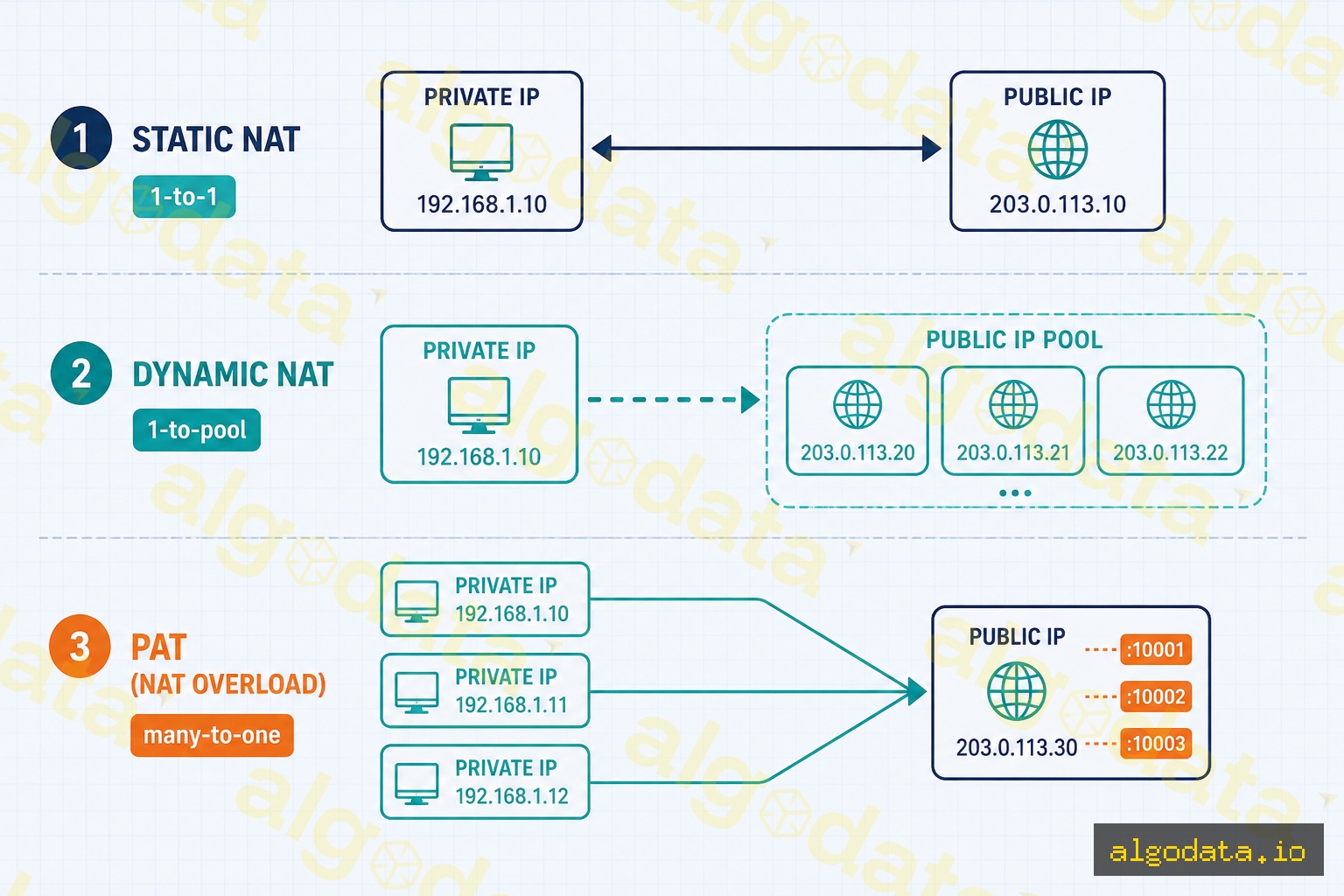
Static NAT
A 1-to-1 fixed mapping: one private IP always corresponds to one fixed public IP. Ideal for web servers and mail servers that need a stable, reachable address so external clients can initiate connections.
Example: 192.168.1.10 ↔ 203.0.113.10 (permanent, bidirectional)
Dynamic NAT
The router maintains a pool of public IPs and temporarily assigns one to a device when it needs internet access. When the device disconnects, the IP returns to the pool. Less common today because it still requires multiple public IPs — you don't get the many-to-one efficiency of PAT.
PAT — Port Address Translation (NAT Masquerade)
This is the most common type — many private IPs share a single public IP, distinguished by port number. Also called "IP Masquerading" on Linux or "NAT Overload" on Cisco IOS.
Virtually every home router and most enterprise routers use PAT. A router with a single public IP can simultaneously serve dozens of devices by multiplexing connections across different source port numbers. TCP/UDP ports range from 0–65535, giving the router tens of thousands of slots per public IP.
How PAT Works: Step-by-Step
When a computer at 192.168.1.10 sends a DNS query to 8.8.8.8:53:
- Original packet leaves device: src=
192.168.1.10:52341, dst=8.8.8.8:53 - Router rewrites source: src=
203.0.113.1:40001, dst=8.8.8.8:53 - Router records in NAT table:
192.168.1.10:52341 ↔ 203.0.113.1:40001 - DNS response arrives at router: dst=
203.0.113.1:40001 - Router looks up NAT table → forwards to
192.168.1.10:52341
The NAT table is stateful — the router tracks every active connection. When a connection ends or times out (typically 30 seconds for UDP, 120 seconds for TCP established), the entry is removed and the port slot becomes available again.
Multiple devices can use the same source port internally (e.g., both 192.168.1.10:52341 and 192.168.1.20:52341) — the router gives each a different external port (40001 and 40002) and maps them separately. This is the core insight of PAT: external port number becomes the unique session identifier.
NAT on Linux with iptables
Linux can act as a full NAT router using iptables. This configuration is common for home labs, cloud gateway instances, or self-hosted VPN exit nodes:
 1# Enable IP forwarding (allow Linux to forward packets between interfaces)
 2echo 1 > /proc/sys/net/ipv4/ip_forward
 3
 4# Persist across reboots via sysctl
 5echo "net.ipv4.ip_forward = 1" >> /etc/sysctl.conf
 6sysctl -p
 7
 8# NAT Masquerade: all traffic from the internal network exits via eth0
 9iptables -t nat -A POSTROUTING -o eth0 -j MASQUERADE
10
11# Port forwarding (DNAT): route external port 8080 to internal 192.168.1.10:80
12iptables -t nat -A PREROUTING -i eth0 -p tcp --dport 8080 \
13  -j DNAT --to-destination 192.168.1.10:80
14iptables -A FORWARD -p tcp -d 192.168.1.10 --dport 80 -j ACCEPT
15
16# Persist rules across reboots
17iptables-save > /etc/iptables/rules.v4
To inspect the current NAT state:
 1# View the connection tracking table (all active NAT mappings)
 2conntrack -L
 3# or read directly from the kernel
 4cat /proc/net/nf_conntrack
 5
 6# View all iptables NAT rules
 7iptables -t nat -L -n -v
 8
 9# Count active NAT entries
10conntrack -L | wc -l
The conntrack command shows every active session being tracked, including protocol, state, timeouts, and the original/reply address tuples. This is the live NAT table you can inspect on a running Linux router.
NAT in Docker
Docker automatically creates NAT rules when launching containers in a bridge network:
 1# Inspect Docker's default bridge network
 2docker network inspect bridge
 3
 4# View iptables NAT rules created by Docker
 5sudo iptables -t nat -L DOCKER -n -v
 6
 7# Port mapping (-p 8080:80) creates a DNAT rule automatically
 8docker run -p 8080:80 nginx
 9# Equivalent to:
10# iptables -t nat -A DOCKER -p tcp --dport 8080 -j DNAT --to 172.17.0.2:80
Containers in the bridge network receive IPs from the 172.17.0.0/16 range by default. When a container sends traffic outbound, the Docker host performs MASQUERADE — replacing the container's IP with the host's IP. Inbound traffic to published ports is DNAT-ed directly to the container's private IP and port.
You can inspect what Docker has created:
1# See all NAT rules in the POSTROUTING chain (including Docker MASQUERADE)
2sudo iptables -t nat -L POSTROUTING -n -v
3
4# See active connections through Docker NAT
5sudo conntrack -L | grep 172.17
Custom Docker networks (created with docker network create) also use NAT by default, but with different subnets (e.g., 172.18.0.0/16, 172.19.0.0/16). This allows containers on different networks to be isolated while still sharing the host's public IP for outbound traffic.
NAT in Cloud (AWS VPC)
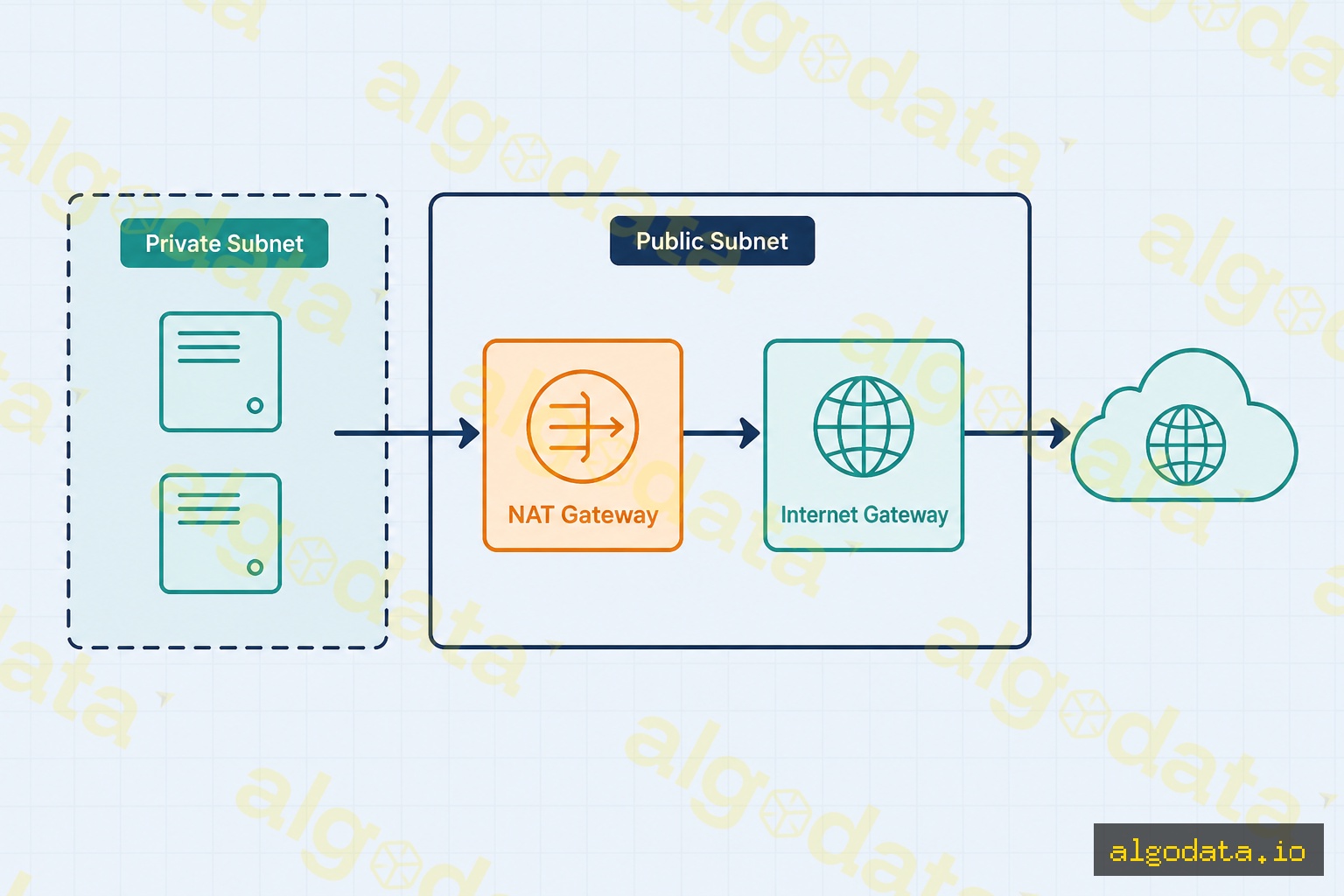
AWS VPC uses a NAT Gateway to give private subnet resources internet access without exposing them with public IPs:
Traffic flow: Private subnet EC2 → NAT Gateway (in public subnet) → Internet Gateway → Internet
AWS NAT Gateway characteristics:
- Has an Elastic IP (static public IP) — useful for IP whitelisting with third-party services
- Fully managed — AWS scales it automatically, no administration required
- Billed per hour (
$0.045/hour) plus data processed ($0.045/GB) - Zone-specific — deploy one NAT Gateway per Availability Zone for high availability
Terraform example:
 1resource "aws_eip" "nat" {
 2  domain = "vpc"
 3}
 4
 5resource "aws_nat_gateway" "main" {
 6  allocation_id = aws_eip.nat.id
 7  subnet_id     = aws_subnet.public.id
 8
 9  tags = {
10    Name = "main-nat-gateway"
11  }
12}
13
14resource "aws_route" "private_internet" {
15  route_table_id         = aws_route_table.private.id
16  destination_cidr_block = "0.0.0.0/0"
17  nat_gateway_id         = aws_nat_gateway.main.id
18}
Other cloud providers have equivalent services: Google Cloud NAT, Azure NAT Gateway, and DigitalOcean NAT Gateway all function on the same principles — managed NAT for private resources that need outbound internet access without inbound exposure.
The NAT Traversal Problem
NAT blocks inbound connections — an external host cannot initiate a connection to a device behind NAT because it has no way to reach the private IP. This creates real-world challenges:
- VoIP & video calls: WebRTC needs direct P2P connections for low-latency audio/video. Solution: STUN (discovers public IP/port), TURN (relays traffic when P2P fails), and ICE (framework that tries all candidate paths in priority order)
- P2P gaming: Game consoles behind NAT need "hole punching" — both endpoints simultaneously send packets to each other to open NAT table entries before the other's packet arrives
- Self-hosted servers: Require port forwarding in the router config, or a VPN reverse tunnel (Cloudflare Tunnel, ngrok, Tailscale funnel) that bypasses NAT entirely
- Symmetric NAT: The strictest NAT type — allocates a different external port for each destination, making STUN-based P2P unreliable. WebRTC falls back to TURN relay, which increases latency and server costs
NAT type classification (from most permissive to most restrictive):
- Full Cone NAT — any external host can reach the internal client after a mapping is established
- Restricted Cone NAT — only hosts the client has contacted can send inbound packets
- Port Restricted Cone NAT — only the exact IP:port the client contacted can reply
- Symmetric NAT — different external port per destination; STUN alone is insufficient
NAT64: Bridging IPv4 and IPv6
As the internet transitions to IPv6, NAT64 allows IPv6-only clients to reach IPv4-only servers:
- IPv6 client → NAT64 gateway → IPv4 server
- The NAT64 gateway translates IPv6 packets into IPv4 and vice versa at the boundary
- Combined with DNS64, which synthesizes IPv6 addresses for IPv4-only domain names, so clients never need to know about the underlying IPv4 infrastructure
NAT64 is increasingly deployed by mobile carriers and enterprise networks that have moved to IPv6-only internally but still need to reach legacy IPv4 services. Apple requires that iOS apps work in NAT64 environments, which is why app developers must test IPv6 compatibility.