Vector Database is the AI infrastructure component talked about most in the past two years —
and not by accident.
As AI has evolved from simple chatbots to semantic search systems, RAG, and recommendation
engines, Vector Database has become an indispensable foundation.
This article explains what a Vector Database is, how it works, the most popular solutions,
and why every serious AI project needs to understand it.
In the past, semantic search was the exclusive domain of large technology corporations
with hundreds of machine learning engineers.
Today, thanks to a rich Vector Database ecosystem and powerful, accessible embedding models,
any technical team can build a semantic search engine or RAG chatbot in just a few days.
This is one of the most fundamental shifts in how businesses build AI products in the
2025–2027 period.
What Is a Vector Database?
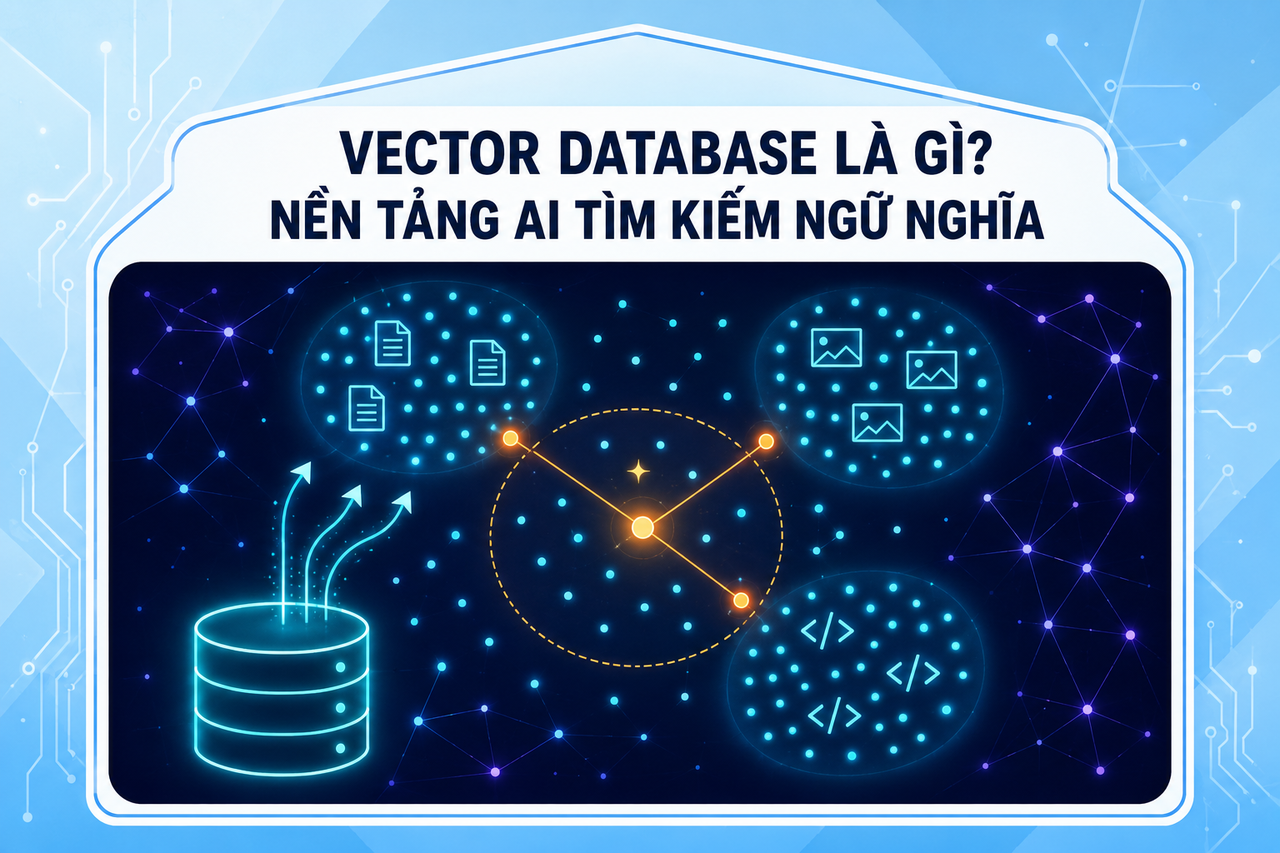
A Vector Database is a type of database specifically designed to store and search
embedding vectors — multi-dimensional arrays of real numbers that represent the
semantic meaning of text, images, audio, or any other type of data.
Rather than searching by exact match like traditional SQL, a Vector Database performs
similarity search — finding the closest vectors in multi-dimensional space according
to measures such as cosine similarity or Euclidean distance.
This is the fundamental difference: SQL compares characters, Vector Database compares meaning.
The core idea comes from the way language models understand the world: rather than comparing
characters, they represent everything as coordinates in a semantic space.
Two words with similar meanings will have vectors that are close together in that space —
"dog," "puppy," and "canine" will cluster near each other even though they are entirely
different words.
Vector Databases exploit this property to build search systems that understand semantics,
not just keyword matching.
This is the foundation of every modern AI application from chatbots to recommendation engines.
A typical vector has between 128 and 1536 dimensions — each dimension is a real number
roughly in the range [-1, 1].
For example, the sentence "laptop for developers" is converted into a 768-dimensional vector
by an embedding model, and this vector will be closer to the vector of "MacBook Pro for
programmers" or "ThinkPad X1 Carbon" than to "electric scooter."
The distance between vectors reflects the degree of semantic similarity — this is the
fundamental principle on which all Vector Database technology is built.
To efficiently store and query millions of such vectors, specialized infrastructure is
required that is completely different from traditional relational databases.
B-tree or hash index structures used in SQL are entirely unsuitable for searching in
high-dimensional spaces — the "curse of dimensionality" makes traditional search algorithms
extremely slow as the number of dimensions increases.
Vector Databases use specialized algorithms such as HNSW and IVF to overcome this limitation.
Why Vector Databases Are Necessary
Try searching for "laptop for work" in a traditional SQL database containing 100,000
electronics products.
If product descriptions do not contain the exact words "laptop" or "work," the query
returns nothing — even if the database contains ThinkPads, MacBook Pros, and Dell XPS
machines with complete technical specifications.
SQL operates on the principle of text matching; it does not understand the meaning behind
the words.
Users are forced to guess how the product was labeled rather than describing their actual needs.
Vector Database solves this problem comprehensively.
When you search for "laptop for work," the system converts this query into a vector,
then finds all product vectors with the highest cosine similarity — the results will include
ThinkPad, MacBook Pro, and Dell XPS even if their descriptions do not contain the exact
words you searched for.
A user can search "birthday gift for mom" and receive suggestions for perfume, jewelry,
and premium home goods — without a single word from the query needing to appear in
any product name.
This is the leap from keyword matching to intent understanding.
Not only in e-commerce, the need for semantic search appears everywhere in modern enterprises:
finding legal documents related to a case based on a situation description,
finding similar research papers based on an abstract, detecting duplicate comments despite
different phrasing, or recommending films based on the emotions a user wants to experience.
All of these require searching by meaning, not keywords — and that is precisely why
Vector Database was created.
Research from major e-commerce platforms shows that semantic search can increase
click-through rates by 15–25% and conversion rates by 10–18% compared to pure keyword search.
This is not just an improvement in user experience — it is a direct competitive advantage
in revenue terms.
In a world where users are increasingly accustomed to conversing naturally with AI,
the ability to understand semantics is the default expectation, no longer a premium feature.
How It Works
The processing pipeline of a Vector Database consists of two main phases: indexing
and querying.
During the indexing phase, each piece of text or data object is passed through an
embedding model — for example, OpenAI text-embedding-3-small produces 1536-dimensional
vectors, Sentence Transformers produce 384–768-dimensional vectors, and multilingual-e5-large
handles multiple languages — to convert it into a numerical vector.
This vector is then stored in the database along with metadata such as ID, source,
creation date, and category, enabling filtering combined with vector search later.
During the querying phase, the user's query is also converted into a vector by the
same embedding model.
This is critical: using different models to embed queries and data produces completely wrong
results because they live in different mathematical spaces.
The system then performs ANN (Approximate Nearest Neighbor) search — an approximate
search algorithm that quickly identifies the vectors in the database closest to the query
vector, without computing distances against the entire dataset.
This is the key to making Vector Database work fast despite millions of vectors.
Popular ANN algorithms include HNSW (Hierarchical Navigable Small World) — graph-based,
the fastest option with query latency typically under 10ms, used in Qdrant and Weaviate;
IVF (Inverted File Index) — clusters vectors first then searches within clusters,
more memory-efficient than HNSW; and FAISS by Meta — a powerful ANN library that forms
the foundation of many Vector DBs.
Each algorithm has different trade-offs between speed, accuracy, and memory usage.
Results are ranked by cosine similarity: a value of 1 means the two vectors are
identical, 0 means unrelated, and -1 means completely opposite.
In production, a similarity threshold is typically set between 0.7 and 0.9 to filter out
insufficiently relevant results.
Metadata filtering can be combined with vector search in the same query to narrow the
search scope according to additional criteria such as creation time, product category,
or document source.
Popular Vector Databases
There are many Vector Database solutions on the market, from cloud-managed to open-source
self-hosted.
Each solution has its own strengths and suits different use cases.
The following table summarizes the most popular options across key criteria:
| Name |
Type |
Indexing |
Language |
Highlights |
| Pinecone |
Cloud managed |
HNSW |
— |
Auto-scaling, clear SLA |
| Weaviate |
OSS + Cloud |
HNSW |
Go |
Multi-modal, hybrid search |
| Qdrant |
OSS + Cloud |
HNSW |
Rust |
High performance, strong filtering |
| Chroma |
OSS (local) |
HNSW |
Python |
Dev-friendly, lightweight |
| pgvector |
Extension |
HNSW/IVF |
C |
PostgreSQL integration |
Pinecone is the leading cloud-managed Vector Database service, founded in 2019 and
now serving thousands of organizations from startups to Fortune 500 companies.
No infrastructure management required, automatic scaling to demand, low-latency metadata
filtering support, and a clear production SLA.
Pinecone offers two indexing modes: serverless (pay-per-usage, suited for workloads with
spikes) and pod-based (fixed capacity, suited for stable workloads with low latency
requirements).
Weaviate is an open-source solution supporting multi-modal storage — capable of storing
and searching text, images, and audio within the same system.
Weaviate integrates popular embedding models out of the box (OpenAI, Cohere, HuggingFace)
and supports hybrid search combining BM25 keyword search with vector search to achieve
higher precision in specialized domains.
It can be deployed on-premise or via Weaviate Cloud Services.
Qdrant is written in Rust and stands out for high performance, good memory efficiency,
and powerful payload filtering — enabling filtering that combines vector similarity
with metadata conditions in a single query.
For example: find "documents similar to marketing content, created in June, rated above 4 stars"
in one query.
Qdrant also supports sparse vectors for hybrid search and binary quantization to reduce
memory usage by 32x with minimal precision trade-off.
Chroma is a lightweight choice for development and prototyping, capable of running
in-memory or persistently on disk, and integrates easily with LangChain and LlamaIndex
in just a few lines of code.
Simple API, no complex configuration, ideal for beginners or quick proof-of-concept builds.
However, Chroma lacks production features such as replication, enterprise authentication,
or horizontal scaling — not recommended for real-world high-traffic systems.
pgvector is a PostgreSQL extension that adds vector search to an existing database
without a separate system.
Supports HNSW and IVF indexing, fully integrates with SQL — enabling JOIN between vector
search and ordinary relational tables, ACID transactions, and the rich PostgreSQL ecosystem.
Best suited when the team already has PostgreSQL infrastructure; good performance for
datasets below several tens of millions of vectors.
Beyond these five, Milvus is a powerful open-source Vector Database designed for
large scale, particularly suited for datasets of billions of vectors and distributed workloads.
Milvus is widely used at large technology companies in Asia.
Redis Stack with the RedisSearch module also supports vector similarity search on the
familiar Redis platform, suited for teams already using Redis and needing vector search
with ultra-low latency thanks to in-memory storage.
A notable trend is cloud-native vector search services from major providers:
AWS OpenSearch Service with the k-NN plugin, Google Vertex AI Matching Engine,
and Azure AI Search have all integrated vector search into their managed services.
These are good choices if a team is already locked into a specific cloud provider and
wants to reduce the number of services to manage.
However, in terms of specialized features, dedicated solutions like Qdrant or Pinecone
generally still outperform them.
RAG — Retrieval-Augmented Generation
RAG (Retrieval-Augmented Generation) is the most important technique in applied AI
today, and Vector Database is its backbone.
The core problem RAG solves is LLM hallucination: when lacking specific information,
the model tends to "invent" answers that sound plausible but are factually wrong.
RAG addresses this by providing the LLM with exactly the relevant information chunks from
a trusted source before it generates its answer.
The RAG pipeline operates through four clear sequential steps: (1) The user's question
is embedded into a vector by the embedding model — the same model used to index the documents.
(2) The Vector Database performs ANN search and returns the text chunks with the highest
cosine similarity — typically 3 to 10 chunks, each 200–500 tokens depending on the
chunking strategy.
(3) These chunks are incorporated into the system prompt sent to the LLM alongside the
original question following a standard template.
(4) The LLM generates an answer based on the provided context and can cite specific
sources, avoiding hallucination.
The result is a chatbot that can accurately answer questions about a company's internal
documents, the most recently updated operational procedures, or information beyond the
LLM's training cutoff — without the need for expensive fine-tuning.
The quality of RAG depends directly on the quality of the Vector Database: a good embedding
model, an appropriate chunking strategy (fixed-size, semantic, or recursive), and accurate
indexing determine whether the LLM receives the right information it needs.
RAG also addresses the cost and speed of updates: rather than re-training or fine-tuning
a model every time there is a new document — taking days and thousands of dollars —
simply index the new document into the Vector Database in seconds and RAG can immediately
use that information.
This is why RAG has become the default architecture for enterprise AI chatbots: flexible,
fast to update, and reasonably priced compared to alternatives like fine-tuning or
context stuffing.
One important design consideration in RAG is chunking strategy — how to divide long
text into smaller segments before embedding.
Fixed-size chunking (dividing by a fixed number of tokens, e.g., 512 tokens with 50-token
overlap) is simple but may cut across important context.
Semantic chunking (dividing by paragraph and topic boundaries) produces better results
but is more complex to implement.
Choosing the right chunking strategy for the type of document (legal text, technical
guides, research papers) can significantly improve retrieval quality.
Hybrid RAG — combining vector search with BM25 keyword search — is becoming best
practice in production.
Vector search excels at finding semantics but sometimes misses important exact matches
(e.g., product codes, proper nouns).
BM25 excels at exact matching but doesn't understand semantics.
Combining both via the Reciprocal Rank Fusion (RRF) algorithm yields significantly better
results in most real-world tasks.
Both Weaviate and Qdrant support hybrid search out of the box.
Comparison of Solutions
Choosing a Vector Database depends on three main factors: dataset scale, the team's
operational capability, and metadata filtering requirements.
Pinecone is best suited for large production scale (hundreds of millions of vectors)
when you don't want to manage infrastructure yourself — higher cost than self-hosting
but significantly saves DevOps time, with SLA guaranteed by the provider.
This is the choice of many startups and enterprises that want to focus on their product.
Qdrant is the strongest open-source choice for self-hosting, especially in use cases
requiring complex metadata filtering or needing full control over data privacy and data
residency — particularly important for financial and healthcare organizations in Vietnam.
Qdrant Cloud also offers a managed option for teams that don't want to self-manage but
still prefer open-source.
Qdrant performance generally outperforms Weaviate in complex filtering benchmarks.
pgvector is the most practical choice if the team already has PostgreSQL —
no new system to learn, leveraging the entire PostgreSQL ecosystem including backup,
monitoring, ACID transactions, and familiar tooling.
However, when the dataset exceeds tens of millions of vectors at a high query rate,
pgvector will need to be replaced by a more specialized solution.
Migration from pgvector to Qdrant is relatively straightforward if the schema is designed
carefully from the start.
Chroma is suitable only for development and proof-of-concept — set up in minutes,
simple API, good integration with LangChain.
When moving to production, migrate to Qdrant or Pinecone.
Practical advice for teams just starting out: use Chroma for the first week of prototyping,
choose Qdrant for self-hosted production, Pinecone for managed production, and pgvector
when you already have PostgreSQL with a moderate dataset.
Real-World Use Cases
Enterprise chatbot on a knowledge base is the most common use case with the clearest
ROI.
A business with 10,000 internal documents — processes, operational guides, technical
reports, HR policies — can build a chatbot allowing employees to ask questions in natural
language and receive answers with specific source citations.
Instead of manually searching through thousands of documents, an employee asks "What is
the procedure for requesting leave of more than 5 days?" and receives an accurate answer
in seconds.
Semantic search in e-commerce significantly increases conversion rate and reduces
the "no results found" rate — one of the top reasons customers abandon a purchase.
Instead of searching only by exact product name, customers can search "things for a newborn"
and receive suggestions for diapers, baby bottles, cribs, and infant clothing —
even though none of those products have that exact phrase in their name.
Research from major e-commerce platforms confirms that semantic search increases conversion
rate by an average of 15%.
Duplicate detection and spam filtering is a high-value application in user-generated
content platforms.
When detecting fake reviews or spam comments that have been paraphrased to bypass keyword
filters, Vector Database can find content with high semantic similarity (>0.9) even when
expressed completely differently.
For example: "this product is terrible" and "really bad quality, don't buy" will have high
similarity and be flagged for further review.
A platform with millions of new pieces of content each day needs to automate this kind
of moderation.
Recommendation systems are one of the earliest and most widespread applications of
vector similarity.
When a user watches movie X, the system finds movies whose embedding vectors are closest
to X in semantic space — not just based on genre or director, but on the movie's actual
content, style, and emotional tone.
Netflix, Spotify, and YouTube all use vector similarity as one of their primary signals
in their recommendation engines.
Code search and technical documentation is also an increasingly popular use case
at software companies.
Instead of searching by function name or file, developers can describe a problem in
natural language — "retry handler when timeout occurs" — and the system returns exactly
the relevant code segment even if no words match.
GitHub Copilot and Cursor both use vector search to find relevant code context before
passing it to the LLM to generate suggestions.
Vector Databases for Vietnamese Text
Vietnamese has several important characteristics that affect embedding quality and need
careful handling.
The complex tonal system with 6 tones creates pairs of words with similar sounds but
completely different meanings — "ma," "mà," "má," "mả," "mã," "mạ."
English-only embedding models process Vietnamese using byte-level tokenization, failing to
capture these subtle semantic differences, resulting in significantly worse similarity
search quality.
PhoBERT by VinAI is currently the strongest Vietnamese embedding model, trained on 20GB
of Vietnamese text from newspapers, social media, and textbooks using the RoBERTa architecture.
The PhoBERT-base version produces 768-dimensional vectors, the large version produces
1024-dimensional vectors — both significantly outperform multilingual BERT on Vietnamese
benchmarks.
VinAI Embedding and Microsoft's multilingual-e5-large are practical choices
when multilingual support is required.
AlgoData uses vector search in its Vietnamese social media content analysis pipeline —
finding posts related to a brand or event even when users write in many different ways:
abbreviations (e.g., "ko" instead of "không"), slang, common typos, or mixing English
and Vietnamese (Vietnamish).
Choosing the right embedding model for Vietnamese can improve recall by 30–40% compared
to pure keyword search — especially important in brand monitoring where no mention
can be missed.
An important technical note: use a Vietnamese-appropriate tokenizer such as VnCoreNLP or
underthesea to segment compound words before embedding.
The phrase "Hà Nội" should be kept as a single unit rather than being split into "Hà" and
"Nội" — this significantly affects vector quality.
Similarly, "Bộ trưởng" (Minister) is a compound word with a completely different meaning
from "Bộ" and "trưởng" separately.
This preprocessing step is often skipped by many teams who then cannot understand why
their results are poor.
Beyond choosing an embedding model, domain-specific embedding fine-tuning is an
advanced step that significantly improves results for Vietnamese.
For example, if you are building a search system in the medical or legal domain,
fine-tuning PhoBERT on a domain-specific corpus will produce significantly better results
than using a general-purpose model.
The fine-tuning process for embeddings is not overly complex — you only need a dataset
of similar and dissimilar sentence pairs (contrastive learning), around 1,000–10,000 pairs
is sufficient to significantly improve performance for a specific domain.
Conclusion
Vector Database is no longer a technology of the future — it is the mandatory foundation
of any serious AI system in 2027.
From RAG chatbots to semantic search in e-commerce, from recommendation systems to
duplicate detection in UGC platforms, all depend on the ability to store and search by
meaning that Vector Database provides.
The explosion of LLMs has brought with it an equivalent explosion in demand for Vector
Database — and this trend is only growing, not declining.
The most important point to remember is that a Vector Database alone doesn't create magic —
the embedding model quality determines 80% of the result.
A good Vector Database with a poor embedding model will produce worse results than a
simple Vector Database with an excellent embedding model.
Invest in selecting and fine-tuning an embedding model appropriate for your domain and
language — especially Vietnamese — as this is the most important step in system design.
Chunking strategy (how to divide text into segments before embedding) also significantly
affects retrieval quality in RAG.
The Vector Database ecosystem is evolving rapidly and competition is intense:
Qdrant, Weaviate, and pgvector all release major updates each quarter;
Pinecone is continuously reducing costs and launching new features;
major cloud providers such as AWS (OpenSearch), GCP (Vertex AI Matching Engine),
and Azure are integrating vector search into their existing infrastructure.
Now is a good time to start — begin with Chroma for prototyping, choose Qdrant or Pinecone
when you need production, and always prioritize an embedding model appropriate for your
language and domain.
What is AI Agent?
What is Fine-Tuning?
What is Recommendation System?