目前主流框架包括:LangChain/LangGraph(Python,工具生态丰富)、CrewAI(基于团队协作模型的多智能体框架)、AutoGPT(单一自主Agent)以及Microsoft AutoGen(多智能体对话框架)。在Go语言中,常见做法是通过OpenAI function calling或Anthropic tool use API直接集成。
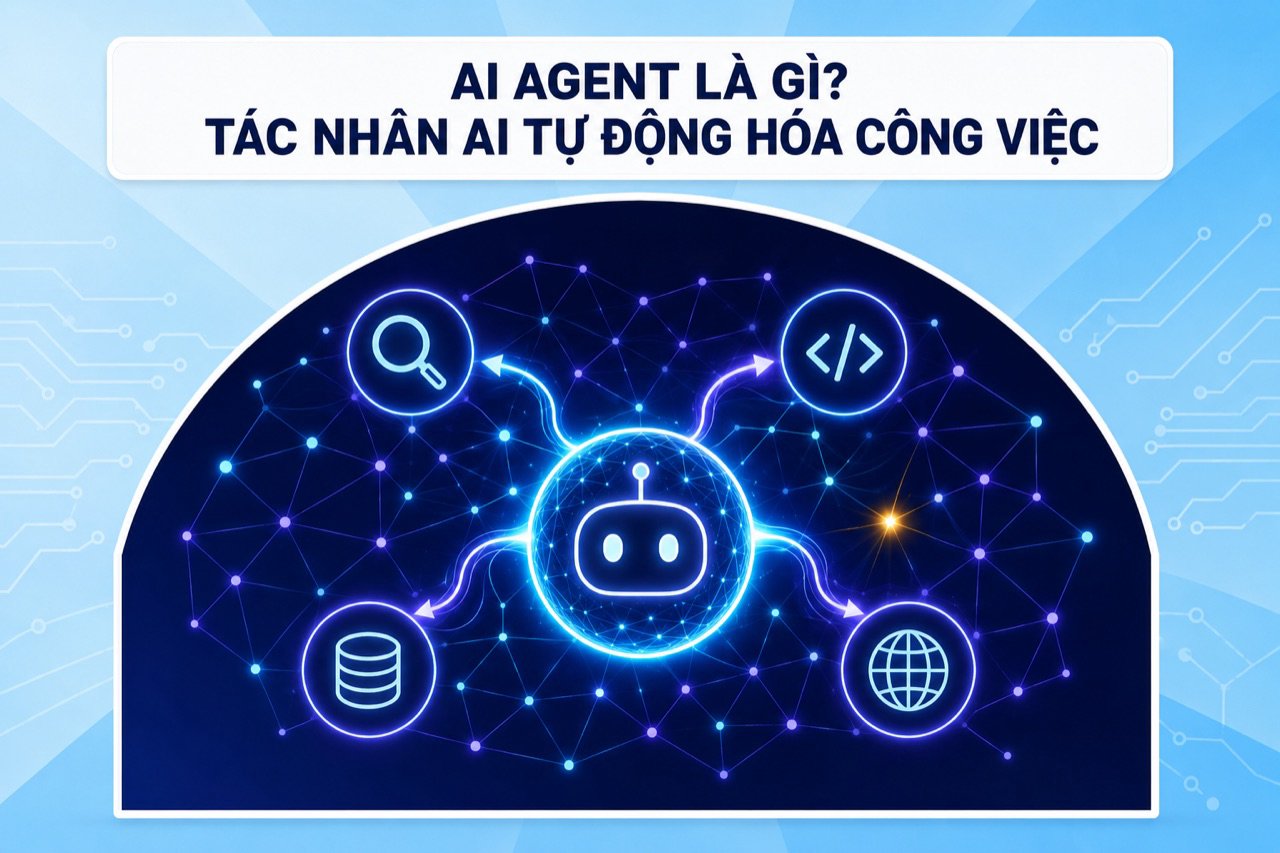
AI Agent — or autonomous AI agent — is the next generation of artificial intelligence systems: rather than simply answering questions, an agent independently plans, invokes tools, and executes multi-step tasks to accomplish whatever goal the user sets. This article explains what an AI Agent is, how the Reason-Act loop works, which frameworks are most popular, and how businesses are using agents to automate data-analysis workflows.
What Is an AI Agent?
An AI Agent is a software system that uses a large language model (LLM) as its "brain" to autonomously plan, make decisions, and take actions in pursuit of a specific goal — rather than merely responding to a single, isolated question.
Think of it like hiring a human assistant. Instead of asking one question and waiting for an answer, you say: "Research the competitive landscape this week and send me a report by Monday morning." The assistant figures out what needs to be done, conducts the research, synthesizes the findings, and delivers the result — all without you supervising every step. An AI Agent operates on exactly the same principle: proactive execution, not passive response.
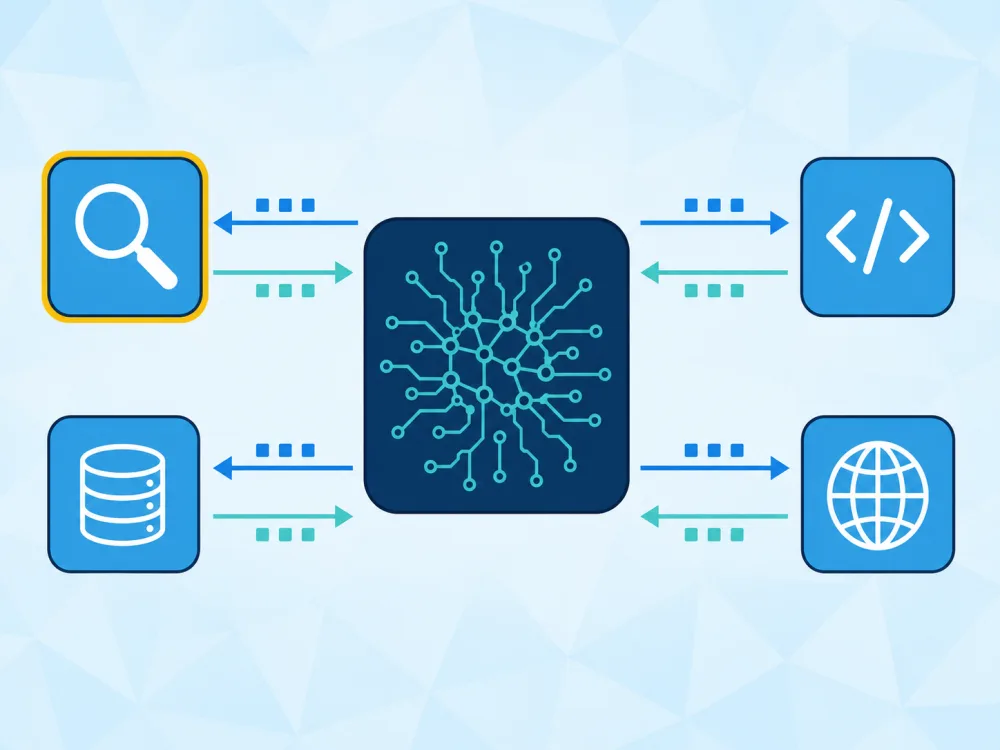
Four core components distinguish an agent from an ordinary chatbot:
LLM (the brain): The large language model is responsible for reasoning, planning, and deciding what action to take next.
Tools: A set of functions or APIs the agent can call — web search, file read/write, code execution, database queries, and so on.
Memory: Short-term context within the conversation window, and long-term memory via a vector store or RAG.
Planning: The ability to decompose a high-level goal into an ordered sequence of smaller steps, evaluate outcomes, and revise the plan as needed.
2019Trusted since
B2BData solutions
Data·AIExpertise
Need data solutions for your business?
AlgoData has helped businesses with data engineering, analytics & AI since 2019.
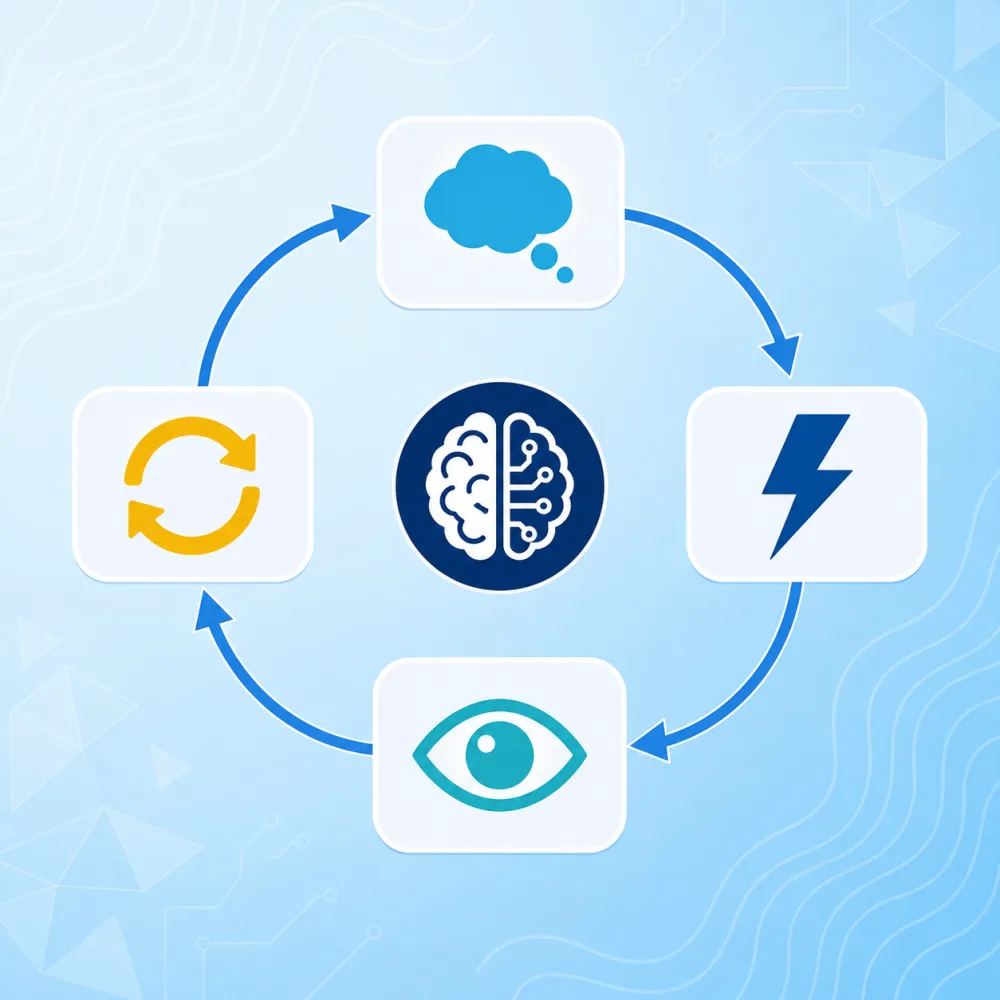
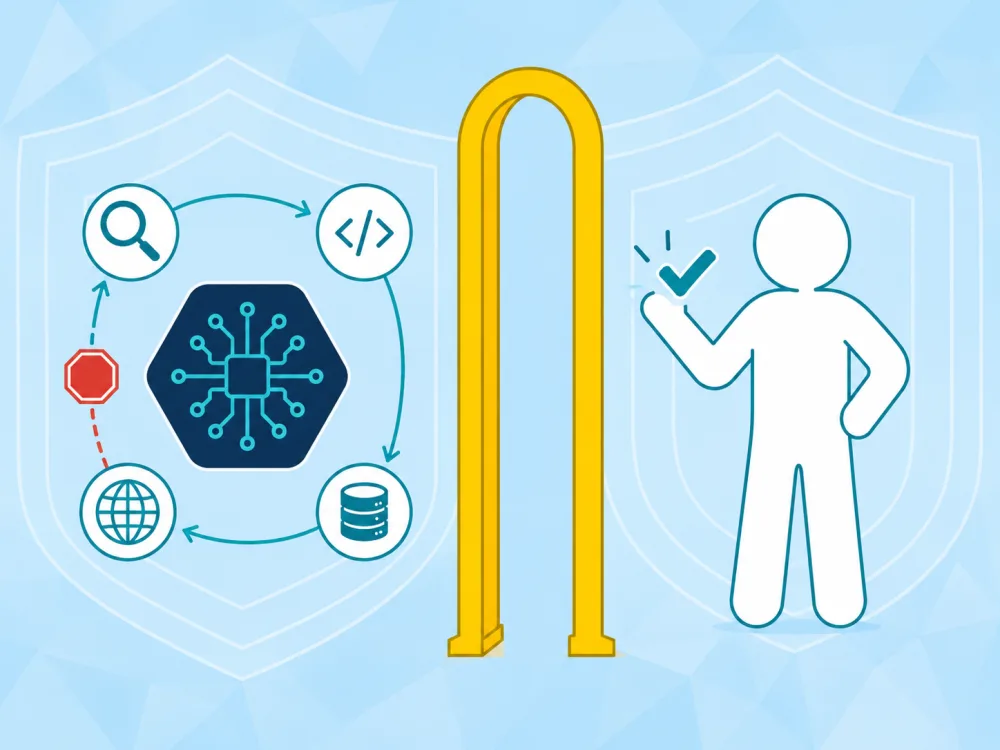
At the heart of every AI Agent is the ReAct loop — short for Reason + Act. This iterative algorithm runs continuously until the agent achieves its goal or exhausts its maximum number of iterations.
The process unfolds as follows:
Thought: The agent analyzes the current state and determines the next step.
Action: The agent calls a specific tool with the appropriate parameters.
Observation: The tool returns a result, which the agent reads.
Repeat from step 1 with the new information, until the goal is complete.
text
1Goal: "Summarize the 5 most notable AI news stories this week"
2 3[Thought] I need to search for AI news from the past 7 days.
4[Action] search_web(query="AI news this week", date_range="7d")
5[Obs] [10 articles with titles + URLs]
6 7[Thought] I need to read each article to produce an accurate summary.
8[Action] fetch_url(url="https://...")
9[Obs] [Article content]
1011... (repeat until 5 articles are processed)
1213[Thought] I have enough data. I'll synthesize it into a report.
14[Action] write_file(filename="ai_news_report.md", content="...")
15[Obs] File saved successfully.
1617[Final Answer] Report saved to ai_news_report.md
The ReAct model was published by Google DeepMind in 2022 and now underpins the majority of commercial agent frameworks.
Tool Use and Function Calling
The real power of an agent comes from its ability to call external tools — known as function calling in modern LLM APIs from providers like OpenAI and Anthropic.
When you define a tool, you describe to the LLM what it does, what parameters it accepts, and what it returns. The LLM then decides autonomously when to invoke that tool and fills in the appropriate parameters.
Here is an example tool definition for searching products:
JSON
1{ 2"name":"search_products", 3"description":"Search for products by keyword on Shopee and return a list of results with prices and ratings", 4"parameters":{ 5"type":"object", 6"properties":{ 7"keyword":{ 8"type":"string", 9"description":"Search keyword, e.g. 'bluetooth headphones'"10},11"max_price":{12"type":"number",13"description":"Maximum price (VND), optional"14},15"sort_by":{16"type":"string",17"enum":["relevance","price_asc","rating"],18"description":"Sort criterion"19}20},21"required":["keyword"]22}23}
Once the LLM receives this tool definition, it knows it can call search_products whenever it needs product information — and will automatically fill in the correct parameters based on the context of the current task.
Good tool design accounts for 80% of an agent's effectiveness
The clearer and more specific your tool description, the less likely the agent is to misuse it. Always state what the tool does, when it should be used, and what format its output takes. Avoid vague names like process_data — use fetch_shopee_product_reviews instead, so the agent never has to guess.
Prompt Engineering plays a crucial role in steering an agent: a well-crafted system prompt helps the agent understand its context, respect scope boundaries, and prioritize the right set of tools.
Multi-Agent: Coordinating Multiple Agents
For sufficiently complex tasks, a single agent is not enough — this is where multi-agent architectures come into play. The idea is straightforward: distribute the work among multiple specialized agents, each excelling at one piece, then combine the results.
The two most common patterns are:
Orchestrator-Worker: A "commander" agent receives the overall goal, breaks it into subtasks, and assigns each to a specialized "worker" agent. For example: the Orchestrator receives the task "analyze brand sentiment this week" → it delegates data collection to a Search Agent, sentiment analysis to an Analyst Agent, and report writing to a Writer Agent.
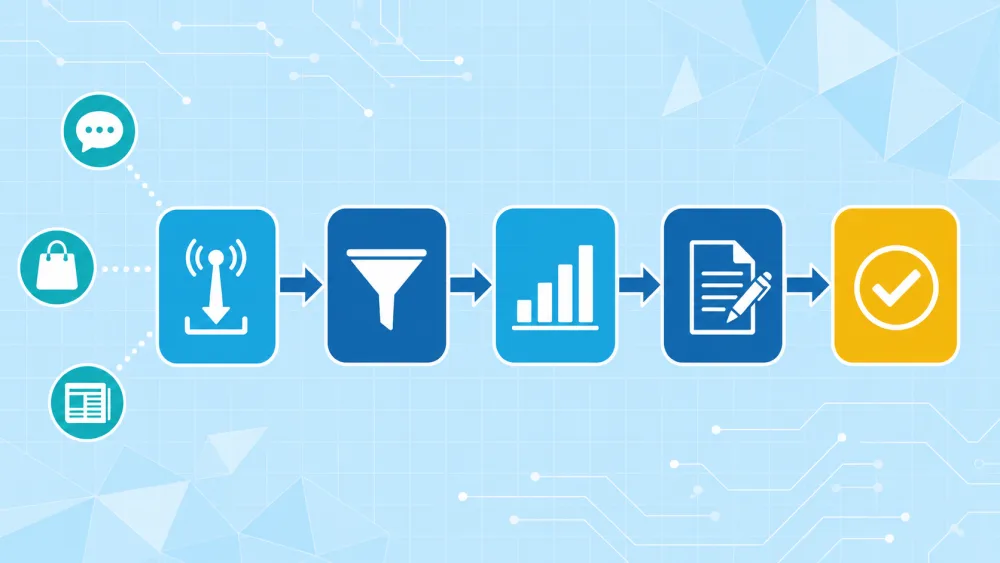
Sequential Pipeline: Agents are chained together, with each agent's output becoming the next agent's input. This suits workflows with a clear order, such as: Collect → Clean → Analyze → Visualize.
text
 1Multi-Agent Research Pipeline:
 2
 3[Search Agent]  → Collect 50 articles from Google, Reddit, social media
 4       ↓
 5[Filter Agent]  → Remove irrelevant and duplicate content
 6       ↓
 7[Analyst Agent] → Sentiment analysis, extract key themes
 8       ↓
 9[Writer Agent]  → Synthesize into an executive summary report
10       ↓
11[Review Agent]  → Verify accuracy before delivery
Frameworks like CrewAI and LangGraph provide first-class support for building multi-agent systems with complex state management and control flow.
Common AI Agent Types in Practice
Coding Agent
A coding agent accepts a feature request or bug description in natural language, writes the code, runs the tests, reads the error output, and iterates until all tests pass. GitHub Copilot Workspace and Cursor Agent are canonical examples. In CI/CD environments, coding agents can automatically patch basic lint errors or update dependencies without human intervention.
Research Agent
A research agent takes a complex question, autonomously searches multiple sources, reads the content, reconciles conflicting information, and synthesizes a cited report. Perplexity AI is a commercial example; frameworks like LangGraph let teams build internal research agents backed by proprietary data sources.
Data Collection and Analysis Agent
This is the fastest-growing enterprise application for AI Agents. An agent automatically collects data from social media, e-commerce platforms, and news sites — then analyzes it and surfaces insights. Instead of manually configuring cron jobs, the agent proactively monitors for changes and triggers alerts whenever anomalies are detected.
AI Agent Frameworks
Framework
Language
Strengths
Best for
LangChain
Python / JS
Massive tool ecosystem, extensive documentation
Rapid prototyping, multi-LLM integrations
LangGraph
Python
Complex state management, multi-agent loops
Production agents requiring tight flow control
CrewAI
Python
Intuitive team model, easy role definition
Multi-agent role-based workflows
AutoGPT
Python
Standalone autonomous agent, plugin marketplace
Experiments, capability demos
Microsoft AutoGen
Python
Multi-agent conversation, Azure integration
Enterprise, Microsoft stack integration
OpenAI Swarm
Python
Lightweight, minimal orchestration overhead
Small teams, simple agents
Choosing a framework for production
For production systems, LangGraph is typically a better choice than vanilla LangChain — it provides a clear state machine, checkpointing for resuming after failures, and explicit loop control. CrewAI is a good fit when business stakeholders need to understand the workflow without reading code.
Risks and How to Manage Them
Greater agent capability comes with greater risk if controls are not applied correctly. The main risks are:
Prompt injection: External data (web pages, emails) contains rogue instructions that cause the agent to take unintended actions. Mitigation: validate and sanitize all tool-returned input before it enters the LLM context.
Tool misuse: The agent calls a tool at the wrong moment or with incorrect parameters, causing irreversible consequences such as data deletion or bulk emails being sent. Mitigation: apply the principle of least privilege — grant only the minimum permissions actually needed.
Infinite loops: The agent becomes stuck in a loop because the goal is ambiguous or a tool repeatedly returns errors. Mitigation: enforce a maximum step count (max_iterations) and a timeout for each iteration.
Hallucination propagation: Incorrect information from one step carries forward into subsequent steps because sources are never verified. Mitigation: use RAG for grounding and require the agent to cite its sources at each step.
The single most important principle is human-in-the-loop — placing checkpoints that require user confirmation before high-impact actions are taken. This is not a design weakness; it is a mandatory practice in any production environment.
AI Agents in Social-Media Data Analytics
One of the most practical applications of AI Agents for businesses is automating the social-media data collection and monitoring pipeline. Instead of analysts logging into Facebook, TikTok, or Shopee every morning to gather numbers by hand, an agent can handle the entire workflow on a schedule.
A typical architecture:
A Collection Agent calls platform APIs or data-collection tools to pull comments, reviews, and engagement metrics for the keywords or brands being tracked.
An Enrichment Agent cleans the raw data, classifies sentiment, identifies topics, and applies tags.
An Alert Agent compares results against predefined thresholds — if negative sentiment spikes or a crisis keyword appears, the agent immediately fires a notification via Slack or email.
A Report Agent consolidates everything into a daily or weekly report and pushes it to a dashboard.
Platforms like AlgoData provide multi-channel data collection infrastructure covering Facebook, TikTok, and Shopee that agents can integrate with directly via API, cutting pipeline build time from weeks to days.
Agentic AI Trends in 2026
Agentic AI — AI that acts proactively toward goals rather than reacting to individual prompts — is the defining trend in the technology industry right now. Several developments stand out:
Long-horizon tasks: Newer models like Claude Opus and GPT-4o with large context windows allow agents to work on tasks that span many hours without losing context — opening the door to agents that can autonomously complete multi-day projects.
Computer-use agents: Agents can now interact with graphical interfaces just like a human user — moving the mouse, filling in forms, and taking screenshots to read application state. Anthropic Computer Use and OpenAI Operator represent the first concrete steps in this direction.
Agent-to-Agent communication: Agents from different vendors are learning to communicate via open protocol standards (MCP — the Model Context Protocol from Anthropic), enabling the construction of interoperable agent ecosystems.
Specialized domain agents: Rather than general-purpose agents, the market is moving toward agents purpose-built for specific industries — finance, healthcare, marketing — with domain knowledge embedded by design and built-in regulatory compliance.
Conclusion:AI Agents mark the shift from AI that "answers" to AI that "works" — and we are still in the earliest phase of the agentic AI revolution. Businesses that understand early how to design, control, and integrate agents into their workflows will hold a substantial competitive advantage in the years ahead.
QHow is an AI Agent different from a regular chatbot?
A chatbot answers questions reactively, one at a time — it takes no independent action and forms no plan. An AI Agent is the opposite: it receives a goal, breaks it down into steps, calls external tools (APIs, browsers, code runners), observes the results, and adjusts its plan until the goal is accomplished. Simply put: a chatbot responds; an agent gets things done.
QWhat kinds of tasks can an AI Agent handle on its own?
Agents can autonomously conduct web research, write and execute code, synthesize reports from multiple data sources, manage calendars, send emails, and collect and analyze social-media data. The scope of what an agent can do depends entirely on the toolset it has been given — the richer the toolkit, the more capable the agent.
QIs it safe to use an AI Agent?
Agents can be used safely when the right controls are in place: apply least-privilege access (grant only the tools truly needed), add human-in-the-loop checkpoints for irreversible actions such as deleting data or sending bulk emails, and review logs after every run. The main risk comes from unsupervised agents, not from the technology itself.
QWhich frameworks are most popular for building AI Agents?
The most widely used frameworks today are LangChain/LangGraph (Python, rich tool ecosystem), CrewAI (multi-agent team model), AutoGPT (standalone autonomous agent), and Microsoft AutoGen (conversational multi-agent). In Go, the most common approach is direct integration via OpenAI function calling or the Anthropic tool-use API.
QHow do businesses apply AI Agents in practice?
E-commerce companies use agents to monitor competitor pricing and adjust strategies in real time. Analytics firms deploy agents that gather data across multiple channels — social media, news, competitors — and compile a fresh report every morning. Engineering teams use coding agents to automatically review code, write tests, and patch basic bugs inside CI/CD pipelines.