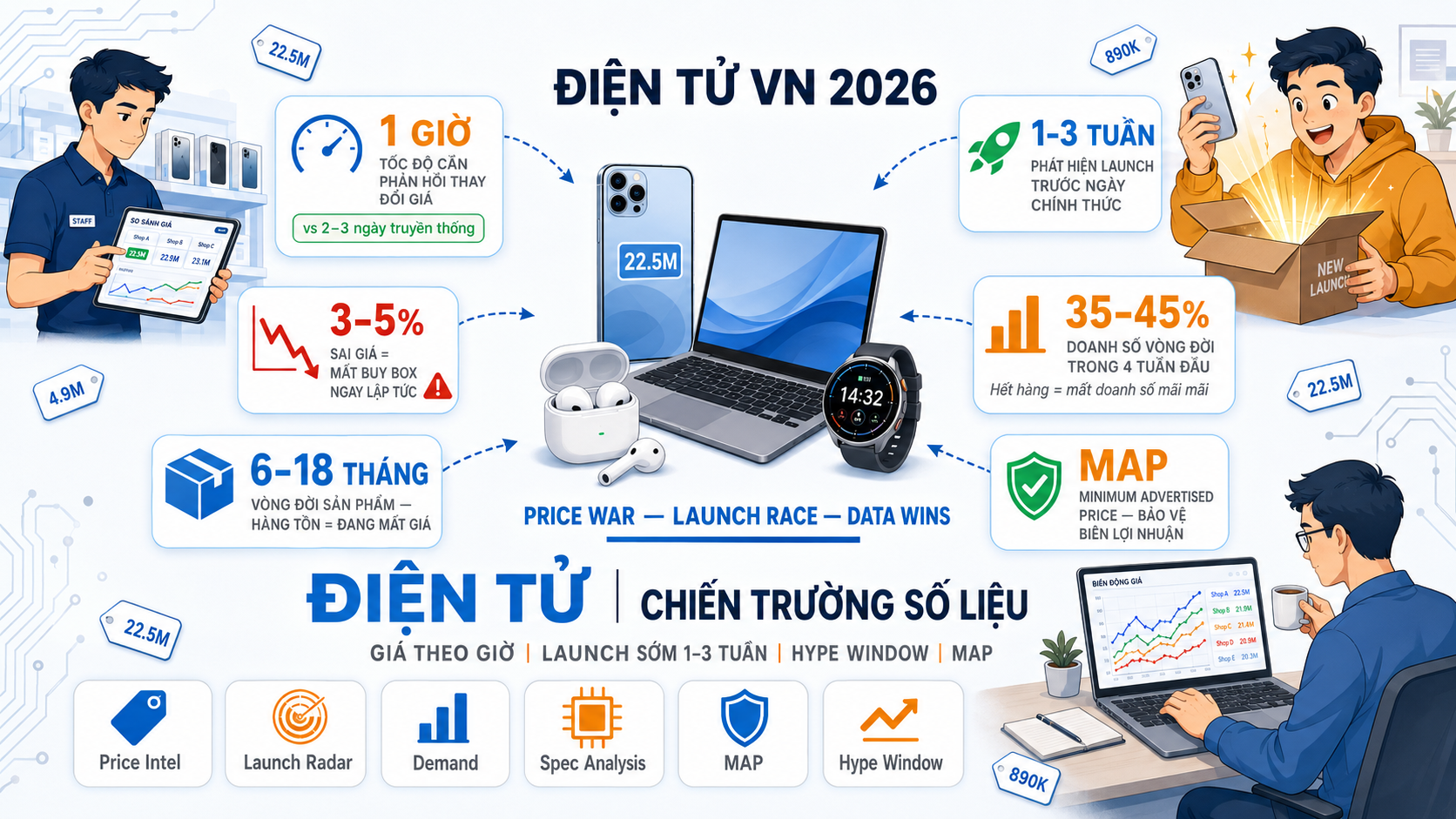
In electronics, a 3–5% pricing error costs you the buy box. Launching a product two weeks late means missing the entire hype cycle. Importing inventory at the wrong time means sitting on depreciating stock for a full quarter. This is an industry where every decision is time-sensitive and margins leave no room for error. Algo Data provides the intelligence layer you need: hourly market prices, launch signals 1–3 weeks early, and demand forecasts built on actual product lifecycle data.
Electronics 2026: The Price War and the Launch Race
2019Trusted since
B2BData solutions
Data·AIExpertise
Need data solutions for your business?
AlgoData has helped businesses with data engineering, analytics & AI since 2019.
Vietnam's consumer electronics market operates at a speed no other category can match:
6–18 month product lifecycles: new flagship smartphones every year, new TWS earbuds every 6 months — inventory is depreciating from the moment it lands
E-commerce price war: the same iPhone/Samsung/Xiaomi model can be listed by hundreds of sellers — mispricing by a few percent loses the order instantly; undercutting destroys your margin
Launch timing determines revenue: the first 4 weeks after a new product launches often represent 35–45% of its total lifetime sales — whoever has stock first and advertises first captures the hype wave
The winner isn't whoever has the best price or the most inventory. It's whoever knows hourly market prices, detects competitor launches 1–3 weeks early, and always has stock exactly when demand peaks.
What Is Algo Data?
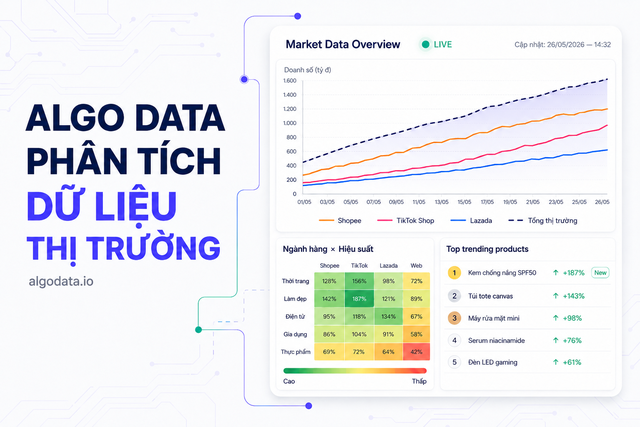
Algo Data is a comprehensive market analytics platform for the electronics industry — monitoring prices in real time, detecting new product launch signals, forecasting demand cycles, and analyzing market reaction through real reviews and search behavior.
Not a basic price scraper. Not a simple repricing tool. Algo Data is the complete market intelligence layer — connecting price data, demand signals, competitive behavior, and user sentiment into a single coherent picture.
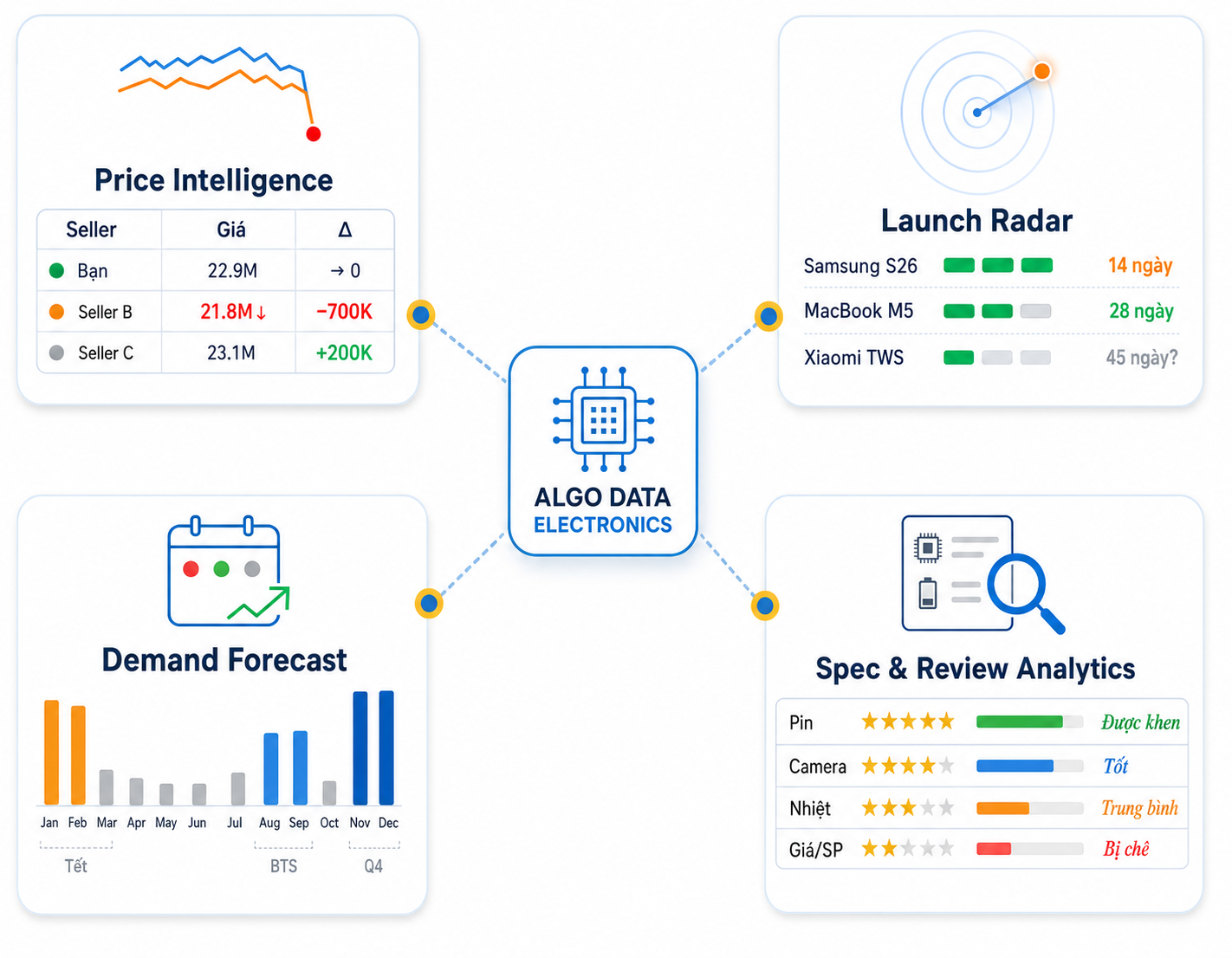
4 core pillars:
Price Intelligence — hourly price movement tracking and competitor pricing strategy analysis
Launch Radar — detect new product launch signals 1–3 weeks before official announcements
Demand Forecast — predict demand cycles by season and product lifecycle stage
Spec & Review Analytics — analyze market reaction at the level of individual technical features
Key Features
Price Intelligence: Know the Market Price Before You Lose the Order
In electronics, price is what buyers compare first and decide on last. A slightly wrong price means losing the order instantly to a competing seller.
Manual repricing isn't fast enough in electronics
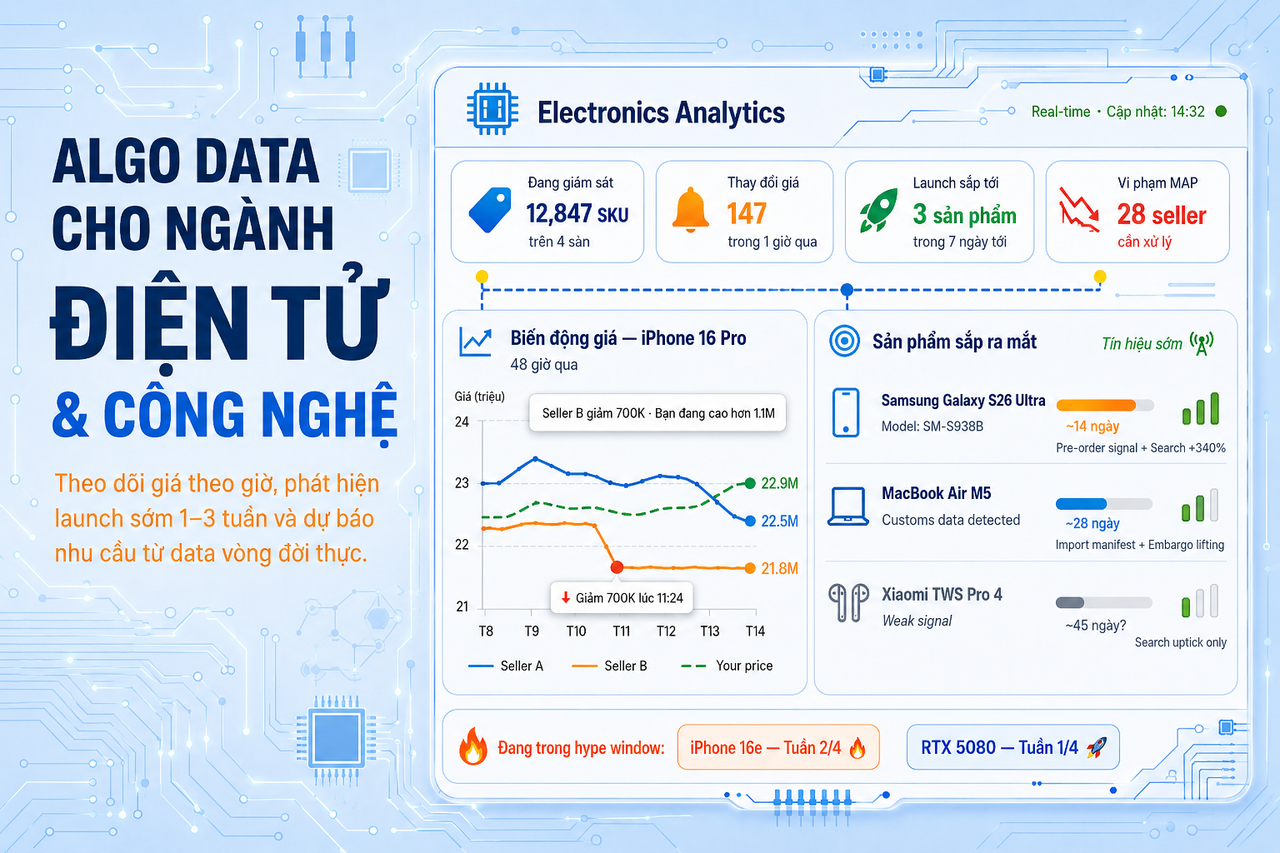
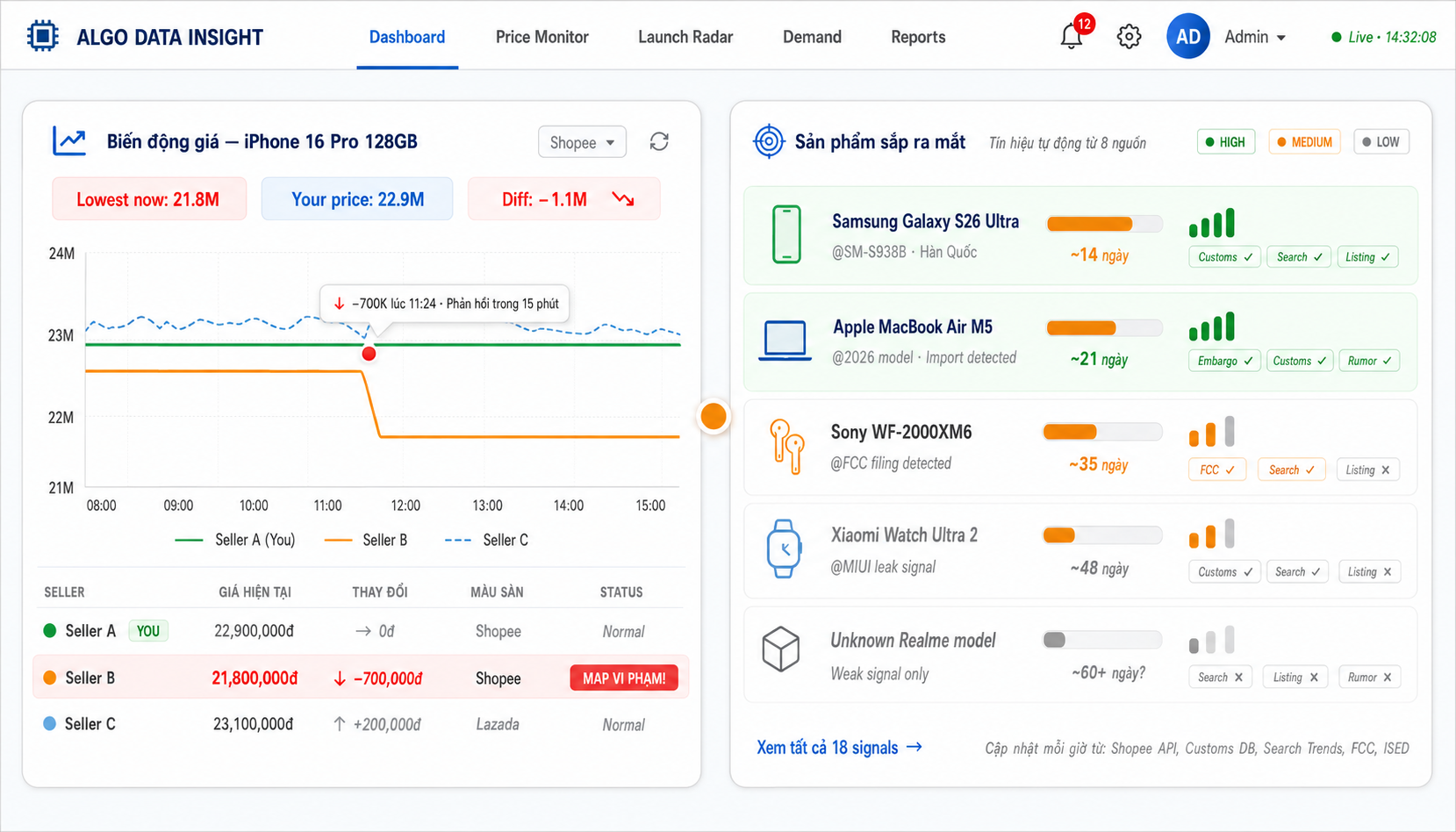
On Shopee and TikTok Shop, electronics prices can change dozens of times per day during major sales events. Algo Data sends hourly alerts when competitors reprice — you can respond within 15 minutes instead of discovering the change days later after the orders have already gone elsewhere.
Real-time price tracking: monitor competitor prices across all major e-commerce platforms and their own websites, updated hourly
Price history visualization: 90/180-day price charts — see clear patterns of discounting, clearance behavior, and each competitor's long-term pricing strategy
MAP monitoring (Minimum Advertised Price): automatically detect sellers violating floor prices — protect your distribution system and channel-wide margins
Competitor margin estimation: estimate competitor margins based on retail price vs. known market cost — understand whether they have room to cut prices further
Price elasticity insight: which products are price-sensitive (2% cut = 30% more orders) vs. price-inelastic (buyer decided before comparing prices)
Launch Radar: Know About Competitor Products Before They Announce Them
In tech, whoever gets stock before the hype wave wins. If you wait until the official launch date to place your order, you're already 2–3 weeks behind your competitors.
New tech product hype cycles last only 2–4 weeks
Market data shows that 35–45% of a new electronics product's lifetime sales are generated in the first four weeks after launch. Stockout during this window means permanently lost revenue — no amount of inventory afterward can recover what was missed at peak.
Pre-launch signal detection: catch new listings appearing on platforms, specific model search queries spiking before any official announcement
Import/customs signals: customs declaration data reveals incoming shipments — the earliest possible indicator of an imminent product launch
Competitor stock level monitoring: track unusual large restocking activity — an abnormal inventory buildup is a reliable launch signal
Review embargo detection: detect when press review embargoes are lifted (reviews appear simultaneously across multiple channels) — a 24–48 hour window before the official launch
Launch timing recommendation: based on brand launch history and current signals, suggest the optimal moment to place your inventory order and activate advertising
Demand Forecast: Import the Right Product, at the Right Time, in the Right Quantity
Seasonal demand cycles: forecast demand around known peaks — back-to-school (August–September), year-end gifting (November–December), Lunar New Year (January–February) — with accuracy built from 3 years of historical data
Product lifecycle staging: identify where a product sits in its lifecycle (launch → growth → peak → decline) — know when to aggressively restock and when to start clearing
Demand spike prediction: detect atypical demand surges driven by external events (new game release → GPUs, new film release → smart TVs, new school term → laptops)
Regional demand variation: demand patterns in Hanoi vs. Ho Chi Minh City differ meaningfully by category — optimize inventory distribution by regional warehouse
Spec & Review Analytics: Understand What Features the Market Actually Wants
Spec preference mapping: which features dominate review discussions and search queries — battery life, AI camera, screen refresh rate, RAM capacity, or weight
Feature-level sentiment: analyze what customers criticize and praise about competitor products at the individual spec level — surfaces product weaknesses before they become market knowledge
Price-to-spec value analysis: compare price/feature ratios across same-segment products — identify products that are mispriced relative to their actual specification value
Upgrade trigger analysis: understand what drives users to upgrade — battery degradation, end of software support, peer influence, or simply trending toward the latest flagship
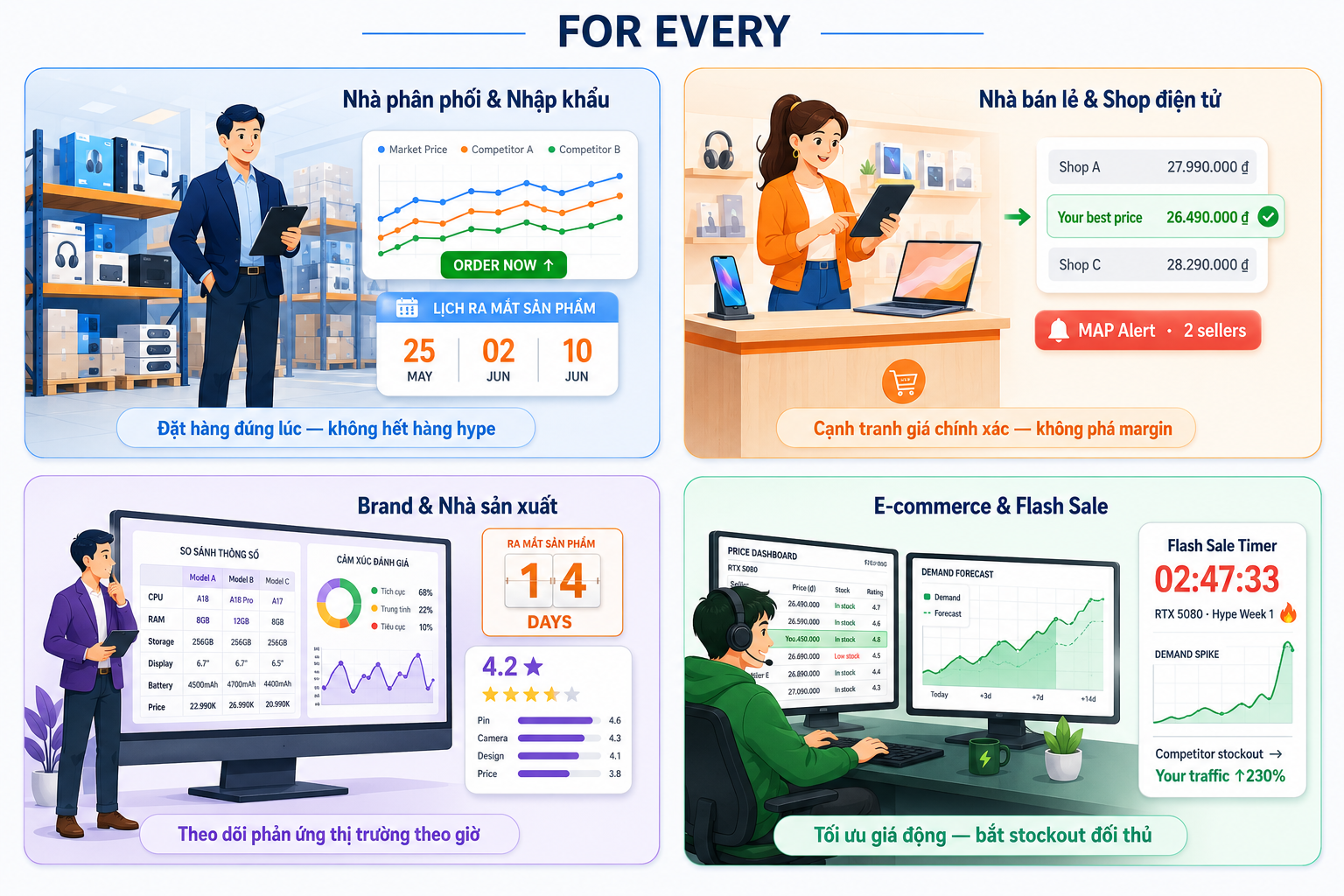
Who Should Use Algo Data?
Distributors & Importers
Know which products are launching soon, when demand will peak, and how competitors are pricing — to order at the right time, in the right quantities, and never run out of stock during the hype window.
Retailers & Electronics Shops
Compete on price precisely without destroying your margin. Monitor MAP compliance, detect price-breaking sellers, and adjust your pricing strategy hourly instead of daily.
Brands & Manufacturers
Track market reaction to new products in real time — reviews, spec comparisons, social media mentions. Understand how competitor products are being received so you can sharpen your messaging and positioning.
E-commerce & Flash Sale Platforms
Optimize flash sale scheduling and dynamic pricing based on real demand data. Know when competitors are stocked out so you can capture diverted traffic during that window.
Algo Data vs. Traditional Approaches
Criteria
Traditional Approach
Algo Data
Price monitoring
Manual checks, a few times daily
✓ Automated, hourly, instant alerts
Detecting new launches
Trade press, market rumor
✓ 1–3 weeks early from real data signals
Demand forecasting
Experience, intuition
✓ 3-year data model + live signals
Review analysis
Manual reading, selective
✓ Full-market, feature-level sentiment
MAP monitoring
None or highly manual
✓ Automated, real-time violation alerts
Get Started with Algo Data
Register at algodata.io — try the free tier to explore core features before deciding to upgrade.
Recommended first steps for electronics businesses: run Price Intelligence on your top 5 best-selling SKUs and compare against 3–5 direct competitors — you'll immediately see where you're priced right and where you're leaving orders on the table. Then activate Launch Radar for 2–3 brands competing directly with you so you're never caught off guard by a competitor launch again.
Conclusion:In electronics, being hours slower than a competitor is already losing. Being priced a few percent off is losing orders. Launching a few weeks late is losing the hype. Algo Data is the intelligence layer that keeps you ahead — not through luck, but through data.
Yes. Algo Data monitors prices on thousands of electronics products across Shopee, Lazada, TikTok Shop, and competitor websites — updating hourly. When a competitor changes their price, you get an alert immediately and can respond within minutes instead of discovering it days later.
QHow does Algo Data detect competitor product launches?
Algo Data monitors multiple signals simultaneously: new listings appearing on e-commerce platforms, specific model search queries spiking before any announcement, pre-order activity, and changes to competitor page categories. Combining these signals typically surfaces launches 1–3 weeks before the official announcement date.
QCan Algo Data forecast electronics demand by season?
Yes. Three years of historical data combined with current signals enables demand cycle forecasting: back-to-school (August–September), year-end (November–December), Lunar New Year (January–February) — giving you a much more precise basis for inventory planning.
QElectronics has thousands of products and models — can Algo Data handle that scale?
Yes. Algo Data builds a dedicated taxonomy for each category (smartphones, laptops, earbuds, smart home...) and tracks tens of thousands of SKUs simultaneously. The dashboard is designed to drill from category → brand → model → variant without getting overwhelmed by data volume.
QWho in electronics should use Algo Data?
Best suited for: (1) Distributors and importers tracking market prices and import timing, (2) Retailers competing on price without eroding margins, (3) Brands monitoring how the market is responding to new products, (4) E-commerce platforms optimizing dynamic pricing and flash sale scheduling.