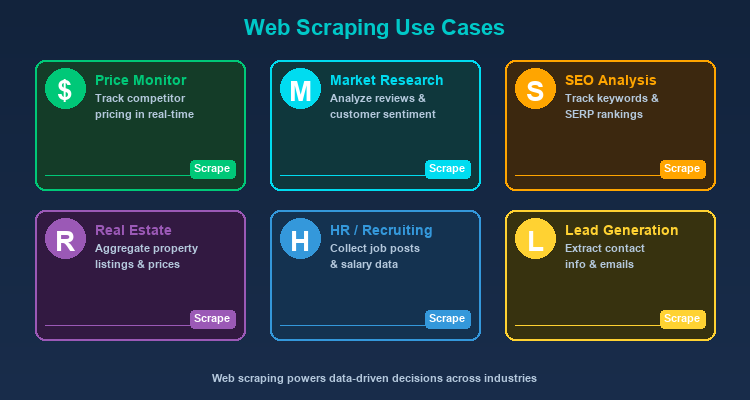
Web Scraping is the technique of automatically collecting data from websites, helping businesses extract information at a speed and scale that manual effort cannot match. This article explains in detail what web scraping is, how it works, popular tools, the role of proxies, and important legal considerations.
What is Web Scraping?
Web Scraping (also known as web harvesting or web data extraction) is the process of using software or scripts to automatically access websites and extract structured data from their HTML source code. Instead of manually copying each piece of information, web scraping allows you to collect millions of data points in just minutes.
Difference Between Web Scraping and Web Crawling
Many people confuse these two concepts:
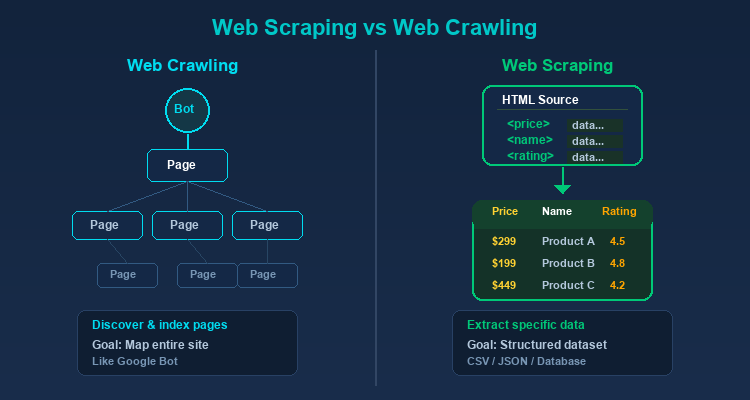
Web Crawling is the process of browsing and indexing web pages, similar to how Google Bot works. Its primary goal is to discover and map website structures.
Web Scraping focuses on extracting specific data from known pages. For example: getting product prices, customer reviews, or contact information.
In practice, a data collection project often combines both: crawling to find the necessary URLs, then scraping to extract data from each URL.
2019Trusted since
B2BData solutions
Data·AIExpertise
Need data solutions for your business?
AlgoData has helped businesses with data engineering, analytics & AI since 2019.
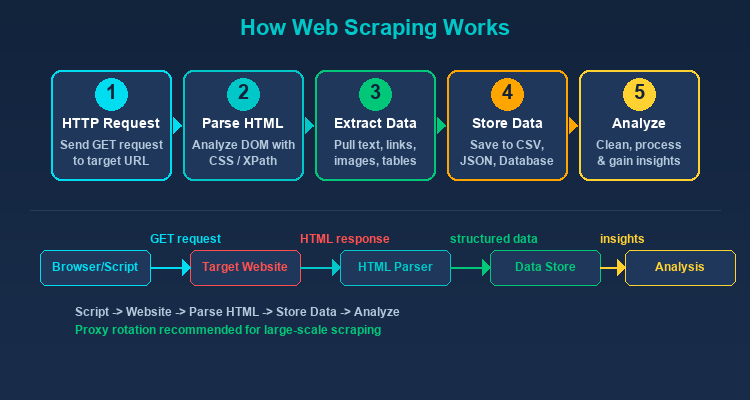
The basic web scraping workflow involves the following steps:
Send HTTP Request
The script sends an HTTP request (usually GET) to the target URL, just like when your browser accesses a web page. The server responds with the page's HTML code.
Parse HTML
After receiving the HTML, the scraping tool analyzes the DOM (Document Object Model) structure to identify where the target data is located. Common methods include:
CSS Selectors: Select elements based on class, id, or HTML structure.
XPath: A powerful query language for XML/HTML that allows precise navigation within the DOM structure.
Regular Expressions: Search for specific text patterns in HTML.
Extract Data
Data is extracted from the identified HTML elements — this can be text, attributes (href, src), tables, or any content displayed on the page.
Store Data
Extracted data is saved in structured formats like CSV, JSON, Excel, or databases (MySQL, PostgreSQL, MongoDB).
Process and Analyze
Raw data is cleaned, normalized, and analyzed to derive valuable business insights.
Popular Web Scraping Tools
Programming Libraries
Beautiful Soup (Python): A simple, easy-to-use HTML/XML parsing library. Suitable for small to medium scraping projects.
Scrapy (Python): A powerful and comprehensive scraping framework. Supports asynchronous processing, data pipelines, and middleware. Ideal for large-scale projects.
Puppeteer (Node.js): A library for controlling headless Chrome/Chromium browsers. Excellent for handling websites that use JavaScript rendering.
Playwright (Multi-language): Similar to Puppeteer but supports multiple browsers (Chrome, Firefox, Safari) and multiple programming languages.
Selenium: A browser automation tool that allows interaction with websites like a real user (clicking, scrolling, filling forms).
No-Code Platforms
Octoparse: An intuitive drag-and-drop interface requiring no coding. Perfect for users without programming experience.
ParseHub: Similar to Octoparse, supports scraping complex websites with JavaScript.
Apify: A cloud-based platform providing ready-made actors (scripts) for many popular websites.
Challenges in Web Scraping
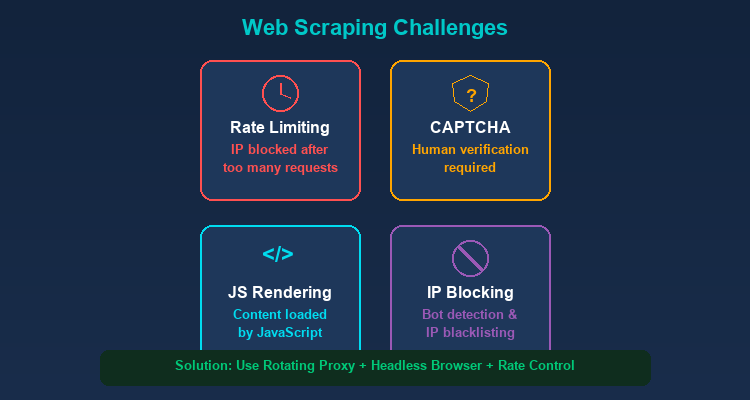
Anti-Scraping Mechanisms
Websites increasingly implement measures to block scraping bots:
Rate Limiting: Restricts the number of requests from a single IP within a given timeframe.
CAPTCHA: Requires verification that the user is human.
IP Blocking: Blocks IPs that send too many requests or exhibit abnormal behavior.
User-Agent Detection: Detects and blocks requests that don't come from real browsers.
Honeypot Traps: Hidden links that only bots would access, used to identify scrapers.
JavaScript Rendering
Many modern websites use JavaScript to render content (Single Page Applications - SPA). This means the initial HTML doesn't contain the data — data is only loaded after JavaScript executes. The solution is to use headless browsers like Puppeteer or Playwright.
HTML Structure Changes
Websites frequently update their interfaces, causing scraper selectors to break. Scrapers need to be designed flexibly with monitoring systems to detect errors early.
Large-Scale Data Processing
Collecting millions of pages requires systems capable of parallel processing, queue management, and efficient storage.
The Role of Proxies in Web Scraping
Proxies are an essential component of any large-scale web scraping project. Here's why:
Avoiding IP Blocks
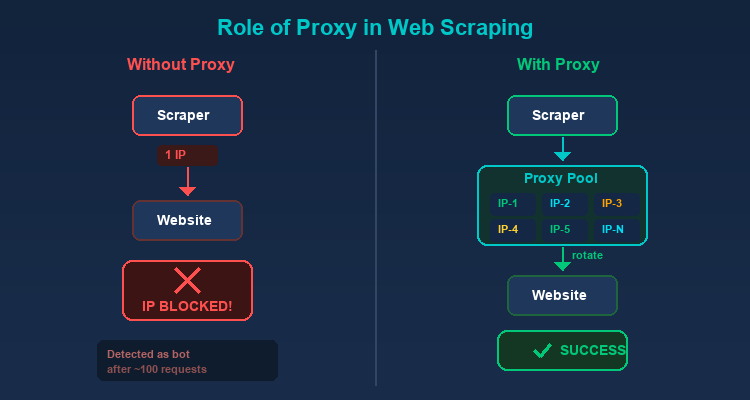
When sending thousands of requests from the same IP, the website will quickly detect and block you. Proxies allow you to rotate IPs continuously, distributing requests across many different IP addresses.
Bypassing Geo-Restrictions
Some websites display different content depending on geographic location. Proxies from different countries let you access content from any region.
Increasing Collection Speed
Using multiple proxies simultaneously allows parallel requests, significantly increasing scraping speed without exceeding the rate limit for each individual IP.
Best Proxy Types for Scraping
Residential Proxy: The best choice for scraping. Real ISP IPs that are very hard to detect as bots. Ideal for websites with strong anti-scraping measures.
Datacenter Proxy: High speed, lower cost. Suitable for scraping websites with less protection or low rate limits.
Rotating Proxy: Automatically changes IP after each request or after a set time period. Perfect for large-scale scraping.
Web Scraping Proxy Test
Tested on 2026-02-15TMProxy
Test results for 3 proxy types when scraping 10,000 product pages from a major e-commerce site:
Proxy Type
Success Rate
Avg Speed
IPs Blocked
Cost/10K pages
Residential
98.5%
1.2s/page
0.3%
$$
Datacenter
72%
0.4s/page
28%
$
Rotating Residential
99.2%
1.5s/page
0.1%
$$$
Rotating residential proxy achieved the highest success rate (99.2%) with virtually no IP blocks. Datacenter proxy was faster but had 28% of requests blocked.
TMProxy offers all these proxy types with over 10 million IPs from 200+ countries and automatic IP rotation — the perfect solution for professional web scraping.
Web scraping is not always legal. You should be aware of:
Terms of Service (ToS): Many websites prohibit scraping in their terms of use. Violations can lead to legal consequences.
Robots.txt: This file specifies which parts of a website allow or disallow bot access. You should respect the robots.txt file.
Personal Data: Collecting personal data must comply with data protection regulations like GDPR (Europe) and CCPA (California).
Copyright: Copyrighted content should not be copied or redistributed without permission.
ToS violations can lead to lawsuits
Some companies have won lawsuits against scrapers who violated Terms of Service (LinkedIn vs. hiQ Labs, Craigslist vs. 3Taps). Before scraping any site at scale, read the ToS carefully and if in doubt — seek legal advice.
Best Practices for Effective Web Scraping
To build a sustainable and professional scraping system, follow these key principles:
Respect robots.txt
Always check and follow the target website's robots.txt file before scraping. This file specifies which URLs bots are allowed or disallowed to access. While robots.txt is not legally binding in all jurisdictions, respecting it demonstrates professional ethics and reduces the risk of being blocked.
Implement Rate Limiting
Don't send requests too quickly — this can overwhelm the target server and get your IP blocked immediately. Set a minimum delay of 1-3 seconds between requests, or adjust according to the site's allowed rate.
Random delay is more effective than fixed delay
Instead of a fixed time.sleep(2), use time.sleep(random.uniform(1.5, 4.0)). Regular patterns are easily detected by anti-bot systems — random delays simulate real user behavior much more naturally.
Use Rotating Proxies
Continuous IP rotation is critical for large-scale scraping. A diverse proxy pool with IPs from multiple countries and ISPs helps distribute requests and avoid detection. TMProxy offers over 10 million residential IPs with automatic rotation, ideal for any scraping project.
Simulate Real User-Agent and Headers
Send requests with headers that mimic real browsers: User-Agent, Accept, Accept-Language, Referer. Rotate User-Agents between requests to avoid fingerprint-based detection. Use an updated list of User-Agents from popular browsers.
Handle Errors with Exponential Backoff
When encountering errors (HTTP 429, 503, timeouts), don't retry immediately. Use exponential backoff — wait 1s, then 2s, 4s, 8s... Set a maximum retry limit (usually 3-5 attempts) to avoid infinite loops. Log errors for analysis and scraper improvement.
Store Raw HTML Before Parsing
Always save the raw HTML of pages to storage (files or database) before extracting data. This allows you to re-parse data when extraction logic changes without re-scraping, saving significant time and bandwidth.
Set Up Monitoring and Alerts
Establish a monitoring system to track: request success rates, scraping speed, number of blocked IPs, and data quality. Automatic alerts when error rates exceed thresholds help detect and resolve issues quickly.
Web Scraping Code Example with Python
Here's a simple example using Beautiful Soup to scrape product titles and prices from a website:
Python
1importrequests 2frombs4importBeautifulSoup 3 4url="https://example.com/products" 5headers={"User-Agent":"Mozilla/5.0 (Windows NT 10.0; Win64; x64) AppleWebKit/537.36"} 6 7# Use proxy to avoid blocking 8proxies={"http":"http://user:pass@proxy.tmproxy.com:8080", 9"https":"http://user:pass@proxy.tmproxy.com:8080"}1011response=requests.get(url,headers=headers,proxies=proxies,timeout=30)12soup=BeautifulSoup(response.text,"html.parser")1314products=soup.select(".product-item")15forproductinproducts:16name=product.select_one(".product-name").text.strip()17price=product.select_one(".product-price").text.strip()18print(f"{name}: {price}")
This example demonstrates key best practices: using User-Agent headers, proxies, timeouts, and CSS selectors for structured data extraction.
Web Scraping Trends
AI-Powered Scraping
Artificial intelligence is transforming how scraping works. AI tools can automatically identify page structures, adapt when layouts change, and extract data without manually written selectors. Machine learning helps scrapers "learn" from HTML patterns and self-adjust when websites update.
Headless Browsers as the Standard
With the rise of Single Page Applications (SPA) and JavaScript-heavy websites, headless browsers like Puppeteer and Playwright have become the default tool rather than just a fallback. Modern websites require JavaScript execution to render content, making simple HTTP requests insufficient.
Increasingly Sophisticated Anti-Bot Measures
Cloudflare, Akamai, and other CDNs continuously improve their bot detection capabilities. New techniques include: mouse and keyboard behavior analysis, TLS fingerprinting, and headless browser detection through JavaScript APIs. This requires scrapers to become increasingly sophisticated.
Growth of Scraping-as-a-Service
Many businesses are shifting to external scraping services instead of building their own infrastructure. Platforms like Apify, ScrapingBee, and Bright Data offer simple APIs that handle proxy rotation, CAPTCHA solving, and browser rendering — letting businesses focus on data analysis rather than infrastructure management.
Ethical and Compliant Scraping
There is a growing trend toward ethical practices and legal compliance in the scraping community. Standards and best practices are becoming more clearly established. Businesses invest in compliance, respect ToS and personal data regulations. This helps the web scraping industry develop sustainably and gain wider acceptance.
Conclusion:Web Scraping is a powerful technique that helps businesses efficiently collect and leverage web data. For successful large-scale implementation, you need a reliable proxy system, the right scraping tools, and solid legal knowledge. With the right combination of tools and strategy, web scraping can deliver tremendous value for your business.
Web scraping is the technique of using software or scripts to automatically access websites and extract structured data from HTML. The process involves: sending HTTP requests, parsing HTML, extracting data, storing it, and processing/analyzing the results.
QWhat is the difference between web scraping and web crawling?
Web crawling browses and indexes web pages (like Google Bot), aiming to discover website structures. Web scraping focuses on extracting specific data from known pages — such as product prices and customer reviews.
QWhat role do proxies play in web scraping?
Proxies help rotate IPs continuously to avoid blocking, bypass geo-restrictions to access region-specific content, and increase collection speed by sending parallel requests through multiple IPs. Residential proxies are the best choice for scraping.
QIs web scraping legal?
It depends on how it's done. You need to check Terms of Service, respect robots.txt, comply with GDPR/CCPA when collecting personal data, and avoid copying copyrighted content. Violating ToS can lead to legal consequences.
QWhat is the best web scraping tool for beginners?
Beautiful Soup (Python) is the best choice for beginners — simple and easy to learn. If you don't know programming, Octoparse or ParseHub offer intuitive drag-and-drop interfaces. Scrapy is ideal for large-scale projects.