- 1 What Is a Vector Database? The Foundation of Semantic AI Search
- 2 What Is a Recommendation System? How TikTok and Shopee Suggest Products
- 3 What is an AI Agent? How Autonomous AI Agents Automate Complex Work
- 4 What Is Deepfake? How to Detect and Protect Yourself
- 5 What is Prompt Engineering? The Art of Giving AI Effective Instructions
- 6 What Is Fine-Tuning? Customizing AI Models for Enterprise Use
- 7 What is RAG? Retrieval-Augmented Generation — when AI knows how to look things up
- 8 What is Vietnam's AI Law? The Legal Framework for Artificial Intelligence (Updated 2026)
RAG — short for Retrieval-Augmented Generation — is a technique that combines the language generation capabilities of an LLM with a real document retrieval step performed before each answer, freeing AI from having to "guess" purely from a fixed set of learned parameters. This article walks through the complete RAG architecture step by step, covering how to build one, how it compares to fine-tuning, and how it applies in enterprise settings.
What is RAG?
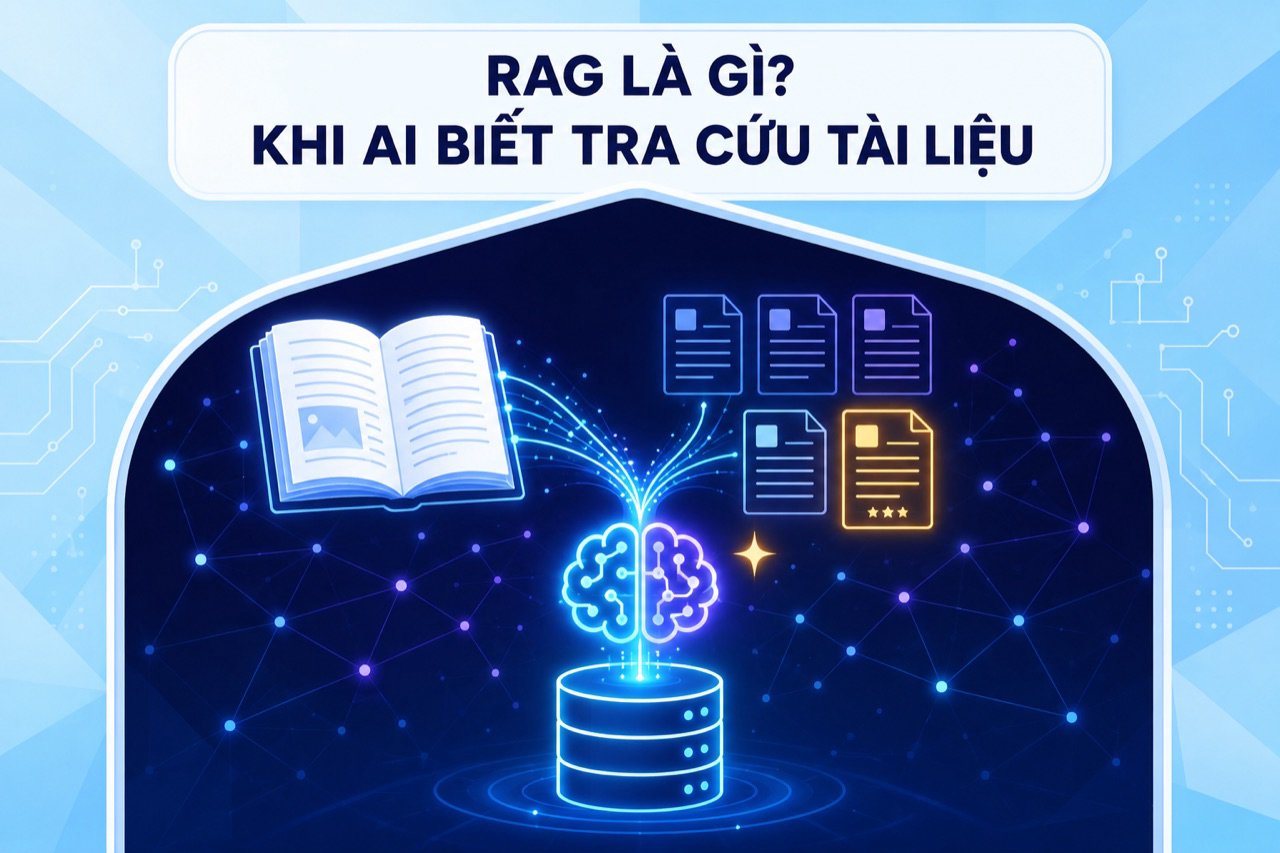
RAG (Retrieval-Augmented Generation) is a method for augmenting large language models with knowledge by automatically retrieving relevant documents and inserting their content into the prompt before the model generates a response. Rather than relying solely on knowledge "baked" into its parameters during training, a RAG-powered model gains access to an external information source — one that is flexible, updatable, and verifiable.
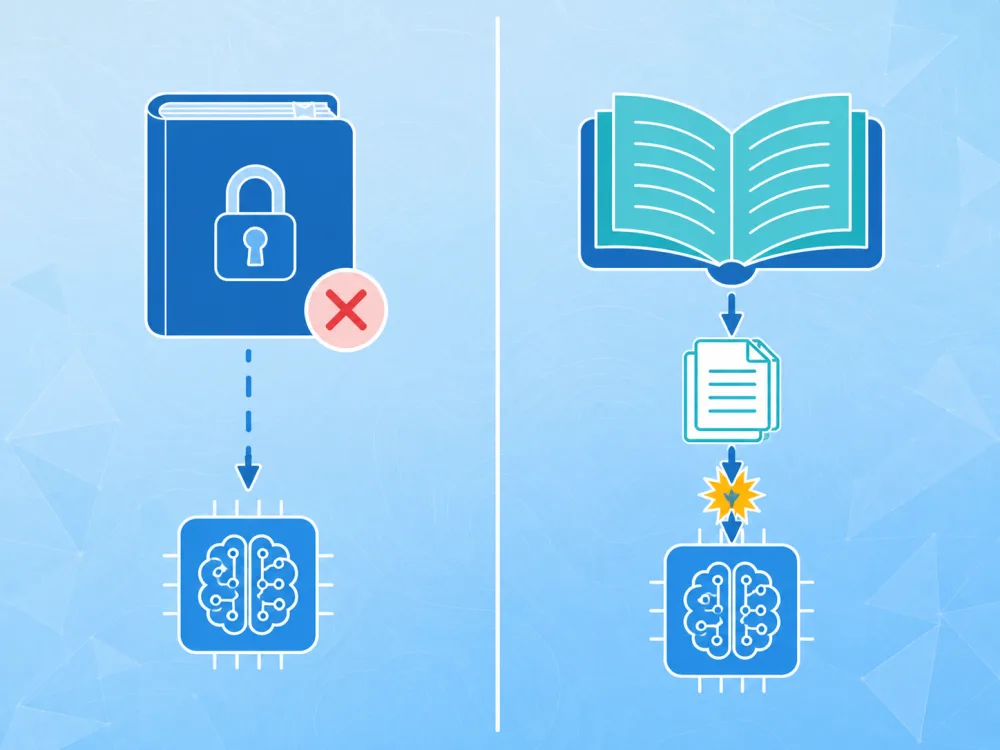
The easiest analogy is an open-book exam. A student taking a closed-book exam must rely entirely on memory — easy to confuse things, easy to make things up. A student allowed to consult their notes can look up the answer before responding — more accurate, with a clear source. RAG transforms an LLM from a closed-book student into an open-book one.
Need data solutions for your business?
AlgoData has helped businesses with data engineering, analytics & AI since 2019.
The problems RAG solves
Before understanding how RAG works, it helps to understand the three pain points it targets.
Hallucination — AI fabricating information
LLMs generate text by predicting the next token based on probabilities. When the model's parameters don't contain enough relevant information, it can still produce a confident-sounding answer that is completely wrong — a phenomenon known as hallucination. In enterprise environments this creates serious risks: incorrect reports, inaccurate legal guidance, or support responses that cause technical failures.
Knowledge cutoff — frozen knowledge
Every LLM has a training cutoff date. After that point, the model knows nothing about new events, regulations, or products. For businesses, internal documents (contracts, policies, product catalogs) change constantly — retraining the model with every update is neither cost-effective nor practical.
Proprietary enterprise knowledge absent from the model
Internal data — technical documentation, customer-service history, business reports — never appears in public training sets. An LLM simply cannot know what it has never read.
RAG architecture, step by step
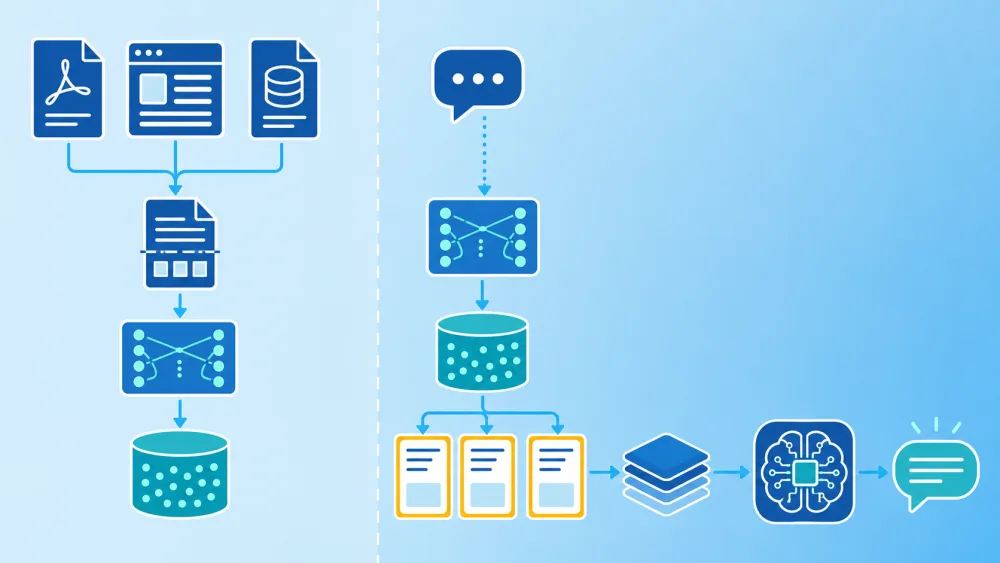
A typical RAG system splits into two phases: indexing (ingesting and indexing documents), which runs offline, and retrieval + generation, which runs online when a user asks a question.
Phase 1 — Indexing (offline)
Step 1: Document loading Documents from multiple sources (PDF, Word, web pages, databases, Confluence, Notion, etc.) are read in and normalized to plain text.
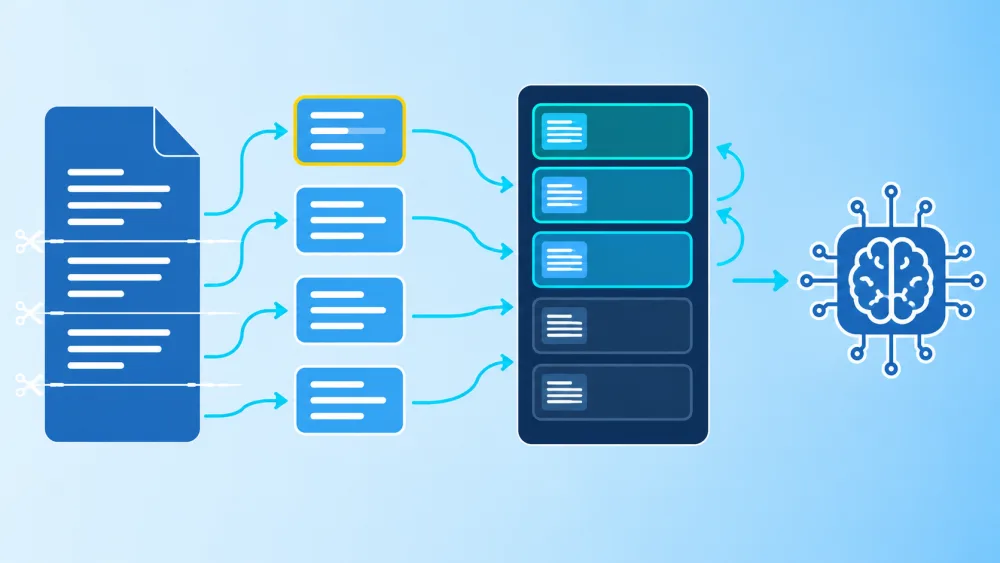
Step 2: Chunking — splitting documents into passages Long documents are divided into smaller segments called chunks. This is the single most important step in RAG — chunks that are too long introduce noise, while chunks that are too short lose context. A common starting point is 256–512 tokens per chunk with a 10–20% overlap to preserve continuity across boundaries.
Step 3: Embedding — generating vectors
Each chunk is passed through an embedding model (e.g., OpenAI's text-embedding-3-large, Google's embedding-001) to produce a high-dimensional vector of real numbers. Passages with similar meaning will have vectors close together in the vector space.
Step 4: Storing in the vector database Each (chunk text, vector) pair is stored in a vector database such as Pinecone, Weaviate, Qdrant, or pgvector — ready to be searched.
Phase 2 — Retrieval + Generation (online)
Step 5: The user's question is embedded When a user asks a question, that question is run through the same embedding model to produce a query vector.
Step 6: Retrieving the top-k chunks
The vector database finds the k chunks whose vectors are closest to the query vector (typically k = 3–10) using cosine similarity or dot product.
Step 7: Context augmentation — injecting chunks into the prompt The retrieved chunks are prepended to the user's question, forming a context-rich prompt.
Step 8: The LLM generates an answer The LLM receives the document-augmented prompt and produces a response — grounded in real sources and verifiable.
 1[Sample prompt]
 2
 3You are a technical support assistant. Answer the question based on the documents below:
 4
 5--- DOCUMENTS ---
 6{chunk_1}
 7{chunk_2}
 8{chunk_3}
 9--- END DOCUMENTS ---
10
11Question: {user_question}
12Answer concisely and accurately. If the documents do not contain enough information, say so clearly.
Embeddings and vector databases — a plain-language explanation
What is an embedding?
Imagine a semantic map: "dog" and "cat" sit close together because both are pets; "bank" (financial institution) and "bank" (riverbank) sit far apart despite being spelled the same. Embedding is the technique of representing text as coordinates on that semantic map — expressed as a vector with thousands of dimensions.
Embedding models are trained on billions of similar sentence pairs to learn how to position vectors: the sentence "The product has a power fault" and "The device won't turn on" will end up near each other even though they share no common words.
What is a vector database?
A vector database is a search engine built specifically for vector data. Unlike SQL, which filters by equality or range conditions, a vector database computes the similarity between a query vector and every vector in the store, then returns the k closest results. Approximate Nearest Neighbor (ANN) algorithms such as HNSW make this search extremely fast even across millions of vectors.
If your infrastructure already runs PostgreSQL, the pgvector extension lets you store and search vectors directly inside Postgres — no separate database to deploy. It is a good fit for prototypes or systems with fewer than a few million vectors.
How to build an effective RAG system
Chunking strategy
Chunking has the greatest single impact on RAG quality. Common strategies include:
- Fixed-size chunking: splits by a fixed token count — simple but can cut sentences mid-thought.
- Sentence / paragraph chunking: splits on sentence or paragraph boundaries — more natural context.
- Recursive chunking: attempts to split on larger boundaries first, falling back to smaller ones only when needed — preserves document structure.
- Semantic chunking: uses embeddings to detect topic shifts automatically and splits at those points — highest quality but more expensive.
Re-ranking — improving top-k quality
The initial vector retrieval step prioritizes speed (ANN) and sometimes returns chunks that are related but not quite precise enough. A re-ranker (such as Cohere Rerank or a cross-encoder) re-reads each (query, chunk) pair and scores them more carefully, reordering the list before it enters the prompt. Re-ranking meaningfully improves precision at the cost of roughly 100–300 ms of additional latency.
Tuning the top-k value
A larger k gives the LLM more context — but also makes the prompt longer, consumes more tokens, and can trigger "lost in the middle" behavior (where the LLM ignores information in the middle of a long prompt). A practical starting point is k = 5, adjusted based on observed answer quality.
RAG vs Fine-tuning — a practical comparison
| Criterion | RAG | Fine-tuning |
|---|---|---|
| Setup cost | Low–medium | High (GPU training) |
| Knowledge updates | Instant (add file to DB) | Requires retraining |
| Domain accuracy | High (specific documents) | High (after sufficient training) |
| Source traceability | Can cite specific chunks | Source is opaque |
| Hallucination risk | Lower | Lower (but different failure mode) |
| Best suited for | Frequently changing documents | Fixed style / tone |
RAG wins decisively on flexibility and source verifiability. Fine-tuning is the better choice when you want the model to learn a distinctive response style or develop deep familiarity with domain-specific terminology.
Real-world applications of RAG
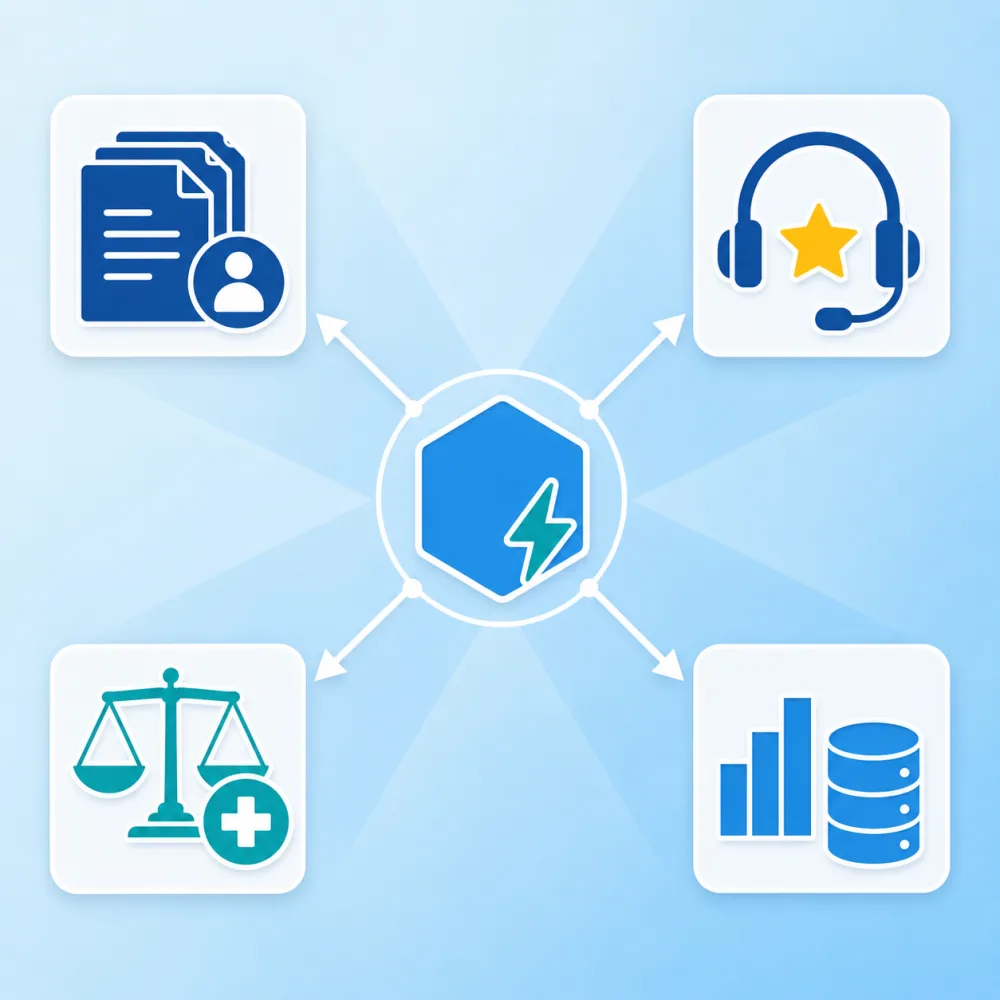
Internal document Q&A chatbot
This is the most common use case: employees can ask directly about company policies, operational procedures, or technical documentation — instead of manually searching through hundreds of files. The system retrieves the right passage and generates a concise, cited answer.
Automated customer support
A customer support chatbot can be loaded with the full FAQ, product catalog, and warranty policies. When a customer reports a specific error, the system finds the correct troubleshooting steps and responds accurately — no need to manually script every possible scenario.
Legal and medical reference
In fields requiring high accuracy, such as law and medicine, RAG lets AI cite specific regulatory texts or clinical treatment protocols — and, crucially, display the source so users can verify the answer themselves.
Enterprise data analysis with RAG
RAG is not limited to static text. Combining it with large-scale data pipelines like Apache Spark to process and refresh corpora in batches, or integrating via API to let the RAG system automatically pull fresh data from multiple sources, are practical deployment patterns in enterprise environments.
Businesses that want to quickly extract insights from internal business reports can use RAG together with an analytics platform like AlgoData — where market and operational data is already organized and ready to feed into a retrieval pipeline.
Limitations of RAG
RAG is not a silver bullet. Several limitations deserve attention:
Output quality depends entirely on the quality of the ingested documents. Garbage in, garbage out — if the source documents are outdated, contradictory, or poorly written, RAG answers will be too.
Synthesis questions are hard. Questions that require aggregating information scattered across many documents, or multi-step reasoning, are difficult to handle with simple top-k retrieval. Advanced RAG variants (multi-hop retrieval, HyDE, query decomposition) have been developed specifically to address this limitation.
Added latency. Every request now requires an extra embedding step for the query, a vector search, and optionally a re-ranking pass before the LLM call. This can add 200–500 ms to the total response time for latency-sensitive systems.
Higher token costs. Longer prompts — filled with retrieved context — mean more tokens consumed per turn, which directly affects cost at scale.
If multiple user groups with different access levels share a RAG system, access control must be enforced at the retrieval layer — filtering chunks by metadata (department, security classification) before returning results. Without this step, sensitive information can leak to users who should not see it.
Conclusion: RAG is the most pragmatic step forward for deploying LLMs in enterprise settings — transforming a powerful but context-blind language model into a genuine assistant that knows how to look things up in the organization's own documents, answer accurately, and point to verifiable sources.
Sources
- Lewis et al. — Retrieval-Augmented Generation for Knowledge-Intensive NLP Tasks (arXiv 2020)
- OpenAI — Embedding models documentation
- LangChain — RAG conceptual guide
- Pinecone — What is a vector database?
- Google — Grounding and RAG in Vertex AI
- Meta AI — FAISS: A Library for Efficient Similarity Search