Oracle Database is the world's leading relational database management system, widely used in enterprises. This article explains what Oracle is, its system architecture, key features, editions, and guidance on choosing the right one.
2019Trusted since
B2BData solutions
Data·AIExpertise
Need data solutions for your business?
AlgoData has helped businesses with data engineering, analytics & AI since 2019.
Oracle is a multi-purpose relational database management system (RDBMS) developed and distributed by Oracle Corporation. It is one of the most popular and reliable database systems in the world, widely used in enterprise applications ranging from human resource management to financial accounting and supply chain management.
Oracle Database provides a powerful platform for storing, managing, and retrieving data efficiently. It supports various data models such as relational, object-relational, and XML, allowing users to store and access both structured and unstructured data flexibly.
One of Oracle's key strengths is its ability to handle large and complex data volumes while ensuring high performance and data consistency. The system also provides many advanced features such as backup and recovery, multi-layered security, and both horizontal and vertical scalability.
History of Oracle Development
Oracle's history began in 1977 when Larry Ellison, Bob Miner, and Ed Oates founded Software Development Laboratories (SDL). Initially, they developed a database for the United States Central Intelligence Agency (CIA) under the code name Project Oracle.
1979: The company was renamed Relational Software Inc. and released the first commercial version of Oracle, Oracle V2 — the first SQL database on the market.
1982: The company was renamed Oracle Corporation, after its flagship product.
1983: Oracle released version 3, rewritten in C to support multiple platforms.
1984: Oracle version 4 was launched with read consistency and transaction support features.
1985: Oracle version 5 was introduced, supporting client-server and distributed models.
1988: Oracle version 6 was released with row-level locking and hot backup features.
1992: Oracle7 was released with many performance and management improvements.
1997: Oracle8 was launched, supporting object-relational and Internet computing.
1999: Oracle8i was introduced, focusing on Internet and Java.
2001: Oracle9i was released with the Real Application Clusters (RAC) feature.
2003: Oracle Database 10g was released, introducing the grid computing concept.
2007: Oracle Database 11g was launched with numerous management and performance improvements.
2013: Oracle Database 12c was introduced, supporting multitenant architecture and in-memory.
2019: Oracle Database 19c was released, considered the long-term version of the 12c Release 2 line.
2021: Oracle Database 21c was released with many new features such as Blockchain Tables and JSON relational duality.
Over more than 40 years of development, Oracle has continuously improved and expanded its system capabilities, evolving from a simple database into a comprehensive platform for enterprise data, including cloud and artificial intelligence solutions.
Oracle Database Architecture
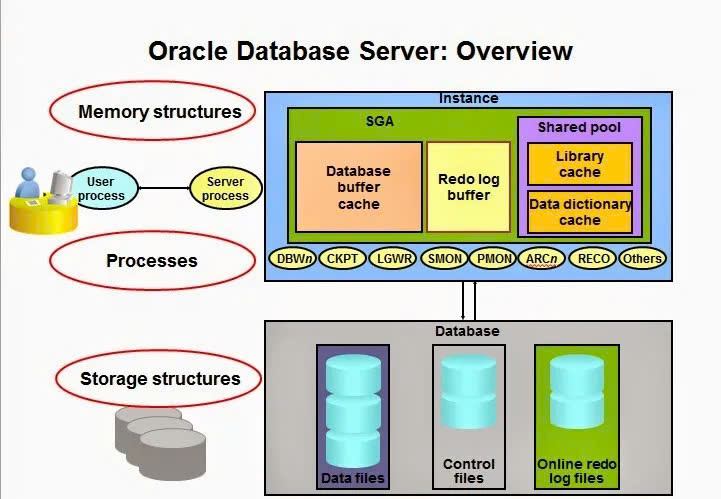
Oracle Database architecture is a sophisticated system designed to ensure high performance, availability, and security. Below is an overview of the main components in Oracle architecture:
Instance: This is the collection of memory structures and background processes required to access the database. Each instance corresponds to one database and includes:
System Global Area (SGA): A shared memory area containing data and control information.
Program Global Area (PGA): Private memory for each server process.
Background Processes: Background processes that perform I/O tasks and maintain the database.
Database: Consists of physical files that store actual data. The main components include:
Data Files: Contain actual data of database objects such as tables and indexes.
Control Files: Store information about the physical structure of the database.
Redo Log Files: Record all changes made to the data.
Logical Structures:
Tablespaces: The largest logical unit of storage in Oracle.
Segments: Database objects such as tables or indexes.
Extents: Contiguous blocks of space allocated to segments.
Data Blocks: The smallest unit of I/O in Oracle.
Memory Structures:
Database Buffer Cache: Stores recently accessed data blocks.
Redo Log Buffer: Temporarily stores redo log information before writing to disk.
Shared Pool: Contains parsed SQL statements and data dictionary data.
Process Structures:
User Processes: Connect users to the Oracle instance.
Server Processes: Perform work for user processes.
Background Processes: Perform maintenance and I/O tasks.
This architecture allows Oracle Database to efficiently handle concurrent transactions, ensure data consistency, and provide robust recovery capabilities. It also supports advanced features like Real Application Clusters (RAC) for scalability and high availability.
Key Features and Options of Oracle Database
Oracle Database provides a wide range of powerful features and options, making it one of the most comprehensive database management systems on the market. Here are some key features:
Performance and Scalability
Oracle Database is renowned for its ability to handle large data volumes and ensure high performance.
In-Memory Option: Allows data to be stored in memory in columnar format, significantly increasing analytical query speed.
Partitioning: Divides large tables and indexes into smaller segments, improving performance and manageability.
Real Application Clusters (RAC): Allows multiple Oracle instances to run simultaneously on multiple nodes, supporting horizontal scaling.
Parallel Execution: Breaks large tasks into smaller parts for concurrent processing.
Data protection is every enterprise's top priority. Oracle provides robust solutions to keep your data safe:
Recovery Manager (RMAN): An integrated tool for backup, recovery, and archive data management.
Flashback Technology: Allows viewing and recovering data at a point in the past without restoring from a backup.
Data Guard: Provides disaster recovery and high availability solutions through maintaining standby databases.
Zero Data Loss Recovery Appliance: A dedicated appliance for backup and recovery with maximum data protection.
Availability and Support
Oracle is committed to providing continuous service and comprehensive support. Here are the key features in this area:
Online Operations: Allows many maintenance tasks to be performed without disconnecting users.
Edition-Based Redefinition: Supports application upgrades with minimal downtime.
Application Continuity: Automatically recovers sessions and transactions after failures without application intervention.
Global Data Services: Load balances and routes requests across multiple databases globally.
Information Security
In the digital age, data security is critical. Oracle provides multiple layers of protection:
Transparent Data Encryption: Automatically encrypts data without requiring application changes.
Data Redaction: Masks sensitive data in query results.
Virtual Private Database: Controls access at the row level based on security policies.
Database Vault: Prevents unauthorized access to sensitive data, even from database administrators.
Audit Vault: Centralizes audit log collection and analysis.
Information Integration
Oracle not only stores data but also integrates and processes various types of information:
XML DB: Supports efficient XML data storage and processing.
JSON Support: Stores and queries JSON data natively.
Spatial and Graph: Supports storage, querying, and analysis of spatial and graph data.
Text: Provides advanced text search and analysis capabilities.
OLAP: Integrates online analytical processing capabilities for business applications.
Simple Management
Despite its power, Oracle is easy to manage thanks to these tools and features:
Enterprise Manager: A comprehensive management tool for the entire Oracle stack.
Automatic Workload Repository (AWR): Collects and stores performance statistics for analysis and reporting.
Automatic Database Diagnostic Monitor (ADDM): Analyzes AWR data to provide performance recommendations.
SQL Tuning Advisor: Automatically analyzes and optimizes SQL statements.
Database Resource Manager: Manages resources to ensure quality of service for different user groups.
These features make Oracle Database a comprehensive solution capable of meeting the needs of businesses from small to large, across many different industries.
Like every technology, Oracle has its own strengths and limitations. Let's evaluate objectively:
Advantages of Oracle
High Performance: Oracle is optimized to handle large data volumes and complex transactions efficiently.
Reliability: With features like RAC and Data Guard, Oracle provides high reliability and availability.
Strong Security: Oracle provides multiple layers of security, including encryption, access control, and auditing.
Scalability: Oracle can scale both horizontally and vertically to meet growing demands.
Rich Features: Oracle provides a wide range of advanced features for data analytics, transaction processing, and data management.
Multi-Platform Support: Oracle can run on many different operating systems and hardware.
Good Integration: Oracle integrates well with many enterprise applications and other technologies.
Disadvantages of Oracle
High Cost: Oracle typically has higher licensing and maintenance costs compared to some other database solutions.
Complex Management: Due to its many advanced features, Oracle can require significant skills and experience to manage effectively.
Large Resource Requirements: Oracle can demand powerful hardware for optimal performance, especially for large-scale deployments.
Steep Learning Curve: Mastering Oracle can take considerable time and effort due to its complexity.
Vendor Lock-In: Using Oracle can lead to dependence on a single vendor for the enterprise's critical database.
Why Should You Choose Oracle Software?
Oracle Database stands out as a top choice for enterprises for many important reasons:
Superior Performance
Oracle Database is specially designed to handle massive data volumes and complex transactions with high performance. In-Memory Column Store technology enables real-time data analytics, while Exadata provides a hardware-software optimized platform for maximum performance. The Parallel Execution feature breaks large tasks into smaller parts for concurrent processing, significantly reducing processing time for demanding workloads.
Powerful Multi-User Capability
With the ability to support thousands of concurrent users, Oracle is the ideal choice for large-scale enterprise applications. The advanced lock and transaction management system ensures data consistency even in environments where many users are updating simultaneously.
Diverse Editions to Choose From
Oracle offers various editions, from the free Express Edition to the fully-featured Enterprise Edition, allowing organizations to choose the solution that best fits their needs and budget. This makes Oracle suitable for both small businesses and multinational corporations.
Real Application Clusters (RAC) Technology
RAC is a unique feature that allows multiple Oracle instances to run simultaneously on multiple servers, sharing the same database. This not only provides horizontal scalability but also ensures high availability, helping maintain continuous business operations even during hardware failures.
Comprehensive Backup and Recovery Solutions
Oracle's Recovery Manager (RMAN) provides a powerful backup and recovery solution, automating many complex tasks. RMAN supports incremental backups, data compression, and point-in-time recovery, helping protect critical enterprise data from loss and ensuring rapid recovery after incidents.
Benefits of Using Oracle Software
Choosing Oracle Database brings many significant benefits to enterprises:
Comprehensive Enterprise Support
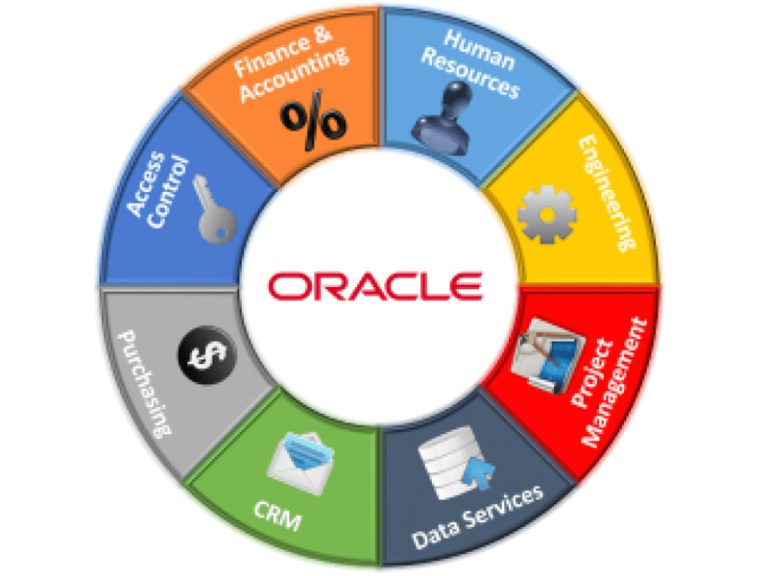
Oracle is not just a database but also provides a comprehensive solution ecosystem for many industries and business processes. From human resource management to supply chain, Oracle has integrated applications that help enterprises optimize their operations on a unified platform.
Intelligent Automation
Oracle integrates many advanced automation features such as automatic memory management, automatic SQL tuning, and automatic statistics collection. These features not only reduce the administrative burden but also continuously optimize database performance, allowing administrators to focus on more strategic tasks.
Advanced Multi-Layered Security
In an era where data security is the top priority, Oracle provides a range of multi-layered security features. From transparent encryption to detailed access control and continuous monitoring, Oracle helps protect sensitive data from internal and external threats while ensuring compliance with data security regulations.
Flexible Deployment
Oracle can be deployed on many different platforms, from traditional physical servers to virtualized and cloud environments. This capability allows enterprises to be flexible in choosing the deployment model that best fits their IT strategy while facilitating gradual cloud migration.
With integrated tools like Oracle Analytics, enterprises can easily access, analyze, and visualize their data. This capability enables fast and accurate data-driven business decisions, thereby enhancing competitive advantage in the market.
Driving Innovation
Oracle provides a comprehensive set of application development tools and frameworks, enabling developers to build powerful and scalable applications. From traditional development tools to support for new technologies like blockchain and artificial intelligence, Oracle facilitates enterprise innovation and adaptation to new technology trends.
Diverse Data Support
Oracle supports many different types of data, from traditional structured data to unstructured data such as JSON, XML, and spatial data. This capability allows enterprises to leverage all their data sources, creating a comprehensive view of business operations and customers.
Long-Term Cost Optimization
Although initial costs may be high, Oracle's automation features and high performance can lead to significant long-term cost savings. By reducing administrative needs, increasing operational efficiency, and improving uptime, Oracle can deliver significant value to enterprises, especially for mission-critical applications requiring high reliability and performance.
Overview of Oracle Software Editions
Oracle offers various editions to meet diverse customer needs:
Oracle Database Standard Edition 2 (SE2): Suitable for small and medium businesses, providing basic features at a lower cost.
Oracle Database Enterprise Edition (EE): The fully-featured edition, suitable for large enterprises and demanding applications.
Oracle Database Express Edition (XE): A free edition with limited resources, suitable for learning and development.
Oracle Database Personal Edition: Designed for individual developers, providing most Enterprise Edition features.
Oracle Database Cloud Service: Provides Oracle Database as a cloud service, enabling flexible deployment and easy management.
Oracle Exadata Database Machine: An integrated hardware and software solution, optimized for maximum performance.
Oracle Autonomous Database: A self-managing, self-securing, and self-repairing database based on cloud technology.
Frequently Asked Questions About Oracle Software
What is Logical Backup in Oracle?
Logical backup in Oracle is the process of copying data at the logical level (such as tables, schemas) rather than copying all physical data files. This method allows selective backup and is commonly used to migrate data between databases or to create copies of a portion of the data.
How Many Background Processes Does Oracle Have?
Oracle uses many background processes to manage and maintain the database. The number and types of background processes can vary depending on the Oracle version and configuration, but some key background processes include:
PMON (Process Monitor)
SMON (System Monitor)
DBWR (Database Writer)
LGWR (Log Writer)
CKPT (Checkpoint)
ARCH (Archiver)
RECO (Recoverer)
Each of these processes has its own role in ensuring stable and efficient database operations.
What Are the Versions of Oracle Software?
Oracle regularly releases new versions of the Database with new features and improvements. Some recent versions include:
Oracle Database 12c (12.1 and 12.2)
Oracle Database 18c
Oracle Database 19c
Oracle Database 21c
Oracle Database 23c
Each version brings performance improvements, security enhancements, and new features to meet the growing needs of users and enterprises.
{{< test-result
title="Comparison of Oracle Database Editions"
headers="Edition|Target Audience|Features|Cost"
rows="Express (XE)|Learning, Development|Basic, limited resources|Free;Standard Edition 2|Small and Medium Businesses|Full basic features|Medium;Enterprise Edition|Large Enterprises|Full + RAC, Data Guard, In-Memory|High;Autonomous Database|All scales|Self-managing, self-securing, cloud|Pay-per-use"
/>}}
Note
Oracle Database is the most powerful enterprise DBMS, with the ability to handle large data, multi-layered security, and high availability through RAC and Data Guard. Choose the right edition based on your scale and budget.
Conclusion: Oracle Database is the world's leading database solution with over 40 years of development. From the free Express Edition to Autonomous Database on the cloud, Oracle meets all enterprise needs. Its robust architecture, rich features, and multi-layered security make Oracle a trusted choice for mission-critical systems.