Luật AI tại Việt Nam là gì? Khung pháp lý cho trí tuệ nhân tạo (cập nhật 2026)
Trí tuệ nhân tạo

Luật AI tại Việt Nam là gì? Khung pháp lý cho trí tuệ nhân tạo (cập nhật 2026)

Tổng quan khung pháp lý AI Việt Nam 2026: Luật 134/2025/QH15, Luật 71/2025, bảo vệ dữ liệu, phân loại rủi ro và nghĩa vụ dán nhãn hệ thống AI.

Trong series: Trí tuệ nhân tạo
  1. 1 Vector Database Là Gì? Nền Tảng Của AI Tìm Kiếm Ngữ Nghĩa
  2. 2 Recommendation System Là Gì? Cách TikTok Và Shopee Gợi Ý Sản Phẩm
  3. 3 AI Agent là gì? Tác nhân AI tự động hóa công việc như thế nào?
  4. 4 Deepfake Là Gì? Cách Phát Hiện và Bảo Vệ Bản Thân
  5. 5 Prompt Engineering là gì? Nghệ thuật ra lệnh cho AI hiệu quả
  6. 6 Fine-tuning Là Gì? Tùy Chỉnh AI Model Cho Doanh Nghiệp
  7. 7 RAG là gì? Retrieval-Augmented Generation — khi AI biết tra cứu tài liệu
  8. 8 Luật AI tại Việt Nam là gì? Khung pháp lý cho trí tuệ nhân tạo (cập nhật 2026)
✦ Tóm tắt nhanh
Tổng quan khung pháp lý AI Việt Nam 2026: Luật 134/2025/QH15, Luật 71/2025, bảo vệ dữ liệu, phân loại rủi ro và nghĩa vụ dán nhãn hệ thống AI.
Bài này thế nào?

Năm 2025–2026 đánh dấu bước ngoặt pháp lý lớn nhất cho trí tuệ nhân tạo tại Việt Nam: lần đầu tiên một đạo luật chuyên biệt về AI được ban hành, song song với hàng loạt văn bản liên quan từ bảo vệ dữ liệu đến công nghiệp số. Đối với doanh nghiệp và lập trình viên đang xây dựng sản phẩm AI, hiểu rõ khung pháp lý này không còn là lợi thế — mà là bắt buộc.

Việt Nam đã có luật riêng về AI chưa?

Câu trả lời ngắn gọn: Có — và khung pháp lý này vừa được hoàn thiện đáng kể trong năm 2025–2026.

Ngày 10/12/2025, Quốc hội Việt Nam thông qua Luật Trí tuệ nhân tạo số 134/2025/QH15 — đạo luật AI chuyên biệt đầu tiên của cả nước, có hiệu lực từ 01/03/2026. Đây không phải điều chỉnh nhỏ trong một văn bản lớn hơn; đây là luật riêng dành toàn bộ nội dung cho AI, từ định nghĩa, phân loại rủi ro đến trách nhiệm pháp lý và nghĩa vụ của bên triển khai.

Song song đó, Luật Công nghiệp công nghệ số 71/2025/QH15 (hiệu lực từ 01/01/2026) cũng dành riêng một chương quy định hệ thống AI trong bối cảnh công nghiệp số rộng hơn — bao gồm bán dẫn và tài sản số. Hai luật này không loại trừ nhau; chúng cùng tạo thành trụ cột pháp lý cho AI tại Việt Nam.

Ngoài hai luật cốt lõi, khung pháp lý AI còn được bổ trợ bởi: Luật Bảo vệ dữ liệu cá nhân 91/2025/QH15 (hiệu lực 01/01/2026), Luật An ninh mạng 24/2018/QH14, Luật Giao dịch điện tử 20/2023/QH15, và các văn bản chính sách như Chiến lược quốc gia AI đến năm 2030 (QĐ 127/QĐ-TTg).

Hai luật AI song song — Cần phân biệt điều gì?

Việt Nam hiện có hai văn bản luật trực tiếp điều chỉnh AI, và sự khác biệt giữa chúng quan trọng với bất kỳ ai xây dựng sản phẩm hoặc triển khai hệ thống AI:

Luật 71/2025/QH15 — Luật Công nghiệp công nghệ số là luật đa lĩnh vực. Chương về AI trong luật này định nghĩa "hệ thống trí tuệ nhân tạo", đặt ra nguyên tắc phát triển và sử dụng, quy định về dán nhãn sản phẩm AI, và phân nhóm rủi ro cao. Định nghĩa tại Khoản 9 Điều 3 tiếp cận theo hướng kỹ thuật:

"Hệ thống dựa trên máy móc, được thiết kế để hoạt động với các mức độ tự chủ khác nhau, có khả năng thích ứng sau khi triển khai nhằm đạt được những mục tiêu rõ ràng hoặc ngầm định"

Nguồn: Luật Công nghiệp công nghệ số 71/2025/QH15, Khoản 9 Điều 3

Luật 134/2025/QH15 — Luật Trí tuệ nhân tạo là luật chuyên biệt. Toàn bộ nội dung tập trung vào AI, từ định nghĩa tổng quát hơn đến hệ thống phân loại rủi ro 3 cấp, quy tắc trách nhiệm bồi thường, và các nguyên tắc cơ bản. Điều 2 định nghĩa:

"Trí tuệ nhân tạo là việc thực hiện bằng điện tử các năng lực trí tuệ của con người, bao gồm học tập, suy luận, nhận thức, phán đoán và hiểu ngôn ngữ tự nhiên."

Nguồn: Luật Trí tuệ nhân tạo 134/2025/QH15, Điều 2

Theo nguyên tắc pháp lý, luật chuyên biệt ưu tiên áp dụng khi hai văn bản có quy định khác nhau về cùng một vấn đề. Tuy nhiên vì đây là vùng pháp lý còn rất mới, việc áp dụng cụ thể trong từng tình huống cần luật sư chuyên ngành xác nhận.

Các nguyên tắc cơ bản của Luật AI 134/2025/QH15

Điều 4 Luật 134/2025/QH15 đặt ra bốn nguyên tắc cơ bản có tính ràng buộc pháp lý:

Khoản 1 — Lấy con người làm trung tâm:

"Lấy con người làm trung tâm; bảo đảm quyền con người, quyền riêng tư, lợi ích quốc gia, lợi ích công cộng và an ninh quốc gia; tuân thủ Hiến pháp và pháp luật."

Nguồn: Luật Trí tuệ nhân tạo 134/2025/QH15, Điều 4 Khoản 1

Khoản 2 — AI phục vụ con người, không thay thế quyền con người:

"Trí tuệ nhân tạo phục vụ con người, không thay thế thẩm quyền và trách nhiệm của con người. Bảo đảm duy trì sự kiểm soát và khả năng can thiệp của con người đối với mọi quyết định và hành vi của hệ thống trí tuệ nhân tạo; an toàn hệ thống, an ninh dữ liệu và bảo mật thông tin; khả năng kiểm tra và giám sát quá trình phát triển và vận hành hệ thống trí tuệ nhân tạo."

Nguồn: Luật Trí tuệ nhân tạo 134/2025/QH15, Điều 4 Khoản 2

Khoản 3 — Công bằng, minh bạch, đạo đức:

"Bảo đảm công bằng, minh bạch, không thiên lệch, không phân biệt đối xử và không gây hại cho con người hoặc xã hội; tuân thủ chuẩn mực đạo đức và giá trị văn hóa Việt Nam; thực hiện trách nhiệm giải trình về các quyết định và hệ quả của hệ thống trí tuệ nhân tạo."

Nguồn: Luật Trí tuệ nhân tạo 134/2025/QH15, Điều 4 Khoản 3

Khoản 4 — AI xanh, bền vững:

"Thúc đẩy phát triển trí tuệ nhân tạo xanh, bao trùm và bền vững; khuyến khích phát triển và ứng dụng các công nghệ trí tuệ nhân tạo theo hướng sử dụng hiệu quả năng lượng, tiết kiệm tài nguyên và giảm tác động tiêu cực đến môi trường."

Nguồn: Luật Trí tuệ nhân tạo 134/2025/QH15, Điều 4 Khoản 4

Khoản 4 đặc biệt đáng chú ý: Việt Nam là một trong số ít quốc gia luật hóa rõ ràng yêu cầu phát triển AI xanh ngay trong nguyên tắc cơ bản, phản ánh định hướng phát triển bền vững trong bối cảnh AI tiêu thụ năng lượng ngày càng lớn.

Phân loại rủi ro và nghĩa vụ dán nhãn

Hệ thống phân loại rủi ro

Luật 134/2025/QH15 phân loại hệ thống AI thành 3 cấp độ rủi ro: thấp, trung bình và cao. Theo tinh thần Điều 9, hệ thống AI rủi ro cao là những hệ thống có thể gây thiệt hại đáng kể đến tính mạng, sức khỏe, quyền và lợi ích hợp pháp — ví dụ điển hình gồm AI trong y tế, tư pháp, tín dụng, hay giám sát hàng loạt.

Luật 71/2025/QH15 (Điều 43) cũng xác định nhóm rủi ro cao là các hệ thống:

"Có khả năng gây rủi ro hoặc tổn hại nghiêm trọng đến sức khỏe con người, quyền con người, quyền công dân, lợi ích công cộng và trật tự an toàn xã hội"

Nguồn: Luật Công nghiệp công nghệ số 71/2025/QH15, Điều 43

Nghĩa vụ dán nhãn và thông báo (Điều 44, Luật 71/2025/QH15)

Hai nghĩa vụ quan trọng áp dụng ngay từ khi hệ thống AI được triển khai:

Thứ nhất — Thông báo tương tác AI:

"Hệ thống trí tuệ nhân tạo tương tác trực tiếp với con người phải có thông báo cho người sử dụng biết việc đang tương tác với hệ thống trí tuệ nhân tạo, trừ trường hợp người sử dụng hiển nhiên biết"

Nguồn: Luật Công nghiệp công nghệ số 71/2025/QH15, Điều 44 Khoản 1

Thứ hai — Dán nhãn sản phẩm AI:

"Sản phẩm công nghệ số thuộc Danh mục sản phẩm công nghệ số tạo ra bởi trí tuệ nhân tạo phải có dấu hiệu nhận dạng để người sử dụng hoặc máy nhận biết"

Nguồn: Luật Công nghiệp công nghệ số 71/2025/QH15, Điều 44 Khoản 2

Điều này có nghĩa: chatbot, trợ lý ảo, công cụ tạo ảnh hay viết nội dung AI đều cần tuân thủ yêu cầu minh bạch này. Danh mục sản phẩm cụ thể thuộc diện bắt buộc dán nhãn do Bộ chủ quản quy định chi tiết.

Trách nhiệm bồi thường — Strict Liability

Một điểm đặc biệt trong Luật 134/2025/QH15 là cơ chế trách nhiệm nghiêm ngặt. Theo Điều 29 Khoản 2:

"Hệ thống trí tuệ nhân tạo có rủi ro cao được quản lý, vận hành đúng quy định nhưng vẫn phát sinh thiệt hại thì bên triển khai phải chịu trách nhiệm bồi thường"

Nguồn: Luật Trí tuệ nhân tạo 134/2025/QH15, Điều 29 Khoản 2

Khác với trách nhiệm dân sự thông thường đòi hỏi chứng minh lỗi, đây là strict liability: doanh nghiệp triển khai AI rủi ro cao chịu trách nhiệm bồi thường kể cả khi đã tuân thủ đầy đủ quy trình. Điều này tạo ra áp lực lớn để đầu tư vào kiểm thử, giám sát và tài liệu hóa hệ thống AI trước khi ra mắt.

Dòng thời gian các văn bản pháp lý chính

Tên văn bản Số hiệu Hiệu lực Nội dung chính
Luật An ninh mạng 24/2018/QH14 01/01/2019 Yêu cầu lưu trữ dữ liệu người dùng Việt Nam tại Việt Nam; áp dụng cho mọi dịch vụ số có thu thập dữ liệu
Chiến lược quốc gia AI đến 2030 QĐ 127/QĐ-TTg 26/01/2021 Định hướng chính sách phát triển và ứng dụng AI quốc gia (không phải luật ràng buộc)
Luật Giao dịch điện tử 20/2023/QH15 01/07/2024 Nền tảng pháp lý cho giao dịch số, hợp đồng điện tử, chữ ký số
9 nguyên tắc AI có trách nhiệm QĐ 1290/QĐ-BKHCN 11/06/2024 Hướng dẫn khuyến nghị (không ràng buộc bắt buộc) về phát triển AI đạo đức
Luật Công nghiệp công nghệ số 71/2025/QH15 01/01/2026 Định nghĩa hệ thống AI, nguyên tắc phát triển, phân loại rủi ro cao, nghĩa vụ dán nhãn và thông báo tương tác AI
Luật Bảo vệ dữ liệu cá nhân 91/2025/QH15 01/01/2026 Luật BVDLCN độc lập, thay thế Nghị định 13/2023; áp dụng cho xử lý dữ liệu trong hệ thống AI
Luật Trí tuệ nhân tạo 134/2025/QH15 01/03/2026 Luật AI chuyên biệt đầu tiên: định nghĩa AI, 4 nguyên tắc cơ bản, phân loại rủi ro 3 cấp, trách nhiệm bồi thường, giám sát
Khung đạo đức AI quốc gia TT 05/2026/TT-BKHCN 10/03/2026 Áp dụng cho cơ quan nhà nước và dịch vụ công; 4 nguyên tắc: an toàn, nhân quyền, phát triển bền vững, đổi mới có trách nhiệm

Bảo vệ dữ liệu cá nhân trong bối cảnh AI

Hệ thống AI hầu như luôn xử lý dữ liệu cá nhân — từ nhận diện khuôn mặt đến phân tích hành vi người dùng. Đây là điểm giao thoa giữa luật AI và luật bảo vệ dữ liệu.

Luật 91/2025/QH15 (Luật Bảo vệ dữ liệu cá nhân, hiệu lực 01/01/2026) đặt ra khung pháp lý toàn diện cho việc thu thập và xử lý dữ liệu cá nhân — bao gồm trong các hệ thống AI. Luật này kế thừa và nâng cấp các nguyên tắc từ Nghị định 13/2023/NĐ-CP (đã hết hiệu lực từ 01/01/2026). Để hiểu thêm về giao điểm giữa AI và quyền riêng tư, xem thêm bài Sentiment Analysis là gì và cách các hệ thống phân tích dữ liệu người dùng hoạt động.

Ngoài ra, Luật An ninh mạng 24/2018/QH14 (Khoản 3 Điều 26) đặt ra yêu cầu lưu trữ dữ liệu trực tiếp ảnh hưởng đến hạ tầng AI:

"Doanh nghiệp trong nước và ngoài nước cung cấp dịch vụ trên mạng viễn thông, mạng Internet, các dịch vụ giá trị gia tăng trên không gian mạng tại Việt Nam có hoạt động thu thập, khai thác, phân tích, xử lý dữ liệu về thông tin cá nhân, dữ liệu về mối quan hệ của người dùng dịch vụ, dữ liệu do người dùng dịch vụ tại Việt Nam tạo ra phải lưu trữ dữ liệu này tại Việt Nam theo quy định của Chính phủ."

Nguồn: Luật An ninh mạng 24/2018/QH14, Khoản 3 Điều 26

Điều này có nghĩa các doanh nghiệp AI — kể cả công ty nước ngoài — cung cấp dịch vụ tại Việt Nam và xử lý dữ liệu người dùng Việt Nam phải lưu trữ dữ liệu đó tại Việt Nam. Yêu cầu này ảnh hưởng trực tiếp đến quyết định kiến trúc hệ thống, đặc biệt với các mô hình AI đám mây.

Văn bản chính sách và đạo đức — Không ràng buộc nhưng có ý nghĩa

Bên cạnh các luật có tính ràng buộc pháp lý, một số văn bản định hướng quan trọng không có tính bắt buộc nhưng phản ánh xu hướng quản lý:

Quyết định 1290/QĐ-BKHCN (11/06/2024) do Bộ KH,CN&ĐMST ban hành hướng dẫn 9 nguyên tắc phát triển AI có trách nhiệm, bao gồm: tinh thần hợp tác và đổi mới sáng tạo, tính minh bạch, khả năng kiểm soát, an toàn, bảo mật, quyền riêng tư, tôn trọng quyền và phẩm giá con người, hỗ trợ người dùng, và trách nhiệm giải trình. Đây là hướng dẫn khuyến nghị — không có tính ràng buộc pháp lý bắt buộc.

Thông tư 05/2026/TT-BKHCN (có hiệu lực từ 10/03/2026) ban hành Khung đạo đức AI quốc gia, áp dụng cho cơ quan nhà nước và dịch vụ công, với 4 nguyên tắc cốt lõi: an toàn, nhân quyền, phát triển bền vững, và đổi mới có trách nhiệm.
So sánh ngắn với EU AI Act

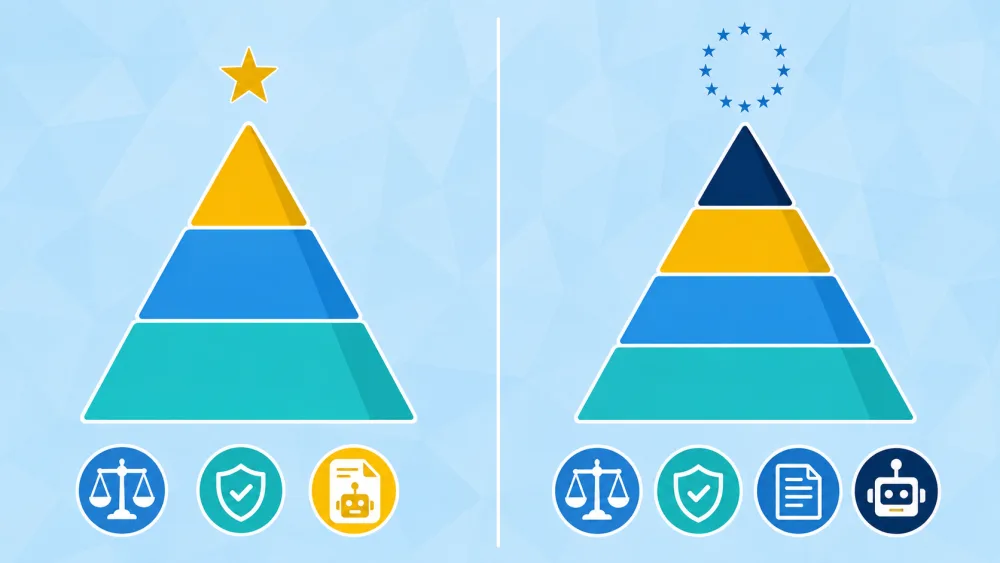
Để có bối cảnh quốc tế, đáng so sánh với EU AI Act — đạo luật AI của Liên minh châu Âu (chính thức có hiệu lực từ 01/08/2024, áp dụng đầy đủ từ 02/08/2026). Đây là luật nước ngoài, không áp dụng tại Việt Nam, nhưng có ảnh hưởng với doanh nghiệp Việt Nam hoạt động tại EU hoặc cung cấp dịch vụ cho người dùng EU. Thông tin đầy đủ tại trang chính thức của EU.

Tiêu chí Luật AI Việt Nam (134/2025/QH15) EU AI Act
Hiệu lực 01/03/2026 01/08/2024 (áp dụng đầy đủ 08/2026)
Phân loại rủi ro 3 cấp: thấp / trung bình / cao 4 cấp: không chấp nhận được / cao / hạn chế / tối thiểu
Trách nhiệm bồi thường AI rủi ro cao Strict liability (không cần chứng minh lỗi) Cơ chế trách nhiệm được xử lý qua AI Liability Directive riêng biệt
Cấm tuyệt đối Chưa có danh mục cấm tuyệt đối được nêu rõ (chờ văn bản hướng dẫn) Cấm một số ứng dụng (chấm điểm xã hội, nhận dạng sinh trắc học thời gian thực nơi công cộng...)
Phạm vi địa lý Áp dụng cho hoạt động tại Việt Nam Áp dụng cho thị trường EU, bất kể nhà cung cấp ở đâu

Điểm tương đồng đáng chú ý: cả hai đều lấy con người làm trung tâm, yêu cầu minh bạch và kiểm soát rủi ro theo vòng đời hệ thống. Điểm khác biệt lớn: EU AI Act chi tiết hơn về danh sách ứng dụng bị cấm và yêu cầu kỹ thuật cụ thể, trong khi luật Việt Nam đang trong giai đoạn triển khai đầu — nhiều nghị định hướng dẫn chi tiết có thể chưa được ban hành đồng bộ.

Nếu bạn muốn tìm hiểu thêm về bối cảnh kỹ thuật, xem thêm bài Generative AI là gìAI Agent là gì.

Những điểm cần lưu ý khi triển khai AI tại Việt Nam

Từ khung pháp lý trên, doanh nghiệp và lập trình viên triển khai AI cần chú ý một số điểm thực tiễn:

1. Đánh giá cấp độ rủi ro ngay từ bước thiết kế. Luật 134/2025/QH15 phân 3 cấp — xác định hệ thống của bạn ở cấp nào sẽ quyết định mức độ nghĩa vụ pháp lý.

2. Tuân thủ nghĩa vụ minh bạch. Chatbot, trợ lý ảo và công cụ AI tương tác người dùng phải thông báo rõ ràng. Nội dung tạo ra bởi AI (ảnh, văn bản, video) cần có dấu hiệu nhận dạng.

3. Hạ tầng dữ liệu phải ở Việt Nam. Nếu xử lý dữ liệu người dùng Việt Nam, yêu cầu lưu trữ trong nước theo Luật An ninh mạng áp dụng cho cả doanh nghiệp nước ngoài.

4. Chuẩn bị cho strict liability. Hệ thống AI rủi ro cao cần tài liệu hóa kỹ quy trình quản lý, kiểm thử và giám sát — không phải để tránh trách nhiệm (vì là strict liability), mà để quản lý rủi ro và bảo hiểm.

5. Theo dõi văn bản hướng dẫn. Các luật 71 và 134 đều còn rất mới; nhiều nghị định hướng dẫn chi tiết có thể chưa được ban hành. Danh mục sản phẩm AI phải dán nhãn, tiêu chí phân loại rủi ro cụ thể — đây là những chi tiết cần theo dõi sát.

Miễn trừ trách nhiệm

Thông tin mang tính tham khảo, không thay thế tư vấn pháp lý; văn bản pháp luật có thể thay đổi — vui lòng đối chiếu nguồn chính thống và xem mục cập nhật.

Kết luận: Việt Nam đã xây dựng một khung pháp lý AI tương đối toàn diện trong vòng chưa đầy hai năm — từ chiến lược quốc gia đến luật chuyên biệt. Luật Trí tuệ nhân tạo 134/2025/QH15 đặt nền móng quan trọng với định nghĩa rõ ràng, phân loại rủi ro 3 cấp, và cơ chế trách nhiệm nghiêm ngặt. Doanh nghiệp xây dựng và triển khai AI tại Việt Nam cần nắm rõ hai trụ cột chính — Luật 134 và Luật 71 — cùng các yêu cầu bảo vệ dữ liệu và an ninh mạng song hành. Trong giai đoạn văn bản hướng dẫn chi tiết còn đang được hoàn thiện, việc theo dõi liên tục và tham vấn pháp lý chuyên ngành là cần thiết.

Nguồn tham khảo

Câu hỏi thường gặp

Câu hỏi thường gặpQ&A
Việt Nam đã có luật chuyên biệt về AI chưa?
Có. Luật Trí tuệ nhân tạo số 134/2025/QH15 được Quốc hội thông qua ngày 10/12/2025, có hiệu lực từ 01/03/2026 — đây là đạo luật AI chuyên biệt đầu tiên của Việt Nam. Song song đó, Luật Công nghiệp công nghệ số 71/2025/QH15 (hiệu lực từ 01/01/2026) cũng dành một chương riêng quy định về hệ thống AI.
Hệ thống AI nào bị coi là rủi ro cao theo luật Việt Nam?
Theo Luật 134/2025/QH15, hệ thống AI được phân thành 3 cấp độ rủi ro: thấp, trung bình và cao. Rủi ro cao là các hệ thống có thể gây thiệt hại đáng kể đến tính mạng, sức khỏe, quyền và lợi ích hợp pháp của con người (tinh thần Điều 9). Luật 71/2025/QH15 (Điều 43) cũng quy định riêng nhóm rủi ro cao là hệ thống có khả năng gây tổn hại nghiêm trọng đến quyền công dân và trật tự an toàn xã hội.
Chatbot AI có bắt buộc phải thông báo cho người dùng không?
Có. Luật Công nghiệp công nghệ số 71/2025/QH15 (Điều 44) quy định hệ thống AI tương tác trực tiếp với con người phải thông báo cho người dùng biết họ đang tương tác với AI, trừ khi người dùng hiển nhiên đã biết. Ngoài ra, sản phẩm tạo ra bởi AI (ảnh, video, văn bản...) phải có dấu hiệu nhận dạng để người dùng hoặc máy móc nhận biết.
Nếu AI gây thiệt hại dù hoạt động đúng quy định, ai chịu trách nhiệm?
Theo Điều 29 Khoản 2 Luật 134/2025/QH15, ngay cả khi hệ thống AI rủi ro cao được quản lý và vận hành đúng quy định nhưng vẫn phát sinh thiệt hại, bên triển khai vẫn phải chịu trách nhiệm bồi thường. Đây là cơ chế trách nhiệm nghiêm ngặt (strict liability) — không cần chứng minh lỗi của người triển khai.
Luật Trí tuệ nhân tạo 134/2025/QH15 và Luật Công nghiệp công nghệ số 71/2025/QH15 khác nhau thế nào?
Luật 71/2025/QH15 là luật đa lĩnh vực bao gồm bán dẫn, tài sản số và AI — chương AI chỉ là một phần trong tổng thể. Luật 134/2025/QH15 ngược lại là luật chuyên biệt, toàn bộ nội dung tập trung vào AI. Theo nguyên tắc pháp lý, luật chuyên biệt ưu tiên áp dụng khi hai văn bản có quy định khác nhau về cùng một vấn đề, tuy nhiên việc áp dụng cụ thể cần luật sư chuyên ngành xác nhận.

The years 2025–2026 mark the most significant legal turning point for artificial intelligence in Vietnam: for the first time, a dedicated AI statute has been enacted, alongside a wave of related legislation spanning personal data protection to the digital industry. For businesses and developers building AI products, understanding this legal framework is no longer a competitive advantage — it is a compliance requirement.

Does Vietnam have its own AI law?

The short answer: Yes — and the framework was substantially completed in 2025–2026.

On 10 December 2025, the Vietnamese National Assembly passed Law on Artificial Intelligence No. 134/2025/QH15 — the country's first standalone AI statute, effective from 1 March 2026. This is not a minor amendment tucked inside a broader piece of legislation; it is a dedicated law whose entire content addresses AI, from definitions and risk classification to legal liability and deployer obligations.

In parallel, Law on Digital Technology Industry No. 71/2025/QH15 (effective 1 January 2026) devotes a dedicated chapter to AI systems within the broader context of the digital industry — including semiconductors and digital assets. The two laws are complementary, not mutually exclusive; together they form the legal pillars for AI in Vietnam.

Beyond these two core statutes, the AI legal framework is further supported by: Law on Personal Data Protection No. 91/2025/QH15 (effective 1 January 2026), Law on Cybersecurity No. 24/2018/QH14, Law on Electronic Transactions No. 20/2023/QH15, and policy instruments such as the National AI Strategy to 2030 (Decision 127/QĐ-TTg).

Two parallel AI laws — What is the key distinction?

Vietnam now has two legislative instruments that directly regulate AI, and the distinction between them matters for anyone building or deploying AI systems:

Law 71/2025/QH15 — Law on Digital Technology Industry is a multi-sector statute. Its AI chapter defines "artificial intelligence system," establishes principles for development and use, sets out AI product labelling rules, and identifies the high-risk category. The definition in Article 3(9) takes a technical approach:

"A machine-based system designed to operate with varying degrees of autonomy, capable of adapting after deployment to achieve explicit or implicit objectives"

Source: Law on Digital Technology Industry No. 71/2025/QH15, Article 3(9)

Law 134/2025/QH15 — Law on Artificial Intelligence is a specialist statute. Its entire content focuses on AI, from a broader definitional framework to a three-tier risk classification system, liability rules, and foundational principles. Article 2 defines:

"Artificial intelligence is the electronic performance of human intellectual capacities, including learning, reasoning, perception, judgment, and understanding of natural language."

Source: Law on Artificial Intelligence No. 134/2025/QH15, Article 2

As a matter of legal principle, the specialist law takes precedence when the two instruments contain differing provisions on the same issue. However, because this is still a very new area of law, the specific application in any given scenario should be confirmed by a specialist lawyer.

The foundational principles of AI Law 134/2025/QH15

Article 4 of Law 134/2025/QH15 establishes four legally binding foundational principles:

Clause 1 — Human-centricity:

"To place human beings at the centre; to safeguard human rights, privacy, national interests, public interests, and national security; to comply with the Constitution and the law."

Source: Law on Artificial Intelligence No. 134/2025/QH15, Article 4(1)

Clause 2 — AI serves humans, not a substitute for human authority:

"Artificial intelligence serves human beings and does not replace human authority and responsibility. To ensure the maintenance of human control and the ability to intervene in all decisions and actions of artificial intelligence systems; system safety, data security, and information security; and the auditability and oversight of AI system development and operation."

Source: Law on Artificial Intelligence No. 134/2025/QH15, Article 4(2)

Clause 3 — Fairness, transparency, and ethics:

"To ensure fairness, transparency, freedom from bias, non-discrimination, and freedom from harm to individuals or society; to comply with ethical standards and Vietnamese cultural values; and to implement accountability for the decisions and consequences of artificial intelligence systems."

Source: Law on Artificial Intelligence No. 134/2025/QH15, Article 4(3)

Clause 4 — Green and sustainable AI:

"To promote the development of green, inclusive, and sustainable artificial intelligence; to encourage the development and application of artificial intelligence technologies that use energy efficiently, conserve resources, and reduce negative environmental impacts."

Source: Law on Artificial Intelligence No. 134/2025/QH15, Article 4(4)

Clause 4 is particularly noteworthy: Vietnam is among the few countries to codify green AI development requirements directly within its foundational principles — a reflection of the sustainability agenda at a time when AI is consuming ever greater amounts of energy.

Risk classification and labelling obligations

The risk classification system

Law 134/2025/QH15 classifies AI systems into three risk tiers: low, medium, and high. In the spirit of Article 9, high-risk AI systems are those that could cause significant harm to human life, health, rights, and legitimate interests — typical examples include AI used in healthcare, the justice system, credit assessment, or mass surveillance.

Law 71/2025/QH15 (Article 43) also identifies the high-risk category as systems:

"Capable of posing risks or causing serious harm to human health, human rights, civil rights, public interests, and public order and safety"

Source: Law on Digital Technology Industry No. 71/2025/QH15, Article 43

Labelling and notification obligations (Article 44, Law 71/2025/QH15)

Two important obligations apply from the moment an AI system is deployed:

First — AI interaction notification:

"An artificial intelligence system that interacts directly with human beings must notify users that they are interacting with an artificial intelligence system, unless the user is clearly already aware of this"

Source: Law on Digital Technology Industry No. 71/2025/QH15, Article 44(1)

Second — AI product labelling:

"Digital technology products on the List of AI-generated digital technology products must carry an identifier enabling users or machines to recognise them as AI-generated"

Source: Law on Digital Technology Industry No. 71/2025/QH15, Article 44(2)

This means chatbots, virtual assistants, AI image generators, and AI writing tools are all subject to these transparency requirements. The specific product list subject to mandatory labelling is to be defined in detail by the responsible Ministry.

Liability for damages — Strict liability

A particularly significant feature of Law 134/2025/QH15 is its strict-liability mechanism. Under Article 29(2):

"Where a high-risk artificial intelligence system has been managed and operated in accordance with regulations but harm still arises, the deploying party shall be liable to provide compensation"

Source: Law on Artificial Intelligence No. 134/2025/QH15, Article 29(2)

Unlike ordinary civil liability, which requires proof of fault, this is strict liability: a company deploying a high-risk AI system bears the obligation to compensate even when it has fully complied with all applicable procedures. This creates strong incentives to invest in rigorous testing, monitoring, and documentation of AI systems before launch.

Timeline of key legislation

Instrument Reference Effective date Key provisions
Law on Cybersecurity 24/2018/QH14 1 Jan 2019 Requires localised storage of Vietnamese user data; applies to all digital services that collect data
National AI Strategy to 2030 Decision 127/QĐ-TTg 26 Jan 2021 Policy direction for national AI development and application (not a binding statute)
Law on Electronic Transactions 20/2023/QH15 1 Jul 2024 Legal foundation for digital transactions, electronic contracts, and digital signatures
9 Principles for Responsible AI Decision 1290/QĐ-BKHCN 11 Jun 2024 Advisory guidance (non-binding) on ethical AI development
Law on Digital Technology Industry 71/2025/QH15 1 Jan 2026 Defines AI systems, development principles, high-risk classification, labelling and AI interaction notification obligations
Law on Personal Data Protection 91/2025/QH15 1 Jan 2026 Standalone personal data protection statute replacing Decree 13/2023; applies to data processing within AI systems
Law on Artificial Intelligence 134/2025/QH15 1 Mar 2026 First dedicated AI statute: AI definition, 4 foundational principles, three-tier risk classification, liability for damages, oversight
National AI Ethics Framework Circular 05/2026/TT-BKHCN 10 Mar 2026 Applies to state agencies and public services; 4 core principles: safety, human rights, sustainable development, responsible innovation

Personal data protection in the AI context

AI systems almost invariably process personal data — from facial recognition to user behaviour analysis. This is where AI law and data protection law intersect.

Law 91/2025/QH15 (Law on Personal Data Protection, effective 1 January 2026) establishes a comprehensive framework for the collection and processing of personal data, including within AI systems. It inherits and upgrades the principles from Decree 13/2023/NĐ-CP (which expired on 1 January 2026). For more on the intersection of AI and privacy, see the article on What is Sentiment Analysis and how user data analysis systems operate.

In addition, Law on Cybersecurity No. 24/2018/QH14 (Article 26(3)) imposes data localisation requirements that directly affect AI infrastructure:

"Domestic and foreign enterprises providing services over telecommunications networks, the Internet, and value-added services in cyberspace in Vietnam that engage in the collection, exploitation, analysis, and processing of personal data, user relationship data, and data generated by users in Vietnam shall store such data in Vietnam in accordance with Government regulations."

Source: Law on Cybersecurity No. 24/2018/QH14, Article 26(3)

This means AI companies — including foreign entities — that provide services in Vietnam and process Vietnamese user data must store that data in Vietnam. This requirement directly affects system architecture decisions, particularly for cloud-based AI models.

Policy and ethics documents — Non-binding but significant

Alongside the legally binding statutes, several important guidance documents are non-binding but nonetheless reflect the direction of regulation:

Decision 1290/QĐ-BKHCN (11 June 2024), issued by the Ministry of Science, Technology and Innovation, sets out 9 principles for responsible AI development: a spirit of collaboration and innovation, transparency, controllability, safety, security, privacy, respect for human rights and dignity, user support, and accountability. This is advisory guidance — it carries no mandatory legal force.

Circular 05/2026/TT-BKHCN (effective 10 March 2026) promulgates the National AI Ethics Framework, applicable to state agencies and public services, built around 4 core principles: safety, human rights, sustainable development, and responsible innovation.

A brief comparison with the EU AI Act

For international context, it is worth comparing Vietnam's framework with the EU AI Act — the European Union's AI legislation (officially in force from 1 August 2024, fully applicable from 2 August 2026). This is a foreign law that does not apply in Vietnam, but it is relevant for Vietnamese companies operating in the EU or providing services to EU users. Full details are available at the official EU AI Act website.

Criterion Vietnam AI Law (134/2025/QH15) EU AI Act
Effective date 1 Mar 2026 1 Aug 2024 (fully applicable Aug 2026)
Risk classification 3 tiers: low / medium / high 4 tiers: unacceptable / high / limited / minimal
High-risk AI liability Strict liability (no proof of fault required) Liability handled through a separate AI Liability Directive
Absolute prohibitions No explicit list of absolute prohibitions yet (pending implementing regulations) Prohibits certain applications (social scoring, real-time biometric identification in public spaces, etc.)
Territorial scope Applies to activities in Vietnam Applies to the EU market, regardless of where the provider is based

A notable similarity: both frameworks are human-centric, require transparency, and mandate risk management across the AI system lifecycle. A key difference: the EU AI Act is more detailed regarding prohibited application lists and specific technical requirements, while Vietnam's law is still in its early implementation phase — many detailed implementing decrees may not yet have been issued.

For further technical context, see the articles on What is Generative AI and What is an AI Agent.

Key compliance considerations for deploying AI in Vietnam

Based on the above legal framework, businesses and developers deploying AI should keep the following practical points in mind:

1. Assess the risk tier from the design stage. Law 134/2025/QH15 defines three tiers — determining which tier your system falls into will determine the extent of your legal obligations.

2. Comply with transparency obligations. Chatbots, virtual assistants, and AI tools that interact with users must provide clear disclosure. AI-generated content (images, text, video) must carry an identifying marker.

3. Data infrastructure must be in Vietnam. If you process Vietnamese user data, the domestic storage requirement under the Cybersecurity Law applies to foreign companies as well.

4. Prepare for strict liability. High-risk AI systems require thorough documentation of management processes, testing, and monitoring — not to avoid liability (since it is strict), but to manage risk and insurance exposure.

5. Monitor implementing regulations. Laws 71 and 134 are both very new; many detailed implementing decrees may not yet have been issued. The list of AI products subject to mandatory labelling and the specific criteria for risk classification are details that warrant close attention.

Disclaimer

This information is for general reference only and does not constitute legal advice; legislation may change — please consult authoritative sources and refer to the updates section.

Conclusion: Vietnam has built a relatively comprehensive AI legal framework in under two years — from national strategy to a dedicated statute. Law on Artificial Intelligence No. 134/2025/QH15 lays an important foundation with clear definitions, a three-tier risk classification system, and a strict-liability mechanism. Businesses building and deploying AI in Vietnam need to understand the two main pillars — Law 134 and Law 71 — alongside the accompanying data protection and cybersecurity requirements. As detailed implementing regulations are still being finalised, continuous monitoring and specialist legal advice remain essential.

Sources

Frequently Asked Questions

Frequently Asked QuestionsQ&A
Does Vietnam have a dedicated AI law?
Yes. The Law on Artificial Intelligence No. 134/2025/QH15 was passed by the National Assembly on 10 December 2025 and took effect on 1 March 2026 — making it Vietnam's first standalone AI statute. Alongside it, the Law on Digital Technology Industry No. 71/2025/QH15 (effective 1 January 2026) devotes an entire chapter to AI systems.
Which AI systems are considered high-risk under Vietnamese law?
Under Law 134/2025/QH15, AI systems are classified into three risk tiers: low, medium, and high. The high-risk category covers systems that could cause significant harm to human life, health, rights, and legitimate interests (in the spirit of Article 9). Law 71/2025/QH15 (Article 43) likewise defines high-risk systems as those capable of causing serious harm to human rights, civil rights, and public order.
Are AI chatbots required to notify users?
Yes. The Law on Digital Technology Industry No. 71/2025/QH15 (Article 44) requires any AI system that interacts directly with people to notify users that they are interacting with an AI, unless it is already obvious to the user. Additionally, AI-generated content (images, videos, text, etc.) must carry an identifier that allows users or machines to recognise it as AI-produced.
If an AI system causes harm despite full regulatory compliance, who is liable?
Under Article 29(2) of Law 134/2025/QH15, even when a high-risk AI system has been managed and operated in full compliance with regulations, the deploying party is still required to provide compensation if harm arises. This is a strict-liability mechanism — no proof of fault on the deployer's part is needed.
How do Law 134/2025/QH15 (AI Law) and Law 71/2025/QH15 (Digital Technology Industry Law) differ?
Law 71/2025/QH15 is a multi-sector statute covering semiconductors, digital assets, and AI — its AI chapter is just one part of the whole. Law 134/2025/QH15, by contrast, is a specialist law whose entire content focuses on AI. As a general principle of Vietnamese law, the specialist law takes precedence when the two instruments conflict on the same issue, though the precise application in any given situation should be confirmed by a qualified lawyer.