GitLab CI/CD is a pipeline automation system built directly into the GitLab platform — no external tools required. A single .gitlab-ci.yml file in the repository is all it takes to trigger a fully automated build, test, and deploy workflow on every commit.
2019Trusted since
B2BData solutions
Data·AIExpertise
Need data solutions for your business?
AlgoData has helped businesses with data engineering, analytics & AI since 2019.
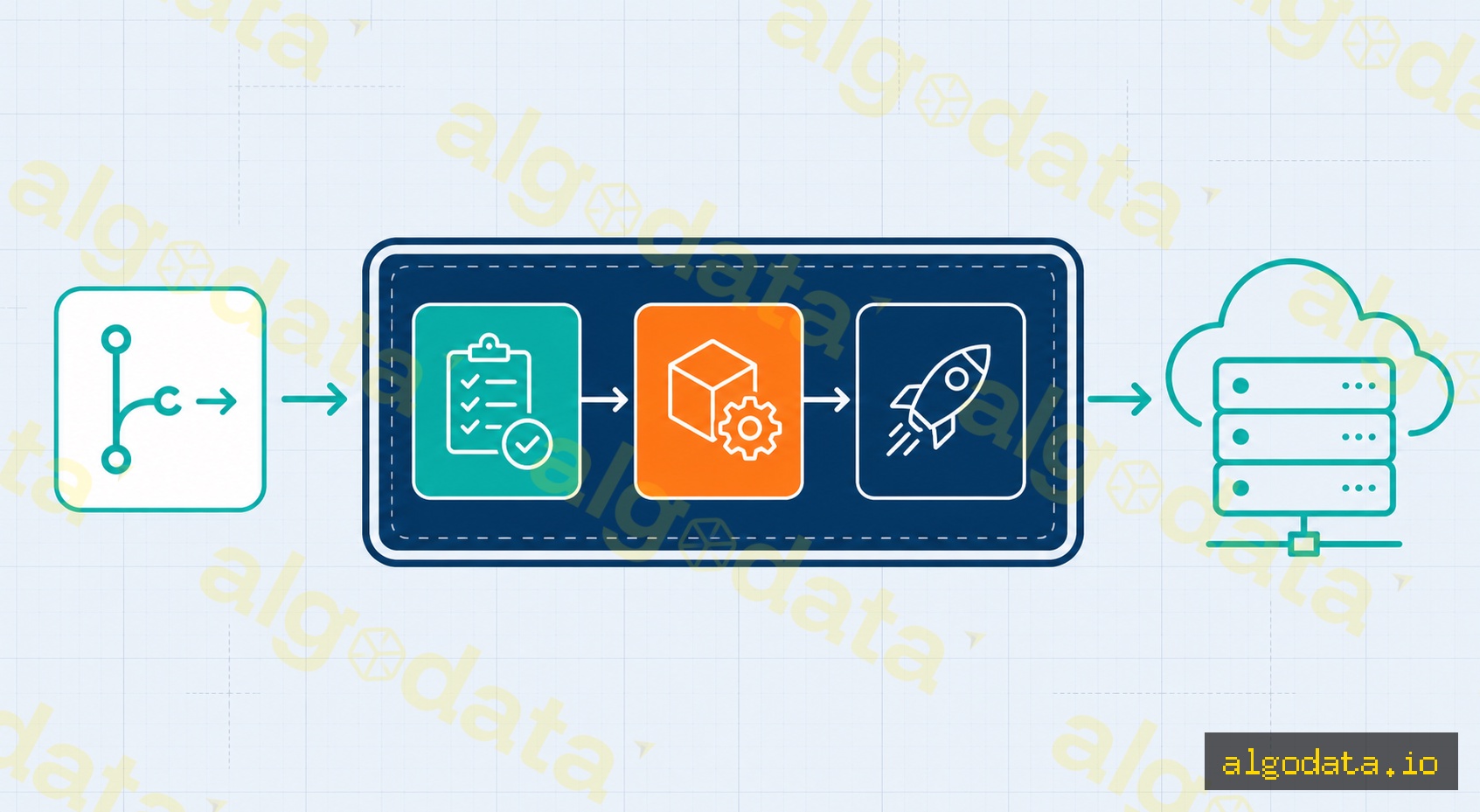
GitLab CI/CD is a Continuous Integration / Continuous Delivery platform embedded natively in GitLab, driven entirely by a .gitlab-ci.yml configuration file placed at the repository root. Every time a developer pushes code or opens a merge request, GitLab reads this file, creates a pipeline composed of sequential stages, and runs one or more jobs in parallel within each stage.
A pipeline follows the pattern: test → build → deploy. If any job fails, the pipeline stops immediately and notifies the developer — the "fail fast" principle ensures errors are caught as early as possible, before broken code reaches production.
The key advantage of GitLab over standalone CI/CD tools like Jenkins is that GitLab bundles a Container Registry, Package Registry, Security Scanning (SAST, DAST), Environments, and Deployment tracking in one platform — dramatically reducing the number of tools your team needs to manage.
The entire pipeline is defined in a single YAML file. The following is a real-world example for a Python application deployed to Kubernetes:
YAML
1stages: 2- test 3- build 4- deploy 5 6variables: 7DOCKER_IMAGE:$CI_REGISTRY_IMAGE:$CI_COMMIT_SHA 8 9# ── Stage 1: Run tests ─────────────────────────────────────────10test:11stage:test12image:python:3.1113script:14- pip install -r requirements.txt15- pytest tests/ -v16cache:17key:${CI_COMMIT_REF_SLUG}18paths:19- .cache/pip2021# ── Stage 2: Build Docker image and push to GitLab Registry ───22build:23stage:build24image:docker:2425services:26- docker:dind27script:28- docker login -u $CI_REGISTRY_USER -p $CI_REGISTRY_PASSWORD $CI_REGISTRY29- docker build -t $DOCKER_IMAGE .30- docker push $DOCKER_IMAGE31only:32- main3334# ── Stage 3: Deploy to Kubernetes (manual gate) ───────────────35deploy:36stage:deploy37script:38- kubectl set image deployment/myapp app=$DOCKER_IMAGE39environment:40name:production41when:manual42only:43- main
Key concepts explained:
stages — declares the execution order. Jobs in the same stage run in parallel; the next stage only starts when the previous one succeeds.
variables — environment variables available across the pipeline. GitLab also provides built-in predefined variables such as $CI_COMMIT_SHA, $CI_REGISTRY_IMAGE, and $CI_COMMIT_REF_SLUG.
image — the Docker image used as the job execution environment. Each job can use a different image.
services — auxiliary containers running alongside the job (for example: docker:dind enables Docker-in-Docker to build images inside a container).
cache — directories persisted between pipeline runs to speed up builds (.cache/pip, node_modules/).
artifacts — output files passed to downstream jobs or downloadable after the pipeline finishes.
only / rules — conditions controlling when a job runs (only on the main branch, only on tags, etc.).
when: manual — the job does not run automatically; someone with permission must click the play button — ideal for production deploy gates.
environment — links the job to a named environment in GitLab Environments, enabling deployment history tracking and one-click rollback.
GitLab Runner
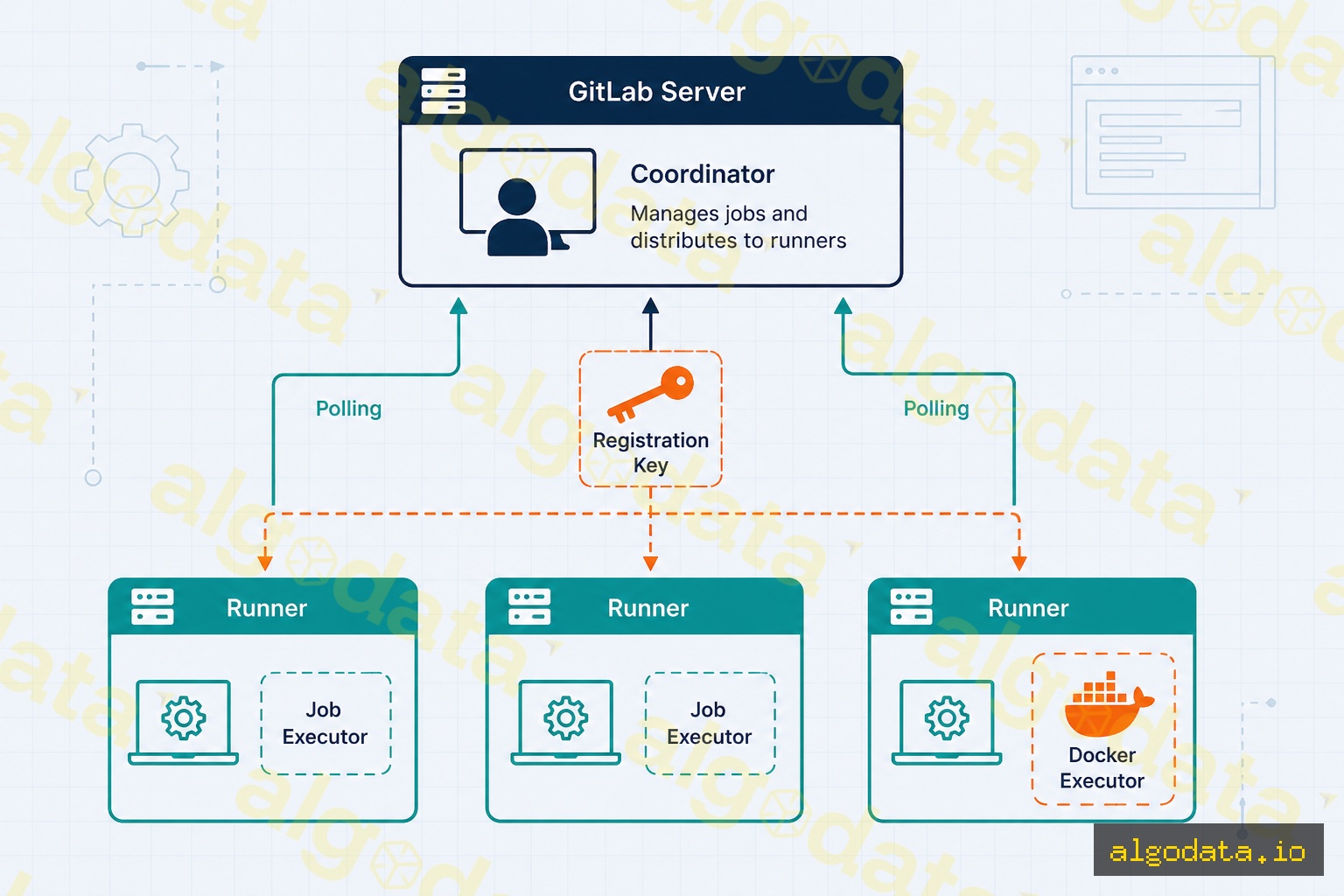
GitLab Runner is a software agent installed on a server (or running inside a container or Kubernetes pod) that accepts jobs from the GitLab server and executes them. The runner continuously polls GitLab, picks up assigned jobs, clones the source code, runs the pipeline scripts inside the configured executor, and sends logs and exit codes back to GitLab.
Shared Runner vs Specific Runner
Shared Runner
Specific Runner
Managed by
GitLab (or group admin)
Your team
Scope
All projects in the instance
A specific project or group
Resources
Shared, may queue under load
Dedicated, no queueing
Cost
Billed per CI minute
Cost of your own server
Best for
Small projects, public repos
Heavy production workloads
Docker Executor — the most popular choice
The Docker executor runs each job inside a fresh Docker container, guaranteeing a fully isolated and clean environment for every run. This is the recommended executor for most use cases.
Registering a specific runner with the Docker executor:
After registration the runner appears in Settings → CI/CD → Runners and is ready to accept jobs. Use tags to route specific jobs to specific runners — for example, the production deploy job can be restricted to a runner tagged production that lives inside the internal network.
Use policy: pull on jobs that only read the cache (no need to re-upload) to avoid unnecessary uploads at the end of every job.
2. Parallelize with needs: (DAG pipelines)
YAML
1test-unit: 2stage:test 3script:pytest tests/unit/ 4 5test-integration: 6stage:test 7script:pytest tests/integration/ 8 9build:10stage:build11needs:[test-unit] # Starts as soon as test-unit passes, no need to wait for test-integration12script:docker build .
needs: breaks the traditional sequential stage model, allowing the build job to begin immediately after test-unit finishes without waiting for test-integration — significantly reducing total pipeline duration.
3. Protect production environments
In Settings → CI/CD → Environments → production, configure:
Required approvals: production deploys require approval from at least one or two designated reviewers.
Protected branches: only main or release/* branches can trigger production deployments.
Deployment freeze: block deployments during peak traffic hours or major holidays.
GitLab SAST automatically selects the appropriate analyzer for the project's language (Bandit for Python, Semgrep for JS/TS, SpotBugs for Java) with no additional configuration required.
5. Manual gate for production deployments
Always combine when: manual with environment: production on deploy jobs. This creates a clear confirmation button in the GitLab UI with a full audit trail recording who triggered the deployment and when.
A startup can use GitLab.com for free (400 minutes/month) with a basic three-stage pipeline: test → build Docker image → deploy to a VPS via SSH. The entire configuration lives in a single .gitlab-ci.yml file — no dedicated DevOps engineer needed from day one. As the team scales, upgrading to a Kubernetes deploy step requires minimal changes to the existing pipeline structure.
Banking and Fintech — self-hosted for compliance
Financial institutions need to keep source code, artifacts, and logs entirely within their own infrastructure. A self-managed GitLab CE instance delivers:
No CI minute caps — pipelines run freely on internal servers.
Data never leaves the datacenter — source code, Docker images, and pipeline logs stay on internal servers.
Complete audit trail — GitLab logs every action: who committed, who approved the merge request, who triggered the deploy, and when.
Integrated SAST and Secret Detection — credentials accidentally committed to the repository are flagged immediately within the pipeline.
A typical pipeline for a core banking system: sast → unit-test → integration-test → build-image → push-to-internal-registry → deploy-staging (auto) → deploy-production (manual, requires 2 approvals).
Conclusion:GitLab CI/CD is a compelling choice when you need an all-in-one platform — from source code management to CI/CD, container registry, and security scanning — especially for self-hosted projects with strict data control requirements. Start with a simple .gitlab-ci.yml, then progressively add caching, parallel jobs, and manual gates as your team matures.
Frequently Asked Questions
Frequently Asked QuestionsQ&A
QHow is GitLab CI/CD different from GitHub Actions?
GitLab CI/CD is built directly into the GitLab platform, configured via a .gitlab-ci.yml file and runnable on GitLab.com (cloud) or a self-managed instance. GitHub Actions is tightly integrated with GitHub and uses a similar YAML syntax but organizes work into workflows and jobs rather than stages and jobs. Key differences: GitLab ships a built-in Container Registry, Package Registry, and security scanning (SAST/DAST) in the same platform; GitHub Actions has a much larger marketplace of reusable actions and more free minutes for public repos. Organizations that must keep data on-premise (fintech, banking) often choose GitLab CE/EE because it is straightforward to self-host.
QWhat is a GitLab Runner?
A GitLab Runner is an agent process installed on a separate server (or running inside a container or Kubernetes pod) that polls GitLab for pending jobs and executes them. The runner picks up a job, clones the source code, runs the script inside the configured executor environment (Shell, Docker, Kubernetes, VirtualBox, etc.), and reports logs and the exit code back to GitLab. GitLab.com provides shared runners free of charge up to a monthly minute limit; you can register a specific runner on your own server for full control over resources with no minute cap.
QWhere should .gitlab-ci.yml be placed?
The .gitlab-ci.yml file must be placed at the root of the repository, alongside README.md and other configuration files. GitLab automatically detects it on every push or merge request event. You can validate the YAML syntax directly in the browser using the CI Lint tool (Settings → CI/CD → CI Lint) before committing. GitLab also supports splitting the configuration into multiple files using the include: keyword to import templates from other projects or from the built-in GitLab CI/CD template library.
QCan pipeline jobs run in parallel?
Yes. GitLab CI/CD supports parallelism in two ways: (1) Jobs within the same stage run in parallel by default whenever enough runners are available. (2) The needs: keyword lets you declare explicit dependencies between jobs — job B can start as soon as job A finishes without waiting for the entire stage to complete. This is called a DAG (Directed Acyclic Graph) pipeline. Additionally, parallel: matrix: allows running the same job with different variable combinations simultaneously, which is ideal for cross-browser or multi-version testing.
QIs GitLab CI free to use?
GitLab.com offers a Free tier with 400 CI/CD minutes per month on shared runners. Premium and Ultimate tiers provide more minutes and advanced features (full DAST, SAST, compliance frameworks, etc.). If you self-host GitLab Community Edition (CE) on your own server, there is no minute cap — usage is only limited by your server resources. This is why many organizations choose self-hosted GitLab CE: no license cost and no pipeline minute restrictions.
QWhat is the difference between artifacts and cache in GitLab CI?
Artifacts are output files produced by a job that GitLab stores and passes to downstream jobs or makes available for download after the pipeline completes (for example: compiled binaries, test reports). Cache is a directory saved between pipeline runs (typically node_modules/ or .cache/pip) to speed up builds by skipping repeated dependency downloads. Artifacts are managed by the GitLab server and support expiry policies; cache is stored directly on the runner and can be invalidated at any time, so your pipeline must never depend on the cache being present to run correctly.