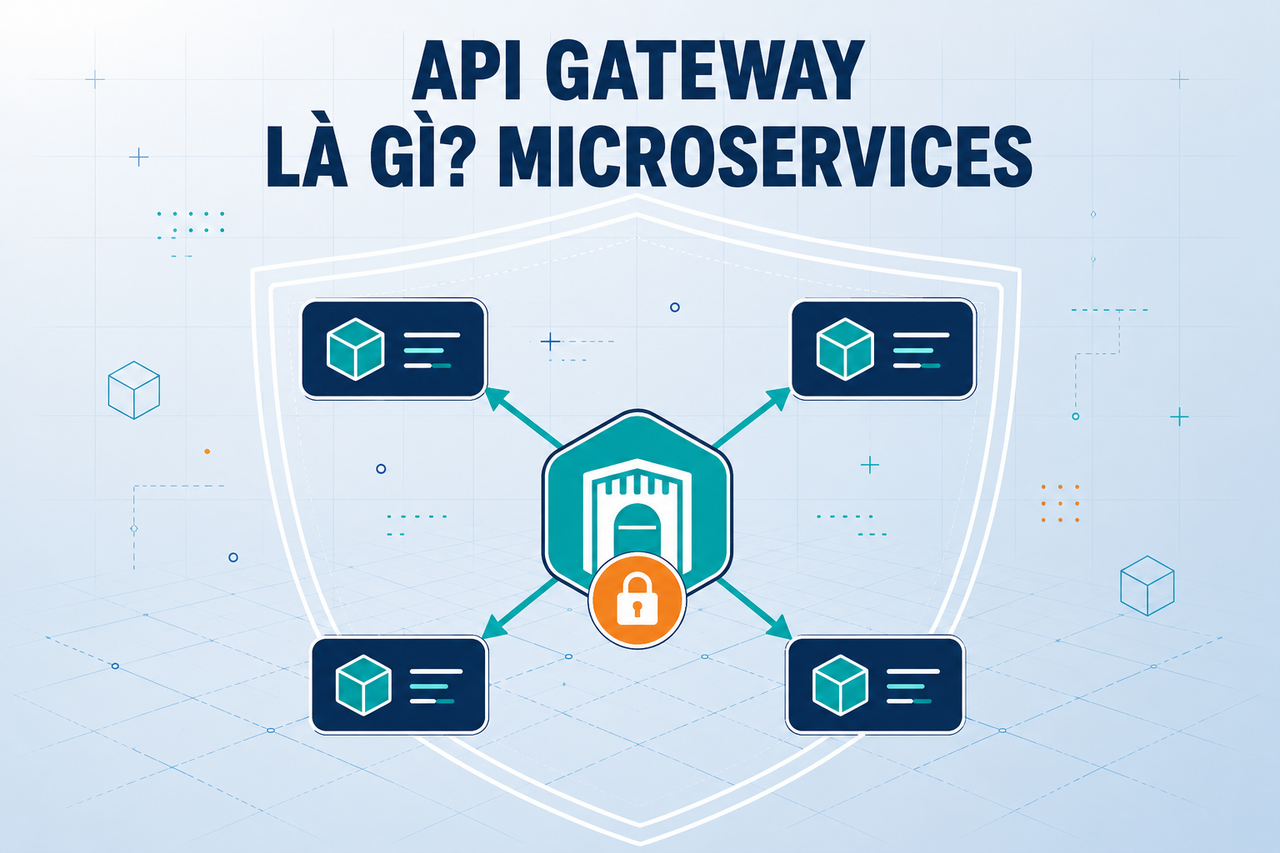
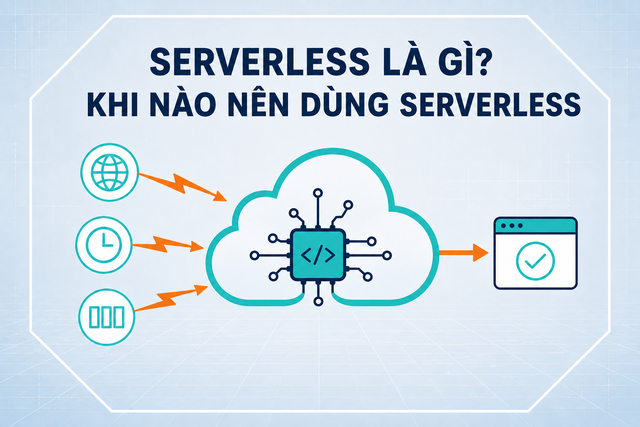
An API Gateway is the intelligent intermediary between clients and the dozens of microservices behind it: it receives every request, validates identity, enforces rate limits, routes to the correct service and returns the result — all through a single entry point. This article explains what an API Gateway is, how a request flows through it, compares the most popular solutions and shows how to secure a system at the gateway layer.
2019Trusted since
B2BData solutions
Data·AIExpertise
Need data solutions for your business?
AlgoData has helped businesses with data engineering, analytics & AI since 2019.
An API Gateway is a reverse proxy that acts as the single entry point for an entire microservices architecture. Instead of clients calling each individual service directly (each with its own address and port), clients only need to know a single address — the gateway.
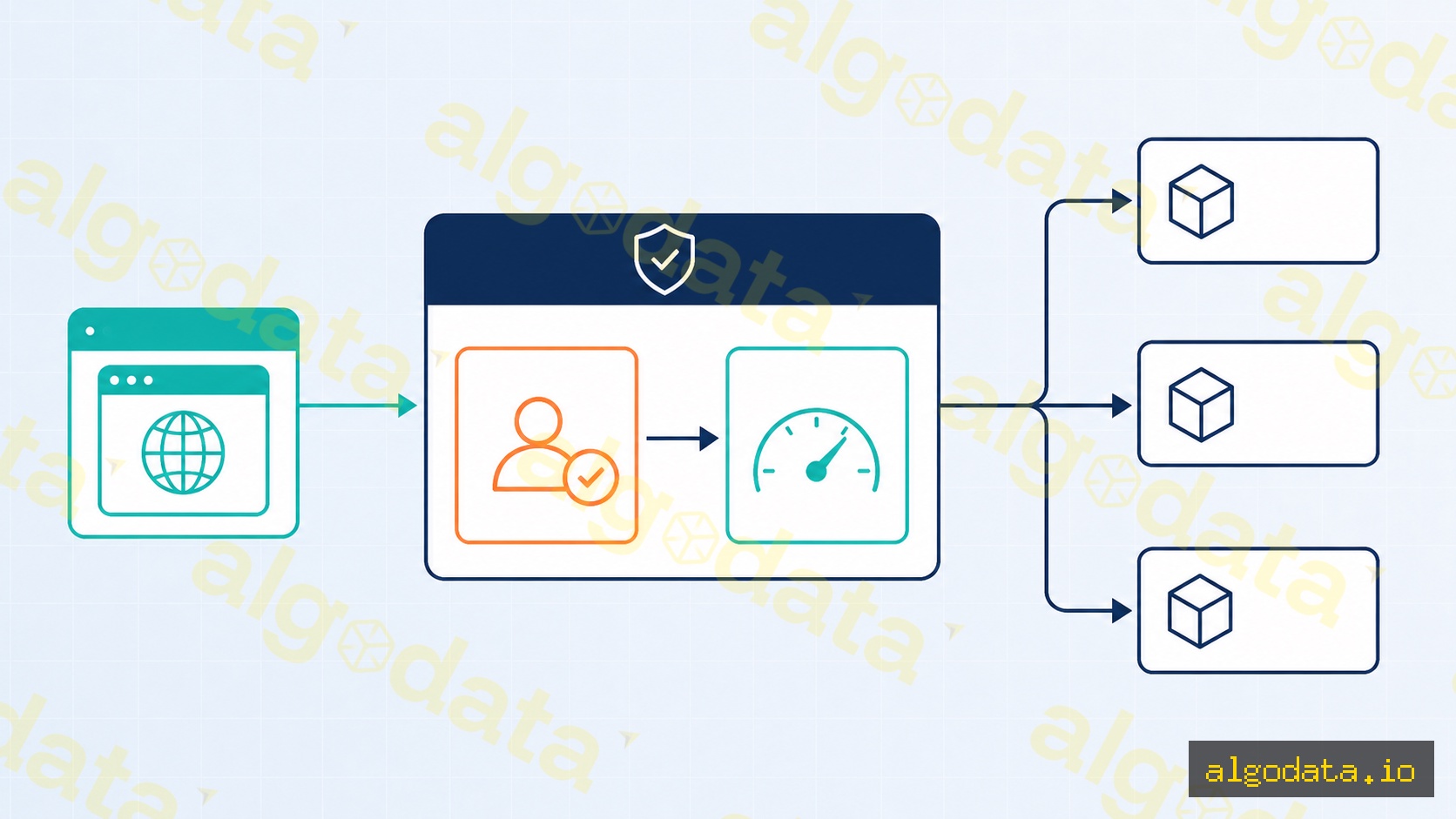
The gateway handles multiple responsibilities simultaneously:
Routing: Based on path (/users/* → User Service, /orders/* → Order Service), headers or HTTP method, it forwards requests to the correct backend service.
Authentication & Authorization: Validates JWT tokens, API keys or sessions before a request ever reaches a service.
Rate Limiting: Limits the number of requests within a time window to protect services from overload.
SSL Termination: Handles HTTPS at the gateway; internal services only need plain HTTP.
Load Balancing: Distributes traffic across multiple instances of the same service.
Without a gateway, every microservice would have to implement its own security and authentication layer — leading to duplicated code, maintenance headaches and a higher risk of vulnerabilities.
Core Functions of an API Gateway
A production-ready API Gateway typically covers at least seven function groups:
1. Smart Routing
The gateway parses the URL, HTTP method and headers of a request, then decides which upstream to forward to. Some gateways support path rewriting — for example, receiving /v1/products from the client but forwarding /internal/catalog to the service.
2. Authentication — identity verification
The gateway integrates with an Identity Provider (IdP) to verify JWT tokens, OAuth2 tokens or API keys. If the token is invalid, the gateway immediately returns 401 Unauthorized without the request ever reaching a backend service.
3. Rate Limiting
Common mechanisms: token bucket or sliding window. Each client (or API key) has a request quota. When the threshold is exceeded, the gateway returns 429 Too Many Requests with a Retry-After header.
4. SSL/TLS Termination
The gateway accepts HTTPS connections from the internet, terminates TLS there, and forwards plain HTTP to internal services. This reduces CPU load on services and simplifies certificate management — you only need to renew in one place.
5. Load Balancing
The gateway can round-robin, least-connections or weighted-balance requests across multiple instances of the same service, with health checks to automatically remove unresponsive instances.
6. Circuit Breaker
When a backend service continuously fails (timeouts, 5xx errors), the circuit breaker "trips" to stop sending more requests — returning a controlled error rather than letting clients hang. This helps the system recover faster.
7. Observability: Logging, Metrics, Tracing
The gateway is the ideal place to inject request IDs, collect latency metrics and forward centralised logs. Since every request passes through here, there is no need to instrument each individual service.
Request Flow through an API Gateway
Understanding the request flow helps with debugging and system design:
Client
  │
  ▼  (HTTPS)
┌─────────────────────────────┐
│        API Gateway          │
│  ┌──────────┐ ┌───────────┐ │
│  │Auth Check│ │Rate Limit │ │
│  └────┬─────┘ └─────┬─────┘ │
│       │             │       │
│  ┌────▼─────────────▼─────┐ │
│  │       Router            │ │
│  └────┬──────────┬────────┘ │
└───────┼──────────┼──────────┘
        │          │
   (HTTP)          (HTTP)
        ▼          ▼
   User Service  Order Service
Detailed processing steps:
Client sends request — always to the gateway address, e.g. https://api.example.com/v1/orders.
SSL Termination — the gateway decrypts TLS; the request becomes plain internal HTTP.
Authentication Check — the gateway checks the JWT or API key in the Authorization header. Missing or invalid → 401.
Rate Limit Check — the gateway counts requests per key (IP, user ID, API key). Threshold exceeded → 429.
Routing — the gateway matches the path against the route table and selects an upstream service.
Load Balancing — if the service has multiple instances, the gateway selects one per the configured algorithm.
Forward Request — the gateway sends the request (HTTP) to the service, adding headers like X-Request-ID and X-Forwarded-For.
Service processes — the service receives, processes and returns a response.
Response to client — the gateway receives the response from the service, optionally adds headers (CORS, security headers) and returns it to the client over HTTPS.
Total gateway processing time is typically only 1–5ms for a well-optimised setup without heavy transformation or caching.
Most Popular API Gateways
There are many options ranging from self-hosted to fully managed:
Gateway
Platform
Strengths
Kong
Self-hosted (NGINX + Lua)
Rich plugin ecosystem, Admin API
NGINX
Self-hosted
High performance, flexible config
Traefik
Self-hosted (Docker/K8s native)
Auto-discovery, built-in Let's Encrypt
Envoy
Self-hosted (C++)
Extremely fast, used in service mesh
AWS API Gateway
Fully managed
Lambda/IAM integration, auto-scales
Kong Konnect
Cloud managed
Kong engine + SaaS control plane
Kong — declarative config
Kong lets you define the entire configuration as a YAML file (declarative):
YAML
1# kong.yaml — Kong declarative configuration 2_format_version:"3.0" 3 4services: 5- name:user-service 6url:http://user-svc:8080 7routes: 8- name:user-routes 9paths:10- /v1/users11strip_path:true12plugins:13- name:rate-limiting14config:15minute:100# max 100 req/min per consumer16policy:local17- name:key-auth # require API key18config:19key_names:20- apikey2122- name:order-service23url:http://order-svc:808024routes:25- name:order-routes26paths:27- /v1/orders28strip_path:true29plugins:30- name:rate-limiting31config:32minute:5033policy:local34- name:jwt # require JWT token35config:36secret_is_base64:false
Apply the config with: deck gateway sync kong.yaml
NGINX — location block
NGINX as a basic reverse proxy using location blocks:
nginx
1# /etc/nginx/conf.d/api-gateway.conf
2 3upstreamuser_service{ 4serveruser-svc-1:8080; 5serveruser-svc-2:8080; 6keepalive32;# maintain connection pool
7} 8 9upstreamorder_service{10serverorder-svc:8080;11}1213server{14listen443ssl;15server_nameapi.example.com;1617ssl_certificate/etc/ssl/certs/api.crt;18ssl_certificate_key/etc/ssl/private/api.key;1920# Route /v1/users → User Service
21location/v1/users/{22proxy_passhttp://user_service/;23proxy_set_headerHost$host;24proxy_set_headerX-Real-IP$remote_addr;25proxy_set_headerX-Forwarded-For$proxy_add_x_forwarded_for;26proxy_set_headerX-Request-ID$request_id;2728# Rate limiting (limit_req_zone defined outside this block)
29limit_reqzone=api_limitburst=20nodelay;30}3132# Route /v1/orders → Order Service
33location/v1/orders/{34proxy_passhttp://order_service/;35proxy_set_headerHost$host;36proxy_set_headerX-Forwarded-For$proxy_add_x_forwarded_for;37limit_reqzone=api_limitburst=10nodelay;38}3940# Gateway health check endpoint
41location/health{42return200"OK\n";43add_headerContent-Typetext/plain;44}45}4647# Rate limit zone — 10MB shared memory, 30 req/s per IP
48limit_req_zone$binary_remote_addrzone=api_limit:10mrate=30r/s;
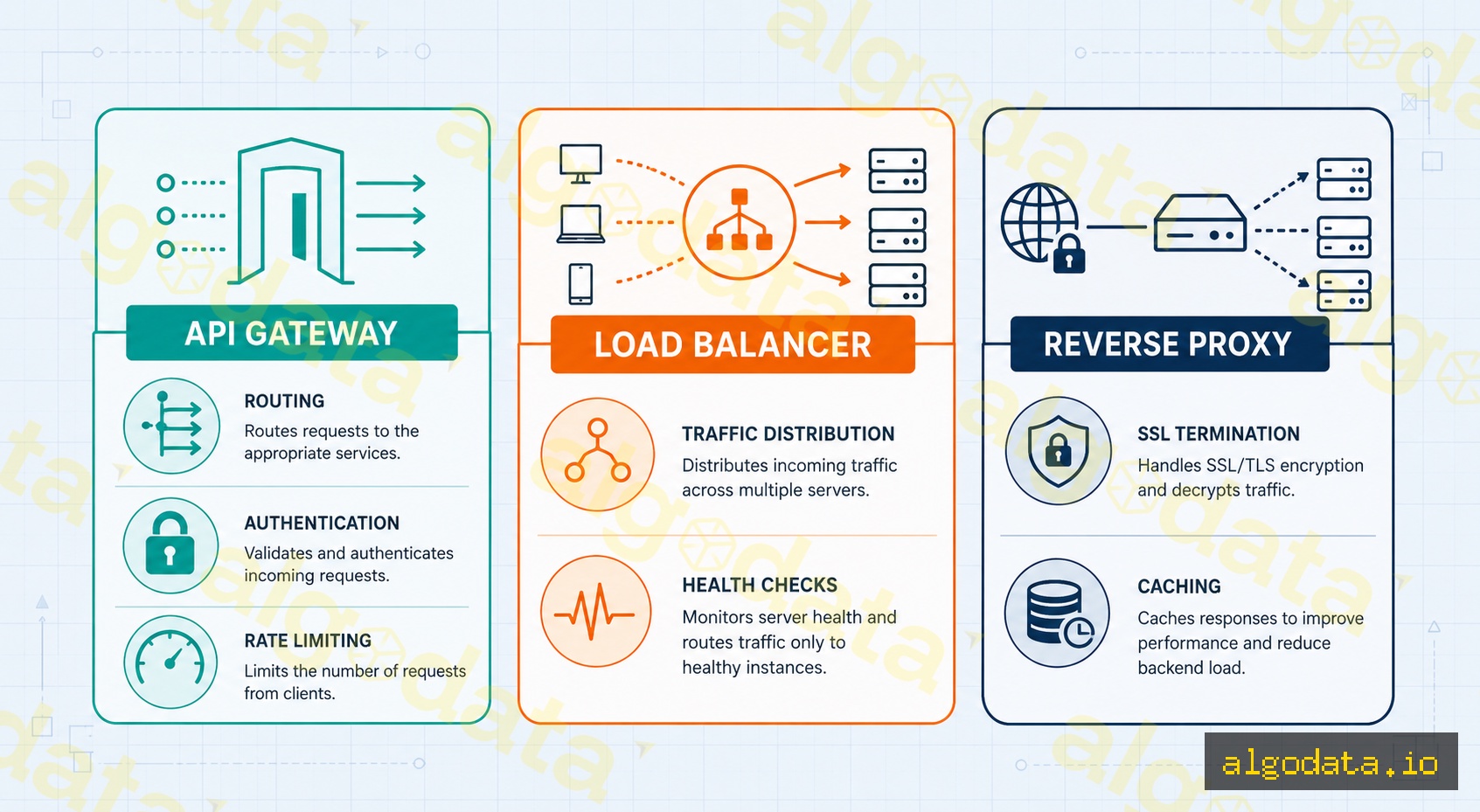
These three concepts are often confused because they all sit "in front of" services, but their roles are clearly distinct:
Criterion
API Gateway
Load Balancer
Reverse Proxy
Purpose
Complex API management
Traffic distribution
Request forwarding
Routing
By path, header, method
By IP/port only
By path/domain
Auth
Built-in (JWT, OAuth2)
No
No (usually)
Rate Limiting
Yes
No
No (usually)
Request Transform
Yes
No
Limited
Use case
Microservices API
Horizontal scaling
Simplified access
Examples
Kong, AWS API GW
AWS ALB, HAProxy
NGINX, Caddy
When to use which?
Just need to spread load across identical instances → A Load Balancer (ALB, HAProxy) is sufficient and faster.
Need SSL termination + static file serving → A Reverse Proxy (NGINX) makes sense.
Multiple different services with centralised auth/rate-limiting → An API Gateway is the right choice.
Large-scale microservices architecture → Usually combines all three layers: API Gateway at the edge, Load Balancers per service cluster behind it.
Security at the API Gateway
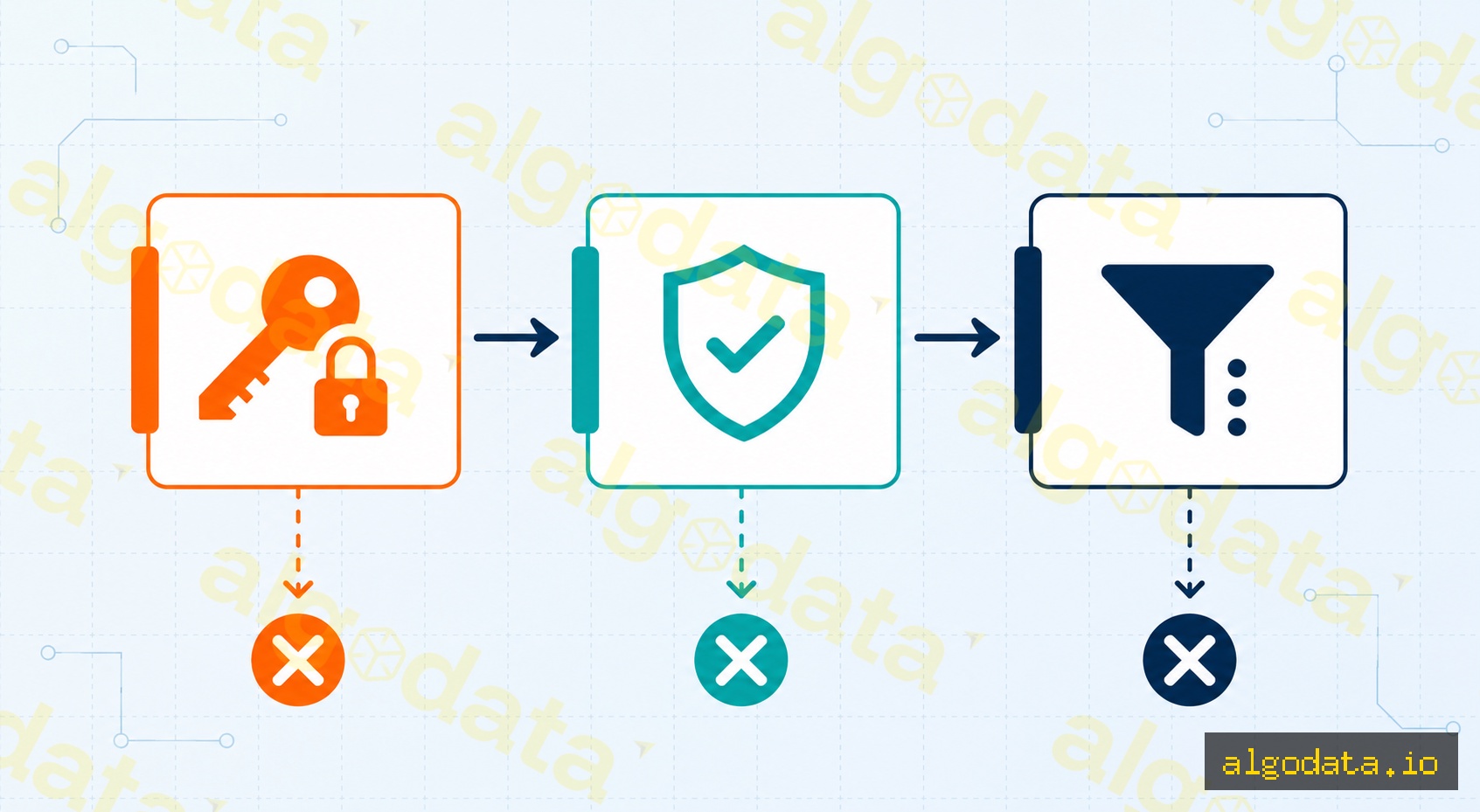
The gateway is the ideal place to implement centralised security, rather than repeating the same implementation in every service:
JWT Validation
JWT (JSON Web Token) is the most common authentication mechanism in REST APIs. The gateway verifies the token's signature using a public key (RS256) or a shared secret (HS256):
YAML
1# Kong JWT plugin 2plugins: 3- name:jwt 4config: 5key_claim_name:iss # claim that holds the key ID 6claims_to_verify: 7- exp # verify token has not expired 8- nbf # verify token is already valid 9secret_is_base64:false10run_on_preflight:false# skip OPTIONS requests (CORS preflight)
When a JWT is valid, the gateway adds X-Consumer-ID and X-Consumer-Username headers to the request so backend services know who is calling without needing to decode the token themselves.
OAuth2 Authorization Code Flow
For APIs that need fine-grained authorisation (scope-based), the gateway integrates with an Authorization Server:
Client → Gateway: GET /v1/orders (Authorization: Bearer <access_token>)
Gateway → Auth Server: Introspect token (check scope "orders:read")
Auth Server → Gateway: {"active": true, "scope": "orders:read", "sub": "user123"}
Gateway → Order Service: Forward request + X-User-ID: user123
Order Service → Gateway: 200 OK + response body
Gateway → Client: 200 OK + response body
API Key Authentication
Simpler than JWT — suitable for server-to-server APIs or third-party integrations:
nginx
1# NGINX — verify API key via X-API-Key header
2map$http_x_api_key$api_key_valid{ 3default0; 4"secret-key-A"1; 5"secret-key-B"1; 6} 7 8server{ 9location/v1/data/{10if($api_key_valid=0){11return403'{"error":"InvalidAPIkey"}';12}13proxy_passhttp://data_service/;14}15}
In practice, API keys should be stored in a secret store (Vault, AWS Secrets Manager) rather than hardcoded in config files.
Security best practices at the gateway
Expose HTTPS only — disable HTTP or redirect everything to HTTPS.
Validate input — limit request body size, check Content-Type.
Hide internal topology — never let internal service names leak via response headers or error messages.
Rotate API keys and JWT secrets regularly — integrate with secret management tooling.
Enable a WAF (Web Application Firewall) for internet-facing gateways — block SQLi, XSS and path traversal at the gateway layer.
Real-World Use Cases
Netflix Zuul (first-generation API Gateway)
Netflix was one of the earliest companies to popularise the API Gateway pattern. Zuul (written in Java; Zuul 2 adds non-blocking I/O) handles billions of requests per day, responsible for dynamic routing, monitoring, resiliency (Hystrix circuit breaker) and security across all of Netflix's backend services.
AWS API Gateway + Lambda (Serverless pattern)
The most common pattern on AWS: API Gateway receives HTTP requests, triggers a Lambda function to handle business logic — no persistent servers needed. All infrastructure is managed by AWS.
Client → AWS API Gateway → AWS Lambda → DynamoDB
                        ↑
               (auto-scale, auth via Cognito,
                rate-limit via usage plan,
                logging via CloudWatch)
Cost is very low at low traffic (pay-per-request), but needs careful calculation at high traffic as costs can grow faster than EC2 or Fargate.
Kong + Kubernetes Ingress
In Kubernetes environments, Kong is often deployed as an Ingress Controller — integrating natively with Kubernetes (using CRDs to define routes) while retaining all of Kong's plugin capabilities.
An API Gateway is a reverse proxy that acts as the single entry point for an entire microservices system. Clients only need to know one address — the gateway — which then routes, authenticates and forwards requests to the correct backend service, then returns the aggregated response to the client.
QHow is an API Gateway different from a Load Balancer?
A Load Balancer distributes traffic across multiple identical instances of the same service. An API Gateway, by contrast, routes traffic to many different services based on path or headers, while also handling authentication, rate limiting and request/response transformation. In short: a Load Balancer 'distributes load', while an API Gateway is an 'intelligent front door'.
QWhat is rate limiting in an API Gateway?
Rate limiting is a mechanism that restricts how many requests a client can send within a given time window. For example: allowing a maximum of 100 requests per minute per API key. When the threshold is exceeded, the gateway returns HTTP 429 Too Many Requests. The goal is to protect backend services from overload and prevent abuse.
QIs Kong or NGINX a better API Gateway?
It depends on your requirements. Kong (built on NGINX) is purpose-designed for API management — it has a rich plugin ecosystem (auth, rate-limiting, logging), is managed via an Admin API and supports multi-service declarative config. Plain NGINX is more flexible and performant but requires more manual configuration. If you need to manage many complex APIs, Kong is the better choice; for a simple gateway, NGINX is sufficient.
QWhen should I use AWS API Gateway?
AWS API Gateway is ideal when your entire backend already lives on AWS — especially when combined with Lambda (serverless). It integrates natively with IAM, Cognito, CloudWatch and scales automatically. It suits projects that do not want to operate their own infrastructure. Downsides are vendor lock-in and potentially high cost at scale.
QDoes an API Gateway slow down requests?
It adds latency, but typically only 1–5ms for a well-optimised gateway layer. Kong and Envoy are designed to run at very high throughput with async I/O. To minimise latency: deploy the gateway close to services (same region/datacenter), use connection pooling, and enable caching for responses that do not change frequently.